 By Shawn Henry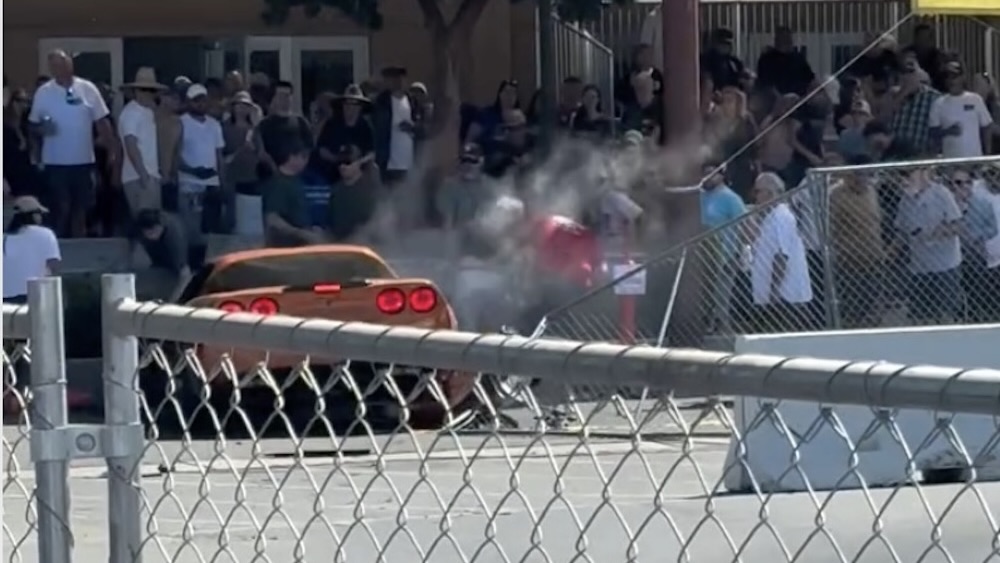
What should have been a controlled autocross run turned into something far more serious in a matter of seconds. A C6 Corvette Z06 lost control at a Goodguys event in Pleasanton, California, and didn’t just spin or slide off course. It kept going.
By the time it stopped, it had gone through a concrete barrier, a fence, and ended up against a planter box. The only thing it didn’t hit was the crowd. That’s the part people keep coming back to.
A Straight-Line Impact That Didn’t Add Up
According to accounts from attendees, the Corvette failed to slow down at the end of the autocross course. Instead of scrubbing speed through the final section, the car continued forward and hit the barrier head-on.
It didn’t stop there. The force carried it through the barrier and into additional structures before it finally came to rest. The car itself was heavily damaged and is believed to be a total loss. The driver was transported to the hospital, but early reports suggest the injuries were not life-threatening.
How Close This Actually Was
Autocross events are designed to keep speeds lower than traditional track driving, but they still carry risk. Cars are moving quickly enough that when something goes wrong, it happens fast and without much room to recover.
In this case, the direction of travel is what made it more concerning. The car didn’t rotate or lose control sideways. It stayed pointed forward and went straight through the barrier line. That’s the scenario event organizers try to prevent, because once a car continues on that path, there’s very little left to stop it.
Mechanical Failure — Or Something Else?
Initial reports suggested the possibility of brake failure, which would explain why the car didn’t slow down. That idea spread quickly, especially given how sudden the incident appeared in video clips. But not everyone agrees with that explanation.
Some observers pointed out that the brake lights didn’t appear to activate in certain footage, raising questions about whether the brakes were ever applied. Others believe the driver may have missed the pedal or reacted too late.
There is at least one video that shows brake lights illuminating briefly just before impact, but it’s not enough to settle the question.
Why This Debate Matters
The difference between mechanical failure and driver error isn’t just technical. It changes how people look at the incident entirely. If the brakes failed, the focus shifts to the car and its condition. If the driver didn’t apply them in time, the conversation moves toward reaction, control, and decision-making under pressure.
Right now, there isn’t a confirmed answer, and that uncertainty is part of what’s keeping the discussion going.
The Outcome Could Have Been Worse
Despite how violent the crash looked, no spectators were injured. That’s not something that gets taken lightly in situations like this.
The car made it through multiple barriers, which is exactly the kind of scenario safety planning is meant to prevent. When those layers get breached, the risk to people nearby increases quickly. In this case, the barriers slowed the car enough to keep it from reaching the crowd.
The Car Is Replaceable — The Situation Isn’t
The Corvette itself can be written off. That part is straightforward.
What stands out more is how quickly a controlled environment turned into something unpredictable. Autocross is often seen as a safer way to push a car compared to full track driving, but it still relies on both the car and the driver doing exactly what they’re supposed to do.
When one of those breaks down, even briefly, the margin for error disappears.
What This Leaves Behind
There’s still no confirmed explanation for what caused the crash, and that may take time to sort out. What’s already clear is how close this came to becoming something much worse.
A car didn’t just lose control. It went through everything meant to stop it and kept going.
And in situations like that, the difference between a bad crash and a serious incident often comes down to just a few feet.
 John Lloyd