 By Eve Nowell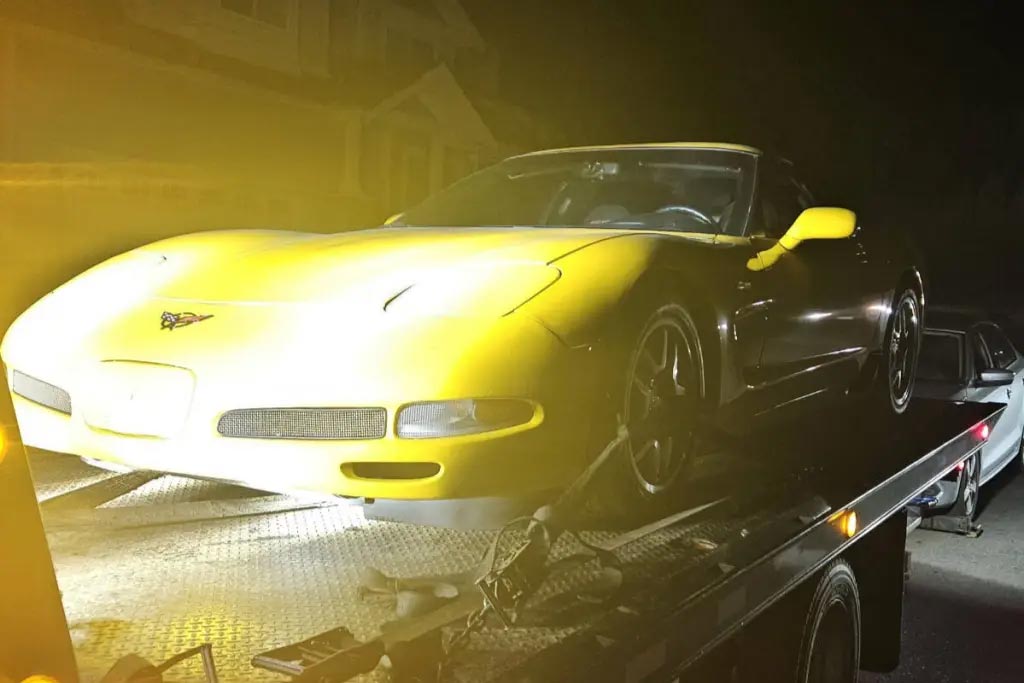
A driver in a bright yellow Chevrolet Corvette C5 was pulled over and cited after police tracked the sports car traveling 106 miles per hour across the Golden Ears Bridge in British Columbia, Canada. Authorities said the driver was clocked at 170 kilometers per hour in a posted 80 km/h zone while crossing the busy commuter bridge connecting communities northeast of Vancouver. The incident ended with multiple excessive speeding tickets and the immediate impoundment of the vehicle.
Police reported that the speeding Corvette was first identified by the Royal Canadian Mounted Police Air 1 helicopter while it was traveling across the bridge at more than double the posted speed limit. Officers in the aircraft tracked the vehicle from above as it moved across the span linking Langley and Surrey with Maple Ridge and Pitt Meadows. The helicopter crew maintained visual contact with the Corvette while ground units coordinated a response.
Investigators reported that after crossing the bridge, the Corvette continued traveling at elevated speeds through nearby roadways. Officers later clocked the car again on Dewdney Trunk Road traveling approximately 120 kilometers per hour in a posted 60 km/h zone. The combination of speeds triggered enforcement action under British Columbia’s excessive speeding laws.
Authorities said officers ultimately stopped the Corvette without incident. The driver received multiple excessive speeding tickets tied to both locations where the vehicle was recorded traveling far beyond the posted limits. Under provincial law, exceeding the speed limit by 60 kilometers per hour or more qualifies as excessive speeding and triggers automatic penalties.
As a result of the violation, the Corvette was immediately impounded for seven days. Police reported that this impoundment is mandatory for a first offense at that level of speed under British Columbia traffic laws. The penalties extend beyond the immediate fine issued during the stop.
Authorities confirmed that the base fine for excessive speeding is $483. However, the financial consequences often increase significantly once additional costs are applied. Those costs can include vehicle impound fees and higher insurance premiums assessed through the Insurance Corporation of British Columbia. In many cases, officials say a single excessive speeding incident can result in costs approaching $2,500 once all related expenses are calculated.
The incident drew attention in part because of how it was detected. Rather than relying solely on ground patrol units, the RCMP helicopter played a central role in identifying and tracking the vehicle as it crossed the bridge at high speed. Air 1 provides officers with a bird’s-eye view of traffic activity, allowing them to monitor large areas and track vehicles across multiple roadways.
Police reported that the helicopter’s aerial perspective allows officers to observe vehicles traveling at extreme speeds while reducing the need for immediate high-speed pursuit on the ground. In situations like this one, the aircraft can maintain visual contact with a vehicle while ground officers position themselves for a controlled stop. That coordination allows enforcement actions to occur without the risks associated with direct pursuit at similar speeds.
Authorities also noted that the Golden Ears Bridge has become a frequent focus for traffic enforcement due to its design and heavy daily use. The bridge’s long, straight approaches and wide lanes can encourage drivers to accelerate beyond posted limits. For that reason, officers regularly monitor traffic activity on the span and surrounding roadways.
The bridge serves as a major commuter corridor connecting several rapidly growing communities northeast of Vancouver. Thousands of drivers cross it daily while traveling between residential areas and employment centers across the region. Because of that traffic volume, authorities say extreme speeding on the bridge presents a serious safety risk for other motorists using the route.
In this case, investigators determined that the Corvette’s speed exceeded the limit by roughly 90 kilometers per hour while crossing the bridge. That level of speed dramatically shortens reaction times and increases stopping distances for any vehicle on the roadway. Police emphasized that enforcement action was taken because of the immediate risk created by those speeds on a public roadway used by other drivers.
The Corvette involved in the incident was described as a bright yellow C5 coupe, a generation of Chevrolet’s long-running sports car that was produced between the late 1990s and early 2000s. While the car is known for its performance capabilities, authorities stressed that public roads are not designed for vehicles traveling at extreme speeds.
According to police, the helicopter crew continued tracking the vehicle after it left the bridge until ground units were able to intercept it. The stop itself was carried out without any reported confrontation or additional incidents. Officers issued the citations and arranged for the car to be towed to an impound facility.
Once impounded, the Corvette will remain in storage for the mandatory seven-day holding period required under provincial law for excessive speeding violations. During that time the driver is unable to retrieve the vehicle, regardless of ownership status. The impoundment serves as an immediate consequence tied directly to the speeding offense.
Police also confirmed that the driver now faces the financial penalties tied to the citations as well as any insurance consequences that may follow. Those insurance increases are typically assessed after excessive speeding violations are reported through the province’s traffic enforcement system.
Law enforcement agencies across British Columbia continue using a mix of ground patrols, radar enforcement, and aerial monitoring to identify drivers traveling at dangerous speeds. The RCMP Air 1 helicopter remains a key tool in those operations because it allows officers to track vehicles across long distances without initiating high-speed chases.
In this case, the helicopter’s presence allowed officers to monitor the Corvette from above until ground units were able to conduct the stop safely. Investigators reported that the coordinated response ensured the situation ended with enforcement action rather than a dangerous roadside encounter.
The driver’s case will proceed through the standard traffic enforcement process as the citations move through the provincial system. For now, the Corvette remains in an impound facility serving out its seven-day hold while the penalties tied to the excessive speeding violations take effect.
 Shawn Henry