 By Eve Nowell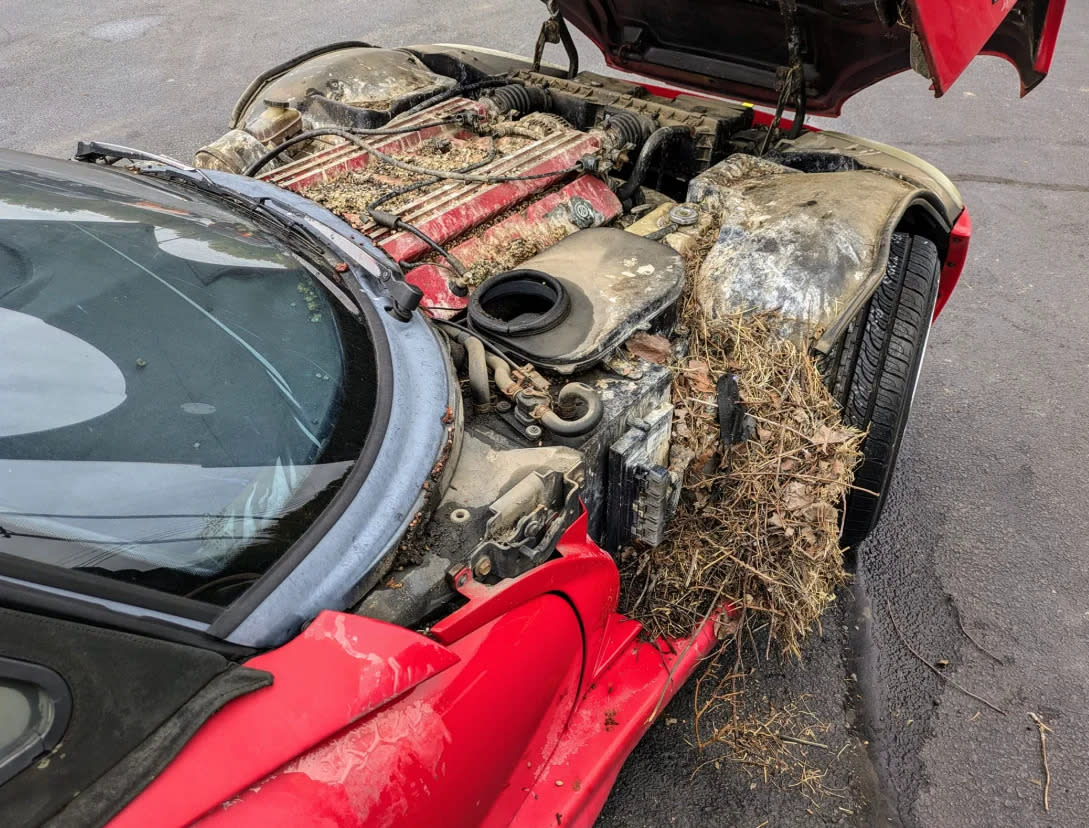
For nearly three decades, a bright red Dodge Viper didn’t sit in a showroom or tear up back roads. It hovered 30 feet in the air like some kind of automotive trophy. People drove past it for years without thinking twice. It became part of the background. But when that car finally came down, the reality hit hard, and it wasn’t anything like the pristine time capsule some expected.
This wasn’t just any Viper either. It was a 1996 RT 10 with just 12 miles on it. That number barely changed over 28 years because the car wasn’t driven. It was displayed. Parked on top of a pole outside Audubon Chrysler in Kentucky, it stayed there through seasons, storms, and everything else that comes with being exposed to the elements for nearly three decades.
Here’s the part that matters. A car like that should have been preserved. Instead, it was treated like a billboard.
Back in May 1996, the dealership made a decision that definitely got attention. Instead of putting the Viper on the lot, they lifted it high above the property as a marketing move. It worked. The car became a local landmark almost immediately. You didn’t need to be a car enthusiast to notice it. It was impossible to ignore.
And for a long time, people started wondering if it was even real. A car sitting that long in the open, never moving, never coming down, it didn’t make sense. Some assumed it had to be a shell or a replica. Something lightweight, something fake, just for show.
That assumption stuck around for years.
The Viper only came down once before, back in 2009, for refurbishment. Then it went right back up again, returning to its spot above the dealership like nothing had changed. Another 15 years passed before anyone touched it again.
That’s where things change.
In November 2024, the dealership decided it was time to bring the Viper down again. This wasn’t just routine. It had been over a decade since the last inspection, and after that much time exposed to weather, there were questions about what condition it was really in.
Photos from the removal started circulating, and that’s when people began to realize this wasn’t going to be a simple cleanup.
Once the car was back on the ground and properly inspected, the damage became obvious. The exterior paint had taken a beating after years of sun, rain, and temperature swings. That part wasn’t exactly shocking. Any car left outside that long is going to show wear.
But the inside told a different story.
The interior had developed mold. Not just a little surface issue, but enough to raise concerns about how deep the damage might go. Moisture had clearly found its way in over time, and once that happens, it doesn’t take much for things to go downhill fast.
And then there’s the detail nobody expected.
A bird had made a home inside the engine bay. Not a quick visit, not some debris caught in a corner. A full nest. That means the car wasn’t just sitting unused. It had become part of the environment.
And that’s where it gets complicated.
Because despite all of that, the dealership confirmed something important. This wasn’t a replica. It wasn’t a hollow shell. It was a complete, authentic Dodge Viper the entire time. Engine, interior, everything. The same car that rolled off the line in 1996 had been sitting up there, slowly deteriorating in plain sight.
That changes how you look at it.
What seemed like a clever marketing move now looks more like a long-term gamble that didn’t age well. A low-mileage Viper from the 90s is the kind of car collectors chase. And this one had just 12 miles. That should have been a major asset.
Instead, it spent nearly 30 years fighting off weather, moisture, and whatever else found its way inside.
After the inspection, the car was sent to Keen’s Auto Body and Paint for a full restoration effort. The focus was on bringing the exterior back to life with a complete repaint, restoring that signature red finish that made it stand out in the first place.
There’s also a bigger goal here. Not just fixing the damage, but keeping the Viper as part of the dealership’s identity. That car isn’t just a vehicle anymore. It’s tied to the location, the history, the image people recognize.
So the plan wasn’t to retire it or hide it away. It was to bring it back.
And they did.
Following the restoration work, the Viper has been returned to display condition. It’s back to looking like the eye-catching machine it was meant to be, even after everything it went through.
But the story doesn’t really end there.
Because once you know what happened behind the scenes, it’s hard to look at it the same way again. A car that could have been preserved as a near-new collector piece spent decades exposed to the elements, quietly aging in ways nobody could see from the ground.
That’s the trade-off.
Attention versus preservation.
The Viper did exactly what it was supposed to do. It grabbed attention. It became a landmark. People remembered it. But it paid for that visibility over time.
And now, even with a fresh coat of paint and a cleaned-up interior, there’s a reality that doesn’t go away.
Cars aren’t meant to sit still forever, especially not 30 feet in the air.
 Shawn Henry
  Elizabeth Puckett
  John Lloyd