 By Eve Nowell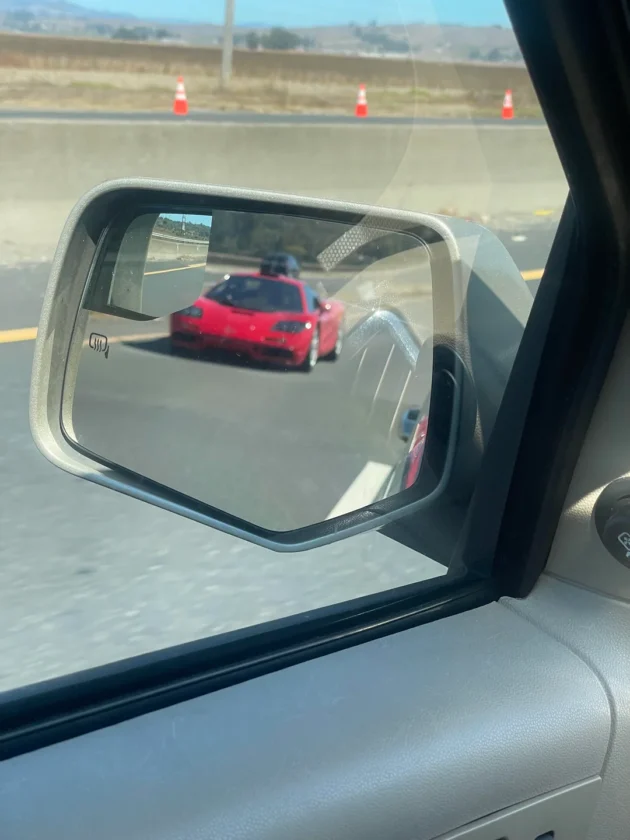
You don’t expect to see a McLaren F1 in traffic. Not on a random stretch of highway, not casually rolling past like it’s just another car. And yet, that’s exactly what happened in California, where one of the rarest and most respected supercars ever built was spotted out in the wild.
It wasn’t parked at a show. It wasn’t behind ropes. It was moving.
The sighting happened along Highway 47, where a red McLaren F1 was caught cruising like it had somewhere to be. A car enthusiast who witnessed it shared photos online, and the reaction was immediate. People who know what they’re looking at don’t brush this off. You don’t just casually run into an F1. That’s where things change.
Because this isn’t just any exotic car. The McLaren F1 sits in a completely different category. Even among supercars, it stands apart. It’s one of those machines that has built a reputation over decades, not through hype, but through what it actually did. And what it did still matters.

The person who spotted the car didn’t try to play it cool. They made it clear the moment stuck with them. Seeing an F1 in person, especially on a public road, isn’t something most enthusiasts ever get to experience. It’s the kind of thing that feels unreal even while it’s happening. And that’s not exaggeration.
The McLaren F1 isn’t just rare because of production numbers. It’s rare because of how it was built and what it represents. Under the hood sits a 6.1 liter BMW V12, an engine that helped define the car’s character. No turbos, no shortcuts, just raw engineering focused on performance. Here’s the part that matters.
That engine pushed out 618 horsepower, which doesn’t sound outrageous by today’s standards. But context matters. When the F1 came out, that number was enough to make it the fastest production car in the world. It wasn’t just quick. It reset expectations for what a road car could do.
And it did it without trying to be flashy.
Then there’s the layout. The F1’s three-seat configuration still feels strange even now. The driver sits in the center, with two passenger seats slightly behind on either side. It’s unconventional, and that’s putting it lightly. But it was designed that way for a reason, putting the driver exactly where they should be for control and balance.
That decision alone tells you how focused this car was.
Everything about the F1 feels intentional. It wasn’t built to follow trends. It wasn’t chasing attention. It was built to be the best, and for a long time, it simply was.
And that’s where it gets even more interesting.
The McLaren F1 didn’t just dominate on paper. It proved itself in racing too. The F1 GTR version went straight into the 24 Hours of Le Mans in 1995 and won on its first attempt. That doesn’t happen by accident. That’s engineering, execution, and a bit of bold confidence all coming together.
So when one shows up on a public road, it’s not just a cool sighting. It’s a reminder.
A reminder of a time when performance meant something different. When speed wasn’t filtered through layers of software and driver assists. When a car like this demanded attention not because of noise or styling, but because of what it could actually do. And yet, here it was, just driving down Highway 47. No track. No spotlight. Just asphalt and open road.
That’s part of what makes this sighting hit harder. Cars like the F1 aren’t meant to be locked away, but that’s usually what happens. They sit in collections, preserved, protected, rarely driven. Owners know what they have, and they treat it accordingly. So seeing one being used, even briefly, feels different.
It raises a simple question. Why don’t we see more of this? Because at the end of the day, cars like the McLaren F1 were built to be driven. That’s the whole point. Not stored, not hidden, not treated like fragile artifacts. Driven. Hard, if possible.
Of course, reality gets in the way. Value, rarity, and risk all play a role. You don’t take something like this out lightly. But when it does happen, it reminds people what these machines are really about.
The reaction online says everything. People weren’t just impressed. They were almost shocked. Because deep down, everyone knows how unlikely this kind of moment is. That’s why it sticks.
Not because it was loud or dramatic, but because it was simple. A legendary car, doing what it was built to do, in a place where no one expected to see it. And honestly, that might be the rarest part of all.
Source
 Elizabeth Puckett
  Shawn Henry