
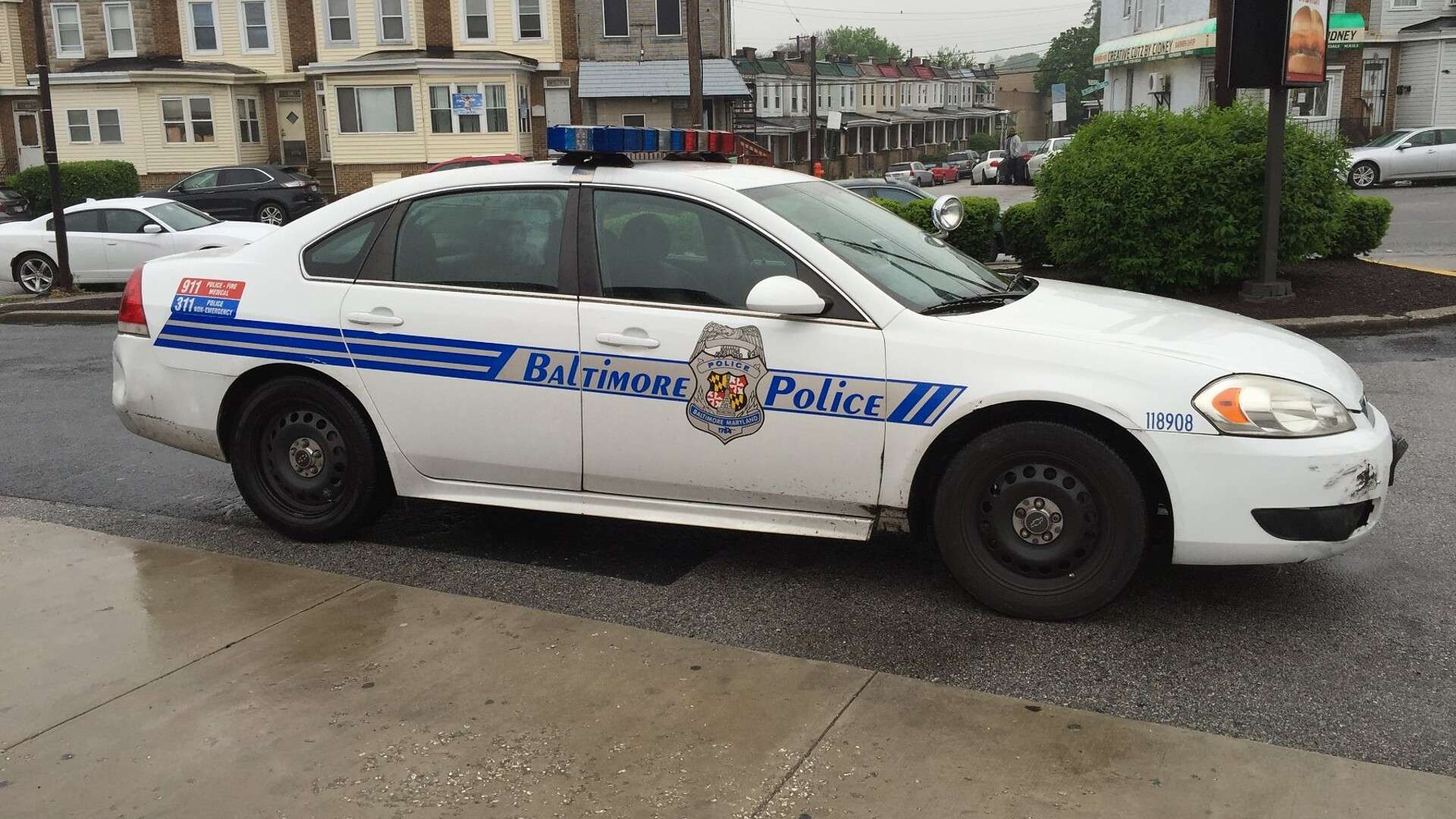
A 15-year-old was taken to the Baltimore City Juvenile Justice Center late Saturday, Oct. 3, after police said a car flagged as stolen hit a patrol vehicle, emptied out while still moving, and rolled down the 5000 block of Anthony Avenue in Baltimore until it struck a parked car and caught fire.
According to the police account reported by CBS Baltimore, it started around 11:15 p.m., when the department’s aviation unit, the helicopter crew it calls Foxtrot, got a license plate reader alert for a stolen vehicle near 33rd Street and Loch Raven Boulevard. Officers tried to pull the car over. The driver kept going and hit a police vehicle. On Anthony Avenue, three people got out while the car was still rolling, and it kept going without them into an unoccupied parked vehicle, then burned. Police said the 15-year-old was arrested without incident and that neither the teen nor any officer reported an injury. The accounts police have given so far describe one arrest and do not say who was driving.


The crash came three days after Maryland’s Youth Charging Reform Act took effect on Oct. 1, in the same week a 69-year-old motorcyclist was killed by a stolen Kia that police say a 12-year-old was driving. Both cases have been pulled into the argument over the new law, and local coverage of the Anthony Avenue crash closed by noting that the act changes how theft and robbery cases involving minors are handled.
I read the law. It changes nothing for a 15-year-old accused in a stolen-car crash, and the 12-year-old’s case runs on a 2024 statute that sends every car-theft complaint against a child under 13 down a non-criminal track. The act’s changes are aimed at gun and assault charges against 16- and 17-year-olds. For children in stolen cars, the rules Baltimore is living with were written in 2022 and 2024.
What Maryland’s Youth Charging Reform Act moved, and what it left in place
The act is Senate Bill 323, which passed the Senate 32-12 and the House 92-39 and was signed May 26 as Chapter 609 of 2026. Before Oct. 1, Maryland’s juvenile courts had no jurisdiction over a child 14 or older accused of a crime punishable by life in prison, or over 16- and 17-year-olds accused of a list of offenses that included first-degree assault and handgun and regulated-firearm crimes. Those cases were filed in adult court, and it was up to the defense to ask a judge to send them back.
Chapter 609 raises the life-crime exclusion from 14 to 16 and takes first-degree assault and the handgun and regulated-firearm charges off the 16-and-up list. Carjacking, armed carjacking, armed robbery, second-degree murder and attempted murder by a 16- or 17-year-old still start in adult court. The act also requires intake officers to authorize detention before a hearing for a 16- or 17-year-old accused of carrying a handgun or committing a crime of violence. A prosecutor who wants a juvenile case moved to adult court can ask for a waiver, and a judge decides.
The word “theft” does not appear in the chapter. Its one mention of Maryland’s motor vehicle theft statute, Criminal Law §7-105, sits in an existing Education Article list of off-campus offenses that must be reported to schools. A 15-year-old accused of taking a car and fleeing officers was in juvenile court under the old law and is in juvenile court under the new one.
The legislature’s own fiscal and policy note shows who the act was written for. In calendar 2025, according to Department of Juvenile Services figures in the note, 303 young people were charged as adults with handgun or firearm violations. Of those, 211 cases were transferred to juvenile court and 34 were dismissed before transfer, leaving 58 in adult court. Of 204 charged as adults with first-degree assault, 115 were transferred, 51 were dismissed and 38 stayed. Juvenile Services Secretary Betsy Fox-Tolentino made the same point the week the law took effect, telling WJZ, “Most of those young people, for the offenses that the law is changing, have those cases come back to the juvenile system anyway.”
The opposition has been about guns, too. “I think it’s going to make the streets more dangerous because now our young people who get charged with a handgun automatically start in the juvenile system,” Baltimore Police Commissioner Richard Worley told the station. Baltimore State’s Attorney Ivan Bates said he was one of 23 prosecutors statewide who opposed the act. Maryland Attorney General Anthony Brown supported it, saying the state had long sent struggling children into the adult system, “a practice that disproportionately harmed Black youth.”
Why the 12-year-old driver in the fatal Dukeland Street crash got a supervision referral
The motorcyclist, Barry Wright, 69, was struck at North Dukeland Street and West North Avenue in Baltimore and died at a hospital. Security video showed a boy and a girl get out of the stolen car and run, WJZ reported. The 15-year-old passenger was charged with motor vehicle theft. For the 12-year-old police identified as the driver, the department said it submitted a Child in Need of Supervision referral, citing his age, and met with the Department of Juvenile Services about the case.
That outcome is set by statute. Maryland’s 2022 Juvenile Justice Reform Act made 13 the minimum age for delinquency cases, with exceptions for 10- to 12-year-olds accused of specified violent offenses. In 2024, lawmakers passed House Bill 814, 126-6 in the House and 42-2 in the Senate, and Gov. Wes Moore signed it as Chapter 735. According to the enrolled fiscal note, it extended those exceptions to handgun and firearm crimes, aggravated animal cruelty and third-degree sexual offense, and handled cars separately. Under Courts and Judicial Proceedings §3-8A-10(c)(5), when a complaint says a child under 13 committed motor vehicle theft, “the intake officer shall authorize the filing of a petition alleging that the child is in need of supervision.”
A CINS petition puts a child under court-ordered supervision and services. It is not a delinquency case. The 2024 law gave the courts a way to reach a 10-year-old who takes a car, but only on that track, and the 2026 act did not change it.
Who pays for a burned stolen car, a damaged parked car and a police cruiser
Juvenile court can order restitution against a child, a parent or both under §3-8A-28, and the Criminal Procedure Article caps such a judgment at $10,000 for each child’s acts arising out of a single incident. Saturday’s crash left a burned car, a parked car with crash damage and a damaged patrol vehicle. Whatever costs more than that cap stays with the car owners, their insurers and the city.
For the owner of the stolen car, theft and fire are comprehensive-coverage claims. An owner who carried liability only gets nothing for the car. The owner of the parked car has a different problem: the person who hit it was in a car taken without permission, and a policy’s coverage for permitted drivers doesn’t extend to a thief. Maryland requires every auto policy to include uninsured motorist coverage that pays for property damage, including loss of use, so that coverage or the owner’s own collision coverage is where the claim usually goes, with the policy wording deciding which.
Baltimore’s string of stolen-car crashes involving children
CBS Baltimore counted the Anthony Avenue crash as at least the fifth incident in recent months involving children and stolen cars. On Sept. 24, according to CBS Baltimore, four juveniles in a stolen car crashed into an MTA bus in East Baltimore, sending 16 people to the hospital. In September, a 14-year-old who struck and killed 3-year-old Jordan Bright while driving a stolen car was sentenced in juvenile court. “He can receive treatment, he can go home, he can eventually move forward with his life. Jordan cannot,” her mother, Nyjada Billy, said. In one sweep the week the law took effect, police said they arrested 11 teens ages 14 to 17 on charges that included car theft.
Car theft is not on Maryland’s adult-court list for any age, and it was not before Oct. 1 either. Baltimore’s car-theft problem was well established years before this act was drafted, and the under-13 supervision rule for car theft has been on the books since 2024.
How the Anthony Avenue car was found is part of the pattern too. A plate reader flagged it and a helicopter was overhead. The version of the department’s vehicle pursuit policy posted on its website, dated 2017, allows officers to chase only a felony suspect who poses an immediate threat of death or serious injury, rules out pursuits over property crimes and traffic violations, and has the air crew take over radio control once it arrives. A stolen car with no violent crime attached is something officers in Baltimore are expected to follow from the air, not run down on the street. Other departments have made the same call. The Auto Wire has covered Minnesota officers who declined to chase a stolen car clocked above 70 mph, and a 2023 Maryland pursuit that ended in a death.
What happens next in the Anthony Avenue case
Juvenile cases in Maryland are largely closed to the public, so the 15-year-old’s case will move through Juvenile Services intake and juvenile court mostly out of view. Under either version of the law, nothing sends a 15-year-old’s stolen-car case to adult court automatically; that would take a prosecutor’s waiver request and a judge’s ruling. Bates said his office is now preparing its juvenile division for “the potential increase in cases and workload,” and advocates said they will push in the 2027 General Assembly session to take more offenses off the automatic adult-charging list.
For the drivers whose cars end up in these cases, the theft report is what gets a plate onto the list that readers like the one near Loch Raven Boulevard check, and the restitution cap is what limits how much of the damage a court can put back on the family of the child involved. When the person accused is under 13 and the charge is car theft, Maryland law already requires a supervision petition.
If it were your car stolen and burned, what would you want out of the case: restitution, or a process that keeps the kid from doing it again?