 By John Lloyd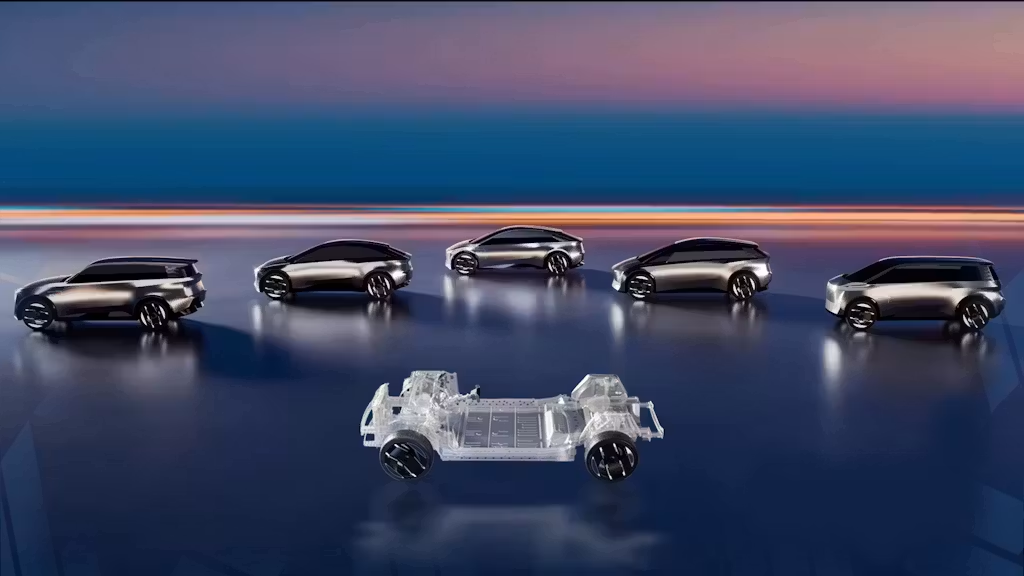
Stellantis has finally revealed how it plans to stop the bleeding, rebuild confidence, and convince buyers that brands like Chrysler, Dodge, Jeep, and Ram still have a strong future in the American market.
More Stories Like This
- Teen Shot at Massachusetts Car Meet as Burning Stolen Car Full of Bullet Holes Sends Crowd Running
- Hellcat Murder Case Takes Dramatic Turn After Suspect Rejects Plea Deal in Deadly AirTag Tracking Confrontation
- Driver Tried to Hide Expired Tags With Blue Duct Tape and a Marker — What Happened Next Got the Car Impounded
- 10 Used V8 Cars Getting Shockingly Affordable Right Now
- Ferrari’s $640,000 EV Gamble Just Changed the Supercar Fight Forever
The company used its 2026 Investor Day presentation to unveil FaSTLAne 2030, a sweeping $70 billion strategy that will shape its next five years. For drivers, truck buyers, and enthusiasts, the biggest takeaway is simple: 11 new vehicles are headed to the U.S. market by the end of the decade.
That number matters because Stellantis has spent the last several years facing questions about product decisions, shrinking lineups, delayed launches, and uncertainty surrounding some of its most recognizable brands. Now the company is promising growth through expansion, arguing that new products will be the key to improving performance in a market it expects to remain largely flat.
The question is whether these new vehicles will be enough.
Stellantis Is Finally Playing the Platform Game
At the center of the plan is a new architecture called STLA One.
The company describes it as a modular global platform designed to replace five different vehicle architectures. The goal is straightforward. Build more vehicles from common components, reduce engineering costs, and create manufacturing efficiencies across multiple brands.
Automakers across the industry have been moving in this direction for years. Toyota successfully built much of its lineup around shared TNGA platforms, allowing it to spread development costs across millions of vehicles worldwide.
Stellantis now wants to achieve something similar.
By 2030, the company expects half of its global vehicles to ride on just three platforms while sharing up to 70 percent of components. From a business perspective, that’s a major cost-saving strategy. From a customer perspective, it means many future vehicles will be built from the same basic building blocks, even if they wear very different badges.
Chrysler Gets a Lifeline
For months, speculation surrounded Chrysler’s future.
The brand has operated with an extremely limited lineup, leading many observers to wonder whether Stellantis would eventually phase it out. Instead, Investor Day confirmed Chrysler will remain part of the company’s North American strategy.
The brand’s focus will center on affordability and practicality.
Three new models are scheduled to arrive before 2030. Those vehicles are the Airflow, Arrow, and Arrow Cross. According to Stellantis, all three will be priced below $40,000, while two are expected to come in under $30,000.
That is where things change.
Affordable vehicles have become increasingly difficult to find, especially as average transaction prices continue climbing throughout the industry. Stellantis clearly sees an opportunity to position Chrysler as a value-focused brand aimed directly at buyers who simply want practical transportation without luxury pricing.
All three vehicles appear to be SUVs, reflecting the reality of today’s market.
Dodge Brings Back Familiar Names
While Chrysler is focusing on practicality, Dodge appears determined to lean into nostalgia and performance.
One of the biggest surprises from the presentation was confirmation that the Copperhead name is returning.
Company leadership was quick to point out that the new Dodge Copperhead is not intended to be a Viper successor. Still, the revival immediately caught attention because the original Copperhead concept remains a memorable chapter in Dodge history.
The timing is interesting.
Dodge already has the Hurricane six-cylinder engine and a two-door Charger platform in its portfolio. Those pieces create a foundation that could make development of a new performance-focused model considerably easier.
Then there is GLH.
The historic Dodge performance badge is also coming back. Originally attached to the high-performance Omni hatchback during the 1980s, GLH carries considerable recognition among longtime enthusiasts.
The company has revealed very little about the vehicle itself. The presentation imagery suggests something compact, though exact details remain limited. What is known is that the vehicle will produce nearly 300 horsepower from a four-cylinder engine.
For Dodge, these revivals are about more than nostalgia. They are an attempt to reconnect with enthusiasts while creating products that stand out in a crowded market.
Jeep Expands Its Off-Road Portfolio
Jeep remains one of the brands receiving the largest share of Stellantis resources.
Among the most significant announcements was confirmation that the Recon will receive an internal combustion version. The vehicle originally debuted as an all-electric off-roader featuring removable doors and substantial power output.
Company leadership believes adding a gasoline-powered version will help boost sales volumes.
Whether that happens remains to be seen.
The challenge is obvious. Jeep already sells the Wrangler, one of the most recognizable off-road vehicles on the market. Differentiating a gas-powered Recon from a gas-powered Wrangler may prove difficult unless buyers see a clear reason to choose one over the other.
The Cherokee is also returning to Belvidere production.
Meanwhile, Jeep enthusiasts received another intriguing piece of news with the announcement of a two-door pickup called the Scrambler.
Details remain limited, but the vehicle is expected to feature four seats, removable roof panels, and styling references to the YJ era. For enthusiasts who miss smaller, more playful off-road vehicles, the Scrambler may end up being one of the most interesting products in the entire roadmap.
There was another notable detail hidden in the presentation.
Stellantis indicated SRT variants are planned for the Scrambler, Grand Cherokee L, and Grand Wagoneer. That suggests the company sees room for even more high-performance Jeep models moving forward.
Ram Targets Two Massive Truck Segments
Ram may have the clearest growth strategy of any Stellantis brand.
The company plans to enter both the midsize and compact pickup segments.
The midsize truck will revive the Dakota name and arrive as a 2027 model. It will offer internal combustion, plug-in hybrid, and battery-electric powertrains while competing directly against established players like the Toyota Tacoma and Chevrolet Colorado.
That is a significant opportunity.
The Tacoma consistently generates strong sales, proving there is substantial demand for midsize trucks in America.
Ram also wants a competitor for the Ford Maverick.
To accomplish that, the company plans to bring the Rampage north from South America. The compact pickup currently uses a unibody platform and comes equipped with all-wheel drive and a Hurricane turbocharged four-cylinder engine.
This is where the story turns.
Related Incidents
Classic Car Buyers Lose Thousands After Scammers Hijack Real Auto Shops in Multi-State Fraud Scheme
Compact trucks have become one of the hottest areas of the market. Buyers want utility, but many no longer need or want the size and cost of a full-size pickup. Ram’s decision to chase that segment reflects a growing reality across the industry.
A High-Stakes Bet on Growth
FaSTLAne 2030 represents more than a product launch schedule. It is Stellantis making a public commitment to its future.
The company is betting that new vehicles, shared platforms, and broader market coverage can stabilize brands that have struggled with uncertainty and shrinking portfolios. Some of these products could become major wins. Others face serious questions before they ever reach dealer lots.
What cannot be ignored is the scale of the gamble. Eleven new vehicles and a $70 billion investment leave very little room for mistakes. For drivers, enthusiasts, and dealers, the next five years will reveal whether Stellantis is finally turning the corner or simply placing one of the biggest bets in the modern automotive industry.
Via Stellantis
 Shawn Henry