
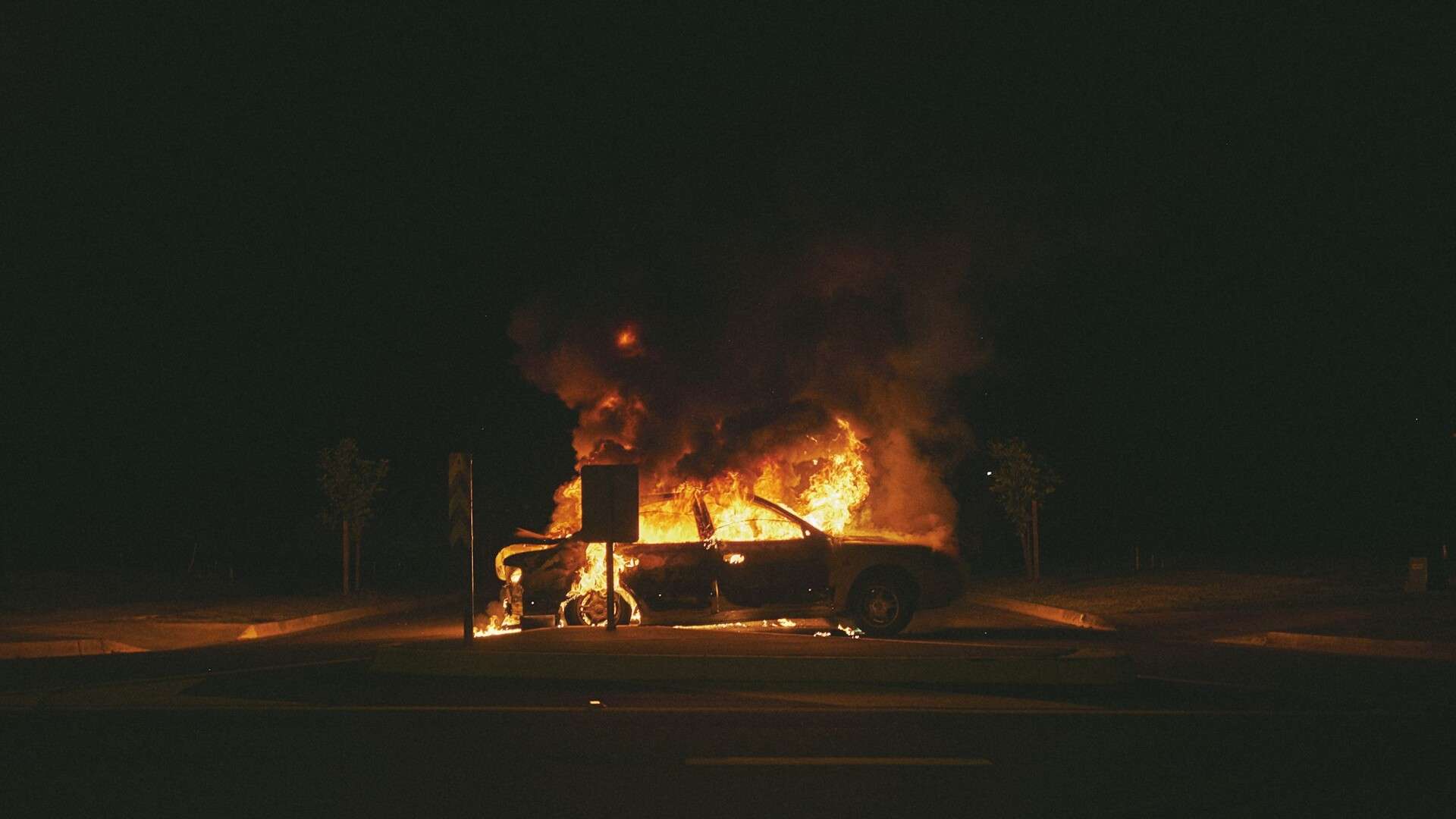
At 2:00 a.m. Monday, Sept. 28, the security camera on the side of Wayne Motors, a family-owned repair shop on Dickerson Street in Far North Dallas, Texas, recorded a car leaving the road, going through the guardrail and hitting the building. Three people from a second car got the driver out through a window as the car started to burn. By the time officers arrived, all four were gone, Dallas police told NBC 5. On Tuesday, the shop posted a follow-up on Facebook: “UPDATE: After crashing into our building Monday, they came back… and removed the license plates.”
Nobody was hurt, according to police, and the shop’s owner has said repeatedly that he is relieved about that. It also means the law that governs this crash is the one written for property. In Texas, a crash that damages only a building carries one main duty: tell the owner. Leaving without doing that is an offense on its own, separate from whatever sent the car off the road.
What the Wayne Motors camera recorded
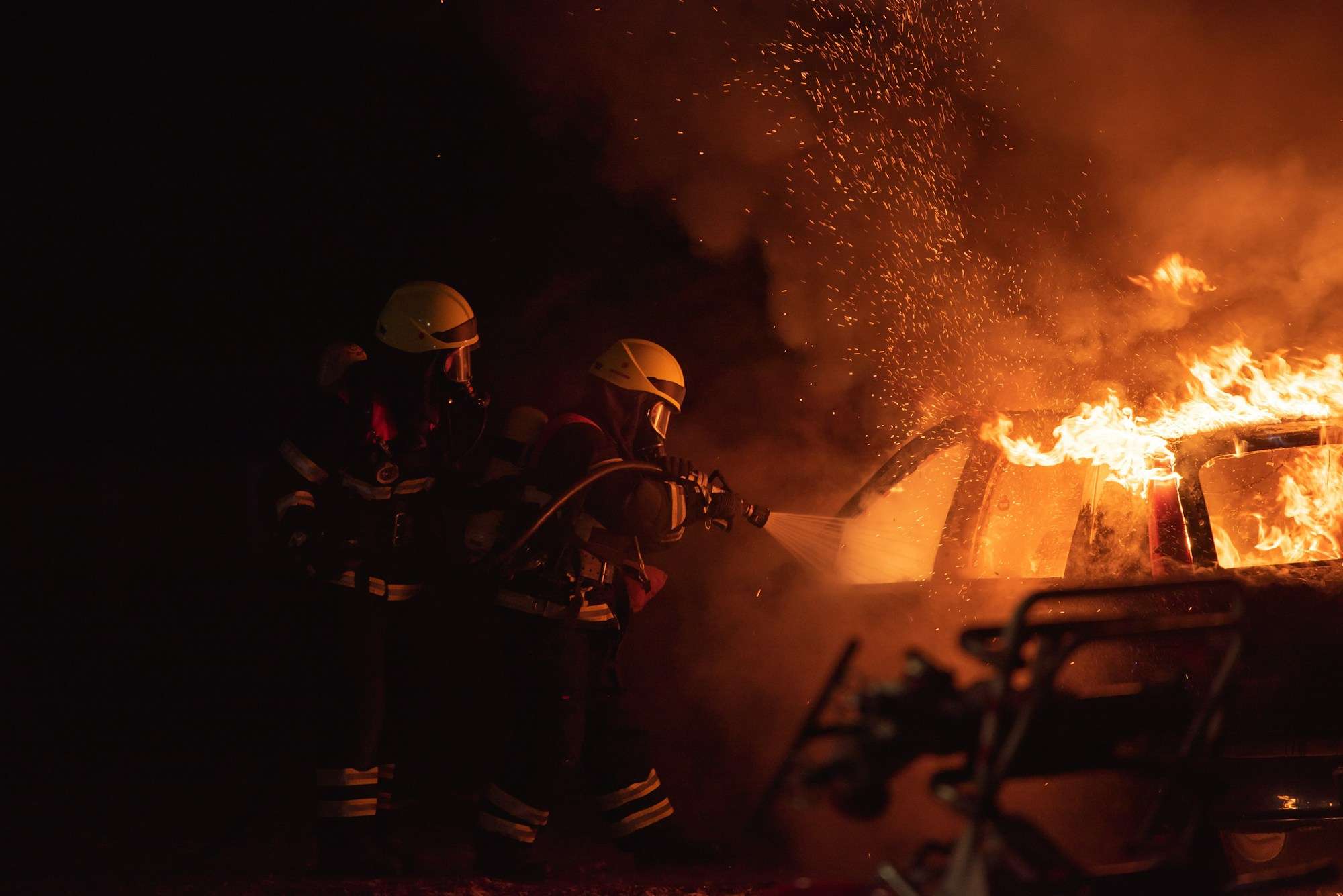
The shop posted its own footage on Facebook with the caption “We don’t care how you get here just get here fast.” The camera’s timestamp reads 2026-09-28 02:00:17 as the clip begins. Dallas Fire-Rescue said reports indicated the vehicle “crashed into the building and caught on fire,” CBS News Texas reported. Firefighters put the fire out quickly.
Owner Jason Wright told NBC 5 the marks on his property showed the car’s path. “I guess it came from that direction and I guess it like spun around, and the tires were up against the wall face down,” he said. The station described a mangled guardrail and a cracked, charred facade. Wright said drivers speed through that stretch and there have been wrecks before, but nothing like this one, NBC 5 reported.
The accounts differ slightly on the rescuers. CBS News Texas described two people jumping out of a second car. NBC 5 and FOX 4 put the number at three, and FOX 4 reported that police said the driver and the three who helped him “all ran from the scene before first responders arrived.” Wright referred to them as the driver’s friends. “I’m glad he got out and his friends were here. And they got him to a hospital or wherever. I’m sure he’s sore, you know,” he told FOX 4.
FOX 4 reported Tuesday morning that police were still looking for the driver, who had not been identified, and that it was not clear whether he would face charges. No charges had been announced as of Tuesday.
Texas law on hitting a building and leaving
Texas has a separate rule for crashes where the only thing damaged is a building. Section 550.025 of the Texas Transportation Code covers a collision “resulting only in damage to a structure adjacent to a highway.” The driver has to take reasonable steps to find and notify the owner or whoever is in charge of the property, and give his name, his address and the registration number of the car he was driving. If the owner asks, the driver has to show a license.
Skipping that step is a Class C misdemeanor when the damage is under $200, and a Class B misdemeanor at $200 or more. A guardrail, a brick facade and a fire put this crash well past $200 on any shop’s estimate. Under the Texas Penal Code, a Class B misdemeanor carries up to 180 days in jail, a fine of up to $2,000, or both. A Class C is a fine of up to $500.
The statute’s wording has a gap. The duty covers a “structure,” a fixture or landscaping, but the penalty tiers are set by the damage “to all fixtures and landscaping,” with no mention of structures. How a court would apply those tiers to a building-only crash is a question for a judge, and a detail a defense lawyer would likely raise.
A second duty applies here too. Section 550.026 says the driver in a crash that leaves a vehicle unable to “be normally and safely driven” must “immediately by the quickest means of communication” notify the local police. A car that has just caught fire against a wall meets that description. That section carries no penalty of its own, so it falls under the Transportation Code’s general penalty: a fine of $1 to $200.
The much heavier hit-and-run law, Section 550.021, applies to crashes that result, or are “reasonably likely to result,” in injury or death. Leaving one of those can be a felony. Police said no one was hurt Monday, so on the facts released so far, the property statutes are the ones in play.
Why pulling the plates doesn’t hide a car
Wayne Motors has not said publicly who came back for the plates or when, beyond the post’s caption. I found no public statement from Dallas police about the plates, so who took them, and why, is unknown.
A missing plate does not make a car anonymous. Federal rules require every passenger car’s vehicle identification number to be mounted inside the cabin and readable through the windshield by someone standing outside next to the left windshield pillar. The same 17 characters are tied to the title and registration at the Texas Department of Motor Vehicles. A burned car left against a wall still has a VIN, and an investigator who reads it gets the registered owner, which is where most searches for a driver begin.
Taking plates off a car is not a crime in itself. The TxDMV tells owners they may keep their plates when they sell or dispose of a vehicle. An owner collecting plates from a car headed for the salvage yard is doing something Texans do every day.
Intent is what changes it. Under Section 37.09 of the Texas Penal Code, a person who knows an investigation is pending or in progress and “alters, destroys, or conceals any record, document, or thing with intent to impair its verity, legibility, or availability as evidence” commits tampering with physical evidence. That is a third-degree felony, punishable by two to 10 years in prison and a fine of up to $10,000. Whether any of that fits here depends on facts no one has released: who removed the plates, what they knew about the police search, and why they did it. The statute shows how a property-damage misdemeanor can grow into a felony question once people start handling the evidence.
Who pays for the wall and the car
Leaving also complicates the money. Texas requires drivers to carry at least $25,000 in property damage liability, which the Texas Department of Insurance says covers “other damaged property,” a building included. That coverage pays only once someone knows which policy to file against. Until the driver is identified, a shop owner in Wright’s position would typically turn to his own business insurance, and that insurer would try to recover from the driver’s carrier once there is a name to send the bill to.
The burned car is a separate claim. Collision coverage “pays to repair or replace your car after an accident,” per the TDI, while comprehensive covers fire “or something other than a collision.” Which one pays for a fire that follows a crash depends on the policy’s wording, and a driver who carries only the state-minimum liability policy has neither coverage for his own car. Wright, for his part, told FOX 4 he was not worried about the damage to the building and was relieved everyone was okay.
The Dallas crash report and what comes next
Dallas police told NBC 5 they will keep investigating. With a broken guardrail, a charred facade and a burned car, the damage appears well above $1,000, and at that level Section 550.062 requires the investigating officer to file a written crash report with the Texas Department of Transportation within 10 days of the crash, which puts the deadline at Oct. 8. Under Section 550.065, Wright is entitled to a copy as the owner of property damaged in the collision, for $6. That report is what an insurer would work from, and it is where a driver’s name, or a VIN and a registered owner, would first show up on paper.
The law asks little of a driver in this spot. Nothing in Chapter 550 requires anyone to stand next to a burning car. Section 550.026 calls for notice to police by the quickest means of communication, which a phone call satisfies, and Section 550.025 calls for reasonable steps to give the property owner a name, an address and a registration number. Wright told FOX 4 he woke up Monday to missed calls from police. The next call that matters in this case is the one that tells him and Dallas police who was driving.
When nobody is hurt, should Texas keep leaving the scene of a crash into a building as a misdemeanor, or should it be punished closer to fleeing a crash where someone was injured?
Top photo: Illustrative photo. (Photo: Matt Hearne/Unsplash)