
Tesla Cybertruck
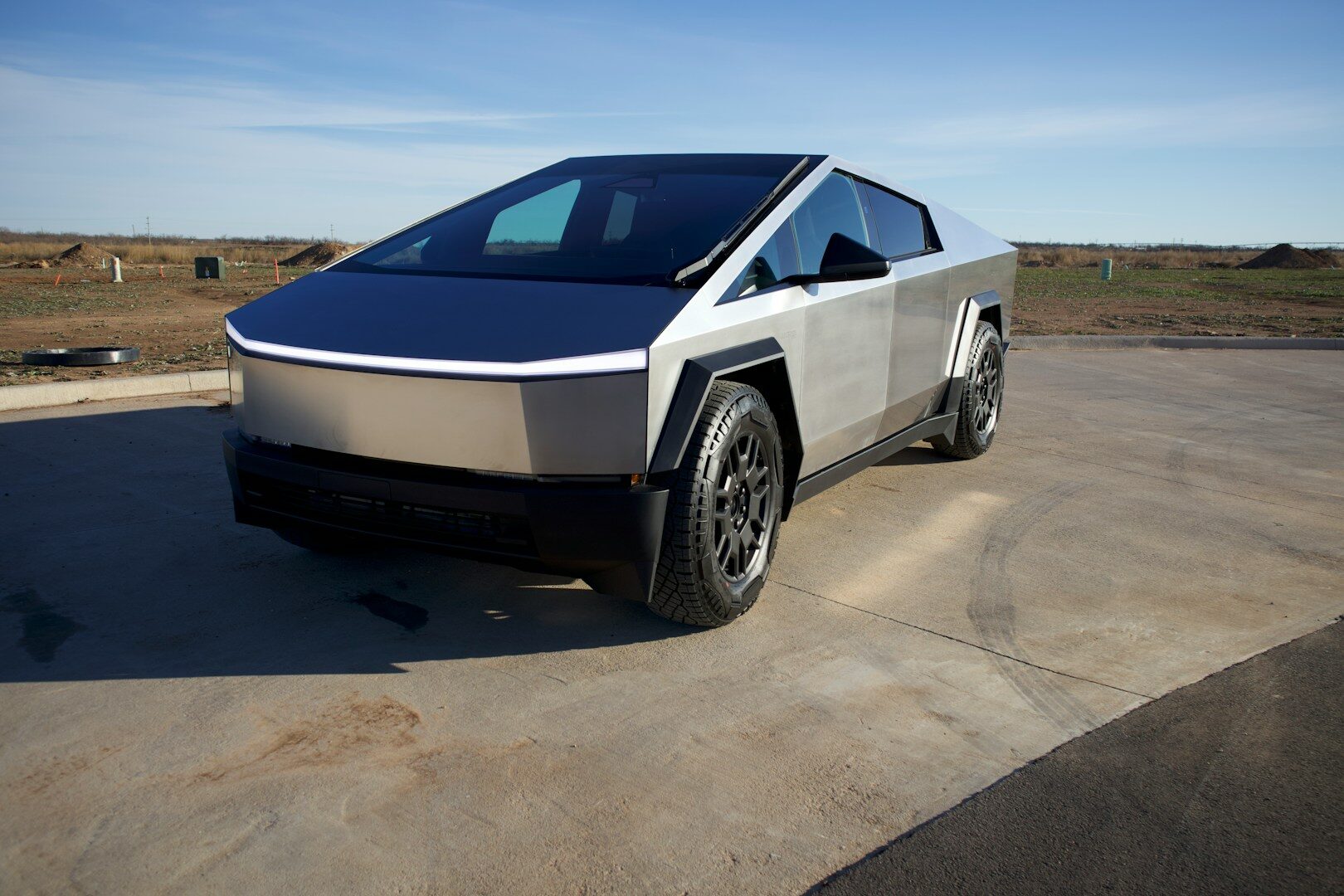
The Tesla Cybertruck is one of the most distinctive and polarizing vehicles ever produced, an all-electric pickup wrapped in an angular, stainless-steel exoskeleton unlike anything else on the road. After a lengthy development, the Cybertruck entered production with deliveries beginning in late 2023, bringing supercar-rivaling acceleration, substantial towing and payload capacity, and Tesla’s technology-forward approach to the full-size truck segment. This guide covers the Cybertruck in depth, including its history, powertrains, performance, range and charging, interior, technology, safety, towing and payload, variants, pricing, competitors, and reliability, along with a detailed FAQ.
Specifications throughout are drawn from manufacturer information and independent testing. Tesla changes pricing and configurations frequently, and figures vary by variant, so where a number cannot be confirmed with confidence we say so directly. Always verify current details with Tesla before purchasing.
Overview
The Cybertruck is a full-size, all-electric pickup with a radical, flat-paneled stainless-steel body and a five-passenger interior. It is offered in multiple configurations, including a rear-wheel-drive Long Range model, a dual-motor all-wheel-drive model, and the tri-motor Cyberbeast performance flagship. Beneath its unconventional exterior, the Cybertruck uses advanced engineering, including a 48-volt electrical architecture and steer-by-wire steering.
The Cybertruck combines genuine truck capability, with towing up to 11,000 pounds and payload up to 2,500 pounds in the right configurations, with electric-vehicle benefits such as instant torque, a quiet ride, and the ability to power tools or a home using its onboard outlets. Its design and Tesla branding make it one of the most talked-about vehicles on the market, drawing both enthusiastic fans and sharp critics.
Vehicle History
Tesla unveiled the Cybertruck concept in 2019, and its dramatic, science-fiction-inspired design immediately became a cultural talking point. The vehicle’s stainless-steel exoskeleton and shatter-resistant glass were central to its reveal, which famously did not go entirely to plan when the glass cracked during a demonstration. Despite the spectacle, the Cybertruck attracted an enormous number of reservations.
After several delays, the Cybertruck entered production with first deliveries in late 2023, ramping up through subsequent years. As Tesla’s first pickup, it represented the company’s entry into the highly profitable and competitive full-size truck market, applying its electric-vehicle expertise and unconventional design philosophy to a segment long dominated by traditional automakers.
Design and Construction
The Cybertruck’s defining feature is its exterior. Rather than using conventional stamped and painted body panels, it employs flat, ultra-hard stainless-steel panels that form a structural exoskeleton, giving the truck its distinctive faceted, angular silhouette and bare-metal finish. This approach is unlike any other production vehicle and is central to the Cybertruck’s identity.
Inside the bed and elsewhere, the Cybertruck integrates practical truck features with Tesla’s minimalist design language. The unconventional construction has trade-offs, including the visual challenge of keeping bare stainless steel clean, but it also gives the Cybertruck exceptional durability claims and a singular presence on the road.
Powertrains & Variants
The Cybertruck is offered in several electric powertrain configurations, ranging from an efficiency-focused rear-wheel-drive model to a high-performance tri-motor flagship.
The Long Range rear-wheel-drive model prioritizes range and value. The dual-motor all-wheel-drive model, often referred to simply as the AWD Cybertruck, has been cited with roughly 600 horsepower and a 0-60 mph time around 3.9 seconds. The tri-motor Cyberbeast is the performance flagship, capable of reaching 60 mph in approximately 2.6 seconds with a top speed cited around 130 mph, performance figures that rival sports cars despite the truck’s size and weight. Because Tesla adjusts its lineup over time, exact configurations and outputs should be confirmed directly with Tesla.
Performance by Variant
| Variant | Drivetrain | 0-60 mph (approx.) | Notes |
|---|---|---|---|
| Long Range RWD | Rear-wheel drive | Slower; range-focused | Up to ~354-mile range; ~7,500-lb towing |
| All-Wheel Drive (Dual Motor) | All-wheel drive | ~3.9 seconds | ~600 hp; ~11,000-lb towing |
| Cyberbeast (Tri-Motor) | All-wheel drive | ~2.6 seconds | Top speed ~130 mph; performance flagship |
Performance
The Cybertruck’s acceleration is its headline performance trait. Even the all-wheel-drive model’s roughly 3.9-second 0-60 time is supercar-quick for a full-size pickup, and the Cyberbeast’s approximately 2.6-second sprint is genuinely astonishing for a vehicle of its size and weight. Like all electric vehicles, the Cybertruck delivers instant torque from a standstill, making it feel effortlessly rapid in everyday driving.
Beyond straight-line speed, the Cybertruck features advanced engineering including steer-by-wire steering with a variable ratio and rear-wheel steering, which improves maneuverability for such a large vehicle. Reviewers have noted a comfortable ride over most surfaces. The combination of size, weight, and the unconventional steering takes some acclimation, but the overall driving experience reflects Tesla’s technology-first approach.
Range & Charging
As an electric vehicle, the Cybertruck’s range replaces the fuel-economy discussion. The Long Range rear-wheel-drive model offers the highest estimated range, cited up to approximately 354 miles, while the all-wheel-drive and Cyberbeast models offer somewhat less range due to their added performance, generally in the low-300-mile range depending on configuration and conditions.
| Variant | Estimated Range |
|---|---|
| Long Range RWD | Up to ~354 miles |
| All-Wheel Drive | ~Low-to-mid 300s; verify current figure |
| Cyberbeast | ~Around 300+ miles; verify current figure |
The Cybertruck charges on Tesla’s Supercharger network and uses Tesla’s connector. Real-world range depends heavily on towing, payload, terrain, climate, and driving style, with towing in particular reducing range substantially, as it does for all electric trucks. Confirm current EPA range estimates for the specific variant with Tesla.
Interior
The Cybertruck’s interior follows Tesla’s minimalist philosophy, centered on a large landscape-oriented touchscreen that controls nearly all vehicle functions. The cabin seats five and features a spacious, airy feel, with a second-row display for rear passengers on equipped models. Materials and design emphasize a clean, modern aesthetic rather than traditional truck ruggedness inside.
Practical truck elements include a powered tonneau cover over the bed and substantial storage, both in the bed and in a front trunk. As with other Teslas, the heavy reliance on the central touchscreen for controls is divisive, with some buyers appreciating the simplicity and others missing physical buttons. Overall, the interior is comfortable and technology-rich.
Technology
Technology is central to the Cybertruck’s appeal. The large central touchscreen runs Tesla’s software, with over-the-air updates that can add features and improve the vehicle over time. The truck supports Tesla’s driver-assistance features, including Autopilot and the available, separately-priced Full Self-Driving (Supervised) capability, which requires active driver supervision despite its name.
The Cybertruck’s 48-volt electrical architecture is a notable engineering step that reduces wiring weight and complexity. The truck also offers power-export capability, with onboard outlets that can run tools, appliances, or even provide backup power to a home with the appropriate equipment, a practical benefit shared with some other electric trucks.
Safety
The Cybertruck includes Tesla’s suite of active-safety and driver-assistance features, such as automatic emergency braking, lane-keeping aids, and the Autopilot system, with additional capability available through Full Self-Driving (Supervised). Its rigid stainless-steel structure is central to Tesla’s durability claims.
As a relatively new and unconventional vehicle, comprehensive independent crash-test ratings may be limited or evolving, and the Cybertruck’s unique construction and large size are factors buyers should consider. Reviewers have noted some blind spots, partly related to the bed cover and the truck’s shape. Buyers should review the latest available NHTSA and IIHS information and rely on the driver-assistance features as aids requiring active supervision.
Towing & Payload
The Cybertruck offers genuine truck capability. Maximum towing capacity is cited at up to 11,000 pounds on the all-wheel-drive and Cyberbeast models, while the rear-wheel-drive Long Range model is rated lower, around 7,500 pounds. Maximum payload is cited up to 2,500 pounds, which is competitive for the segment.
| Variant | Max Towing | Max Payload |
|---|---|---|
| Long Range RWD | ~7,500 lbs | Up to ~2,500 lbs (verify) |
| All-Wheel Drive | Up to 11,000 lbs | Up to ~2,500 lbs |
| Cyberbeast | Up to 11,000 lbs | Up to ~2,500 lbs |
An important consideration for any electric truck is that towing heavy loads dramatically reduces driving range, often by half or more, which can complicate long-distance towing given charging logistics. Buyers who tow frequently over long distances should plan carefully. Always confirm the exact tow and payload ratings for your configuration and never exceed the published limits.
Pricing
Cybertruck pricing varies by variant and has changed over time, as Tesla frequently adjusts prices. Independent listings have placed the Long Range rear-wheel-drive model around $70,000 to $72,000, the all-wheel-drive model around $82,000, and the Cyberbeast flagship around $115,000 to $117,000. These figures are subject to change.
Because Tesla updates pricing and configurations regularly and sells directly to consumers, prospective buyers should confirm current pricing, available variants, and any incentives directly with Tesla rather than relying on a single advertised figure.
Competitors
The Cybertruck competes in the growing electric-pickup segment as well as against capable gas and hybrid full-size trucks. Its most direct electric rivals include the Ford F-150 Lightning, Rivian R1T, the Chevrolet Silverado EV, and the GMC Sierra EV and Hummer EV pickup.
| Vehicle | Type | Notable Trait |
|---|---|---|
| Tesla Cybertruck | Electric pickup | Radical stainless-steel design; quick; Supercharger access |
| Ford F-150 Lightning | Electric pickup | Conventional truck design; familiar F-150 layout |
| Rivian R1T | Electric pickup | Adventure focus; strong off-road ability |
| Chevrolet Silverado EV | Electric pickup | Long available range; work-truck options |
| GMC Hummer EV Pickup | Electric pickup | Extreme power; large size |
The Cybertruck’s signature advantages are its unmistakable design, blistering acceleration, advanced engineering, and access to Tesla’s extensive Supercharger network. Its polarizing styling and unconventional approach mean it appeals strongly to some buyers while others prefer the more traditional designs of its rivals.
Reliability
As a relatively new and highly unconventional vehicle, the Cybertruck’s long-term reliability record is still being established, and early production vehicles from any manufacturer can experience teething issues. Tesla’s over-the-air update capability allows some issues to be addressed remotely, but the Cybertruck’s novel construction and technology introduce uncertainty that buyers should weigh.
Prospective buyers should review the specific model year’s recall history and current third-party reliability and owner-satisfaction data for the most accurate picture, recognizing that the Cybertruck is a first-generation product. As with any vehicle, maintenance and usage affect longevity.
Frequently Asked Questions
What is the Cybertruck made of?
The Cybertruck uses flat, ultra-hard stainless-steel panels that form a structural exoskeleton, giving it its distinctive angular, bare-metal appearance unlike conventional painted body panels.
How fast is the Cybertruck?
The all-wheel-drive model reaches 60 mph in about 3.9 seconds, while the tri-motor Cyberbeast flagship does it in approximately 2.6 seconds with a top speed cited around 130 mph.
What is the Cybertruck’s range?
The Long Range rear-wheel-drive model offers up to approximately 354 miles of estimated range, while the all-wheel-drive and Cyberbeast models offer somewhat less. Verify current figures with Tesla.
How much can the Cybertruck tow?
Maximum towing is cited up to 11,000 pounds on the all-wheel-drive and Cyberbeast models, and around 7,500 pounds on the rear-wheel-drive Long Range model. Note that towing significantly reduces range.
What is the Cybertruck’s payload?
Maximum payload is cited up to 2,500 pounds, which is competitive for the segment. Confirm the exact figure for your configuration.
What is the Cyberbeast?
The Cyberbeast is the tri-motor performance flagship of the Cybertruck lineup, capable of reaching 60 mph in about 2.6 seconds, making it one of the quickest pickups ever produced.
How many people does the Cybertruck seat?
The Cybertruck seats five passengers across two rows, with a spacious interior and a second-row display on equipped models.
Does the Cybertruck have steer-by-wire?
Yes. The Cybertruck uses steer-by-wire steering with a variable ratio, along with rear-wheel steering, which improves maneuverability for such a large vehicle.
Can the Cybertruck power my home or tools?
The Cybertruck offers power-export capability through onboard outlets, allowing it to run tools and appliances, and with the appropriate equipment it can provide backup power to a home.
How much does the Cybertruck cost?
Pricing has placed the Long Range RWD around $70,000 to $72,000, the all-wheel-drive model around $82,000, and the Cyberbeast around $115,000 to $117,000, though Tesla changes pricing frequently. Confirm current pricing with Tesla.
Where does the Cybertruck charge?
The Cybertruck charges on Tesla’s Supercharger network using Tesla’s connector, one of the most extensive fast-charging networks available.
How does the Cybertruck compare to the F-150 Lightning and Rivian R1T?
The Cybertruck offers radical styling, blistering acceleration, and Supercharger access, while the F-150 Lightning offers a familiar truck design and the Rivian R1T emphasizes adventure and off-road ability. The choice depends on priorities and design preference.
Is the Cybertruck good for towing long distances?
It can tow up to 11,000 pounds, but like all electric trucks, towing heavy loads dramatically reduces range, often by half or more, which complicates long-distance towing. Frequent long-distance towers should plan charging carefully.
Is the Cybertruck reliable?
As a first-generation, highly unconventional vehicle, its long-term reliability record is still being established. Tesla’s over-the-air updates can address some issues, but buyers should review model-year-specific recall and reliability data.
Final Summary
The Tesla Cybertruck is among the most distinctive vehicles ever produced, pairing a radical stainless-steel exoskeleton with genuine electric-truck capability. Offered in a range-focused Long Range rear-wheel-drive model, a roughly 600-horsepower all-wheel-drive version, and the supercar-quick tri-motor Cyberbeast, it delivers towing up to 11,000 pounds, payload up to 2,500 pounds, advanced engineering such as steer-by-wire and a 48-volt architecture, and access to Tesla’s Supercharger network. Its polarizing design and unconventional approach make it a love-it-or-hate-it proposition, and as a first-generation product its long-term reliability is still being proven. For buyers drawn to its unmistakable looks, electric performance, and technology, the Cybertruck is unlike anything else on the road. As always, verify current specifications, range, towing ratings, and pricing directly with Tesla before purchasing.