
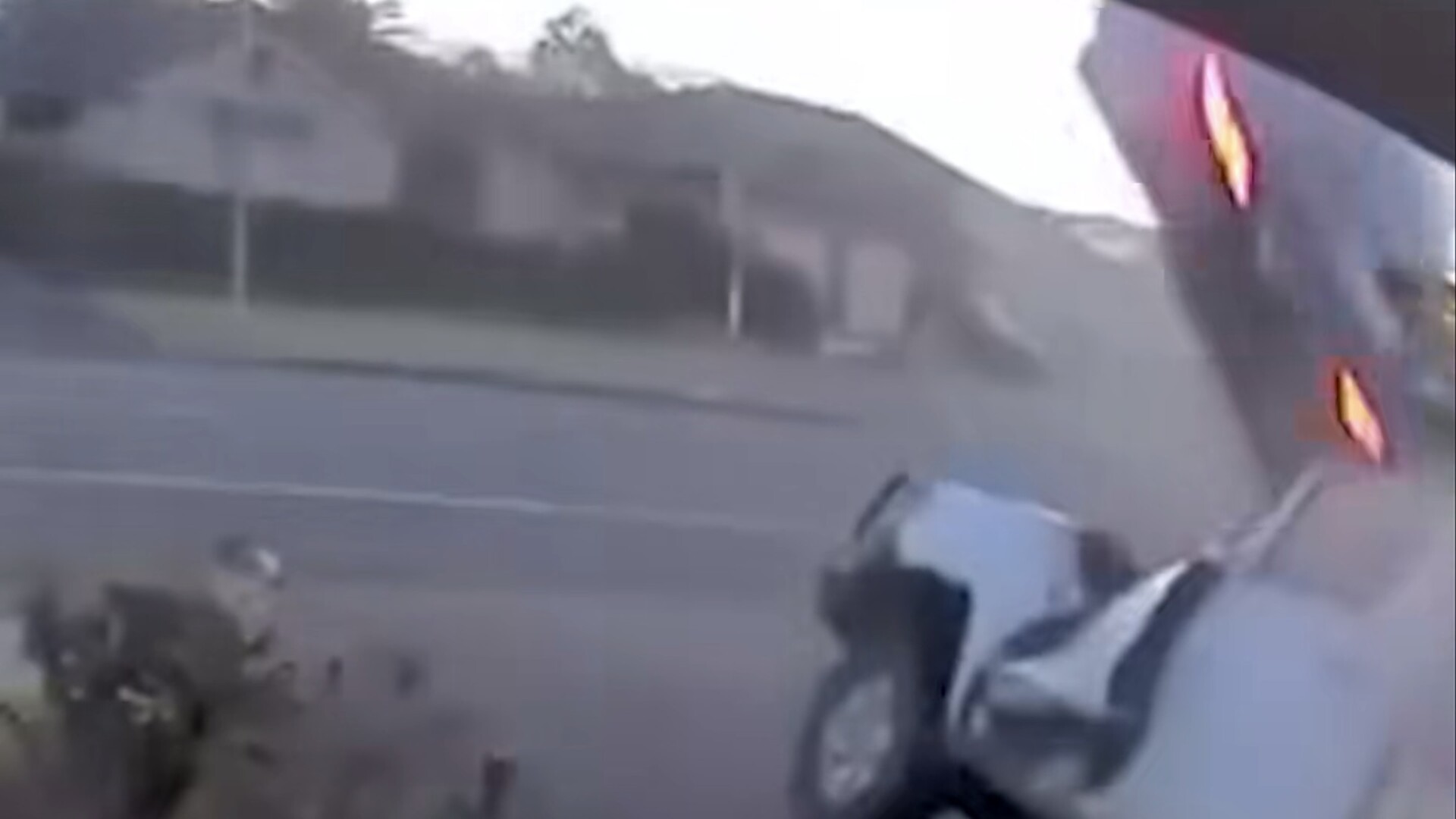
At about 5:30 a.m. on Tuesday, September 29, a Mercedes sedan that police say had been stolen an hour earlier lost control on South Seas Drive in Ashtonfield, a suburb of Maitland in New South Wales’ Hunter region, left the ground, and came down nose-first on a white ute parked in a front yard. A home security camera caught the whole thing. Police arrested a 14-year-old boy at the scene and charged him. He was released on strict conditional bail, with a Children’s Court date of October 19.
That bail decision landed in an odd week. Five days before the crash, the NSW Parliament voted to keep alive a special bail test aimed at teenagers charged with car theft and break-ins, a test that was otherwise set to expire on October 1. The test is tough, but it only applies to a narrow group of kids, and the documents so far don’t show that this boy was one of them. And whoever owns that ute can’t look to the state’s compulsory car insurance for the repair bill.
@9newssydney CCTV has captured the terrifying moment a car flipped into a home’s front yard near Newcastle. #9News
Video: Home security footage via 9News Sydney. Newcastle Weekly reported the clip was first shared by Maitland Accident and Towing.
What police say happened on South Seas Drive
The footage runs only a few seconds. The ute sits on the lawn beside a garden bed, the street quiet behind it. The Mercedes enters the frame already in the air, tail lights glowing, and slams down on the front of the ute, lifting it off the lawn in a spray of dirt and mulch. A second camera angle in the 9News clip shows a plume of dust rising beside a 40 km/h school-zone sign.
According to police information reported by the Newcastle Herald, the sedan had been reported stolen from a home on Coromandel Close, also in Ashtonfield, at 4:30 a.m. Two people were inside when it crashed. One ran. The other, the 14-year-old, stayed, was assessed by paramedics and taken to John Hunter Hospital under police guard. Officers searching the car seized a mobile phone and a balaclava, and the Mercedes was towed away for forensic examination. Police said inquiries are continuing under Operation Soteria.
NBN News reported that both the Mercedes and a Toyota Hilux were destroyed and that the second teenager was still on the run. As of Wednesday morning, NSW Police had not posted a statewide media release on the crash, and Newcastle Weekly noted it had not been able to confirm several details from official channels.
The boy is charged with aggravated break and enter and commit serious indictable offence, and with being carried in a stolen vehicle. He has not been convicted of anything, and under NSW law he cannot be named.
Why a stolen Mercedes becomes a 20-year charge
The most serious charge here is not about the car at all. Section 112 of the NSW Crimes Act covers breaking and entering a dwelling-house or other building and committing a serious indictable offence inside. The basic version carries up to 14 years. Add “circumstances of aggravation” and the maximum becomes 20.
The bar for aggravation is low. Section 105A lists six circumstances, and any one is enough: being armed, using violence, causing actual bodily harm, detaining someone, knowing people are in the building, or being “in the company of another person or persons.” Two people acting together meet that last test without anyone being hurt or even woken up. Police haven’t said how the Mercedes was taken, but the charge itself tells you they allege someone got into a house or other building on Coromandel Close, not just into a car on the driveway.
The vehicle charge is older and blunter. Section 154A makes it an offence to drive a car, or to allow yourself to be carried in it, knowing it was taken without the owner’s consent, and says the offender “shall be deemed to be guilty of larceny.” Larceny carries five years under section 117. The wording of the charge matters: “carried” describes a passenger. Police have not said who was behind the wheel when the Mercedes left the road.
Those maximums are adult numbers. If the case stays in the Children’s Court, the heaviest penalty available is a control order of no more than two years, under section 33 of the Children (Criminal Proceedings) Act.
His age matters in another way. In NSW, children aged 10 to 13 are covered by doli incapax, a common-law presumption that they can’t be held criminally responsible unless prosecutors prove, beyond reasonable doubt, that the child knew the act was seriously wrong. A state review published in August 2025 recommended writing that test into legislation rather than weakening it. At 14, this boy is past the line. Prosecutors won’t have to clear that extra hurdle.
NSW’s youth bail test was due to lapse on October 1
Since 2024, section 22C of the Bail Act has told magistrates they must not grant bail to a 14- to 17-year-old charged with a car theft or serious break-and-enter offence allegedly committed while already on bail for another one, unless the court has “a high degree of confidence” the young person won’t commit a serious indictable offence while out. Both of this boy’s charges are on the list. As printed on the state’s legislation site on Wednesday, the section still reads: “This section is repealed on 1 October 2026.”
That date won’t hold. On September 24, Parliament passed the Justice Legislation Amendment (Miscellaneous) Bill (No 2) 2026, which extends section 22C. The Attorney General’s release the next day didn’t give the new end date, but it said the government had previously sought to extend the test to April 2028 and last year opposed a Coalition and Greens amendment to shorten the sunset to October this year. National Indigenous Times reported the extension runs for two more years.
“These reforms extend youth bail laws we know are working and preventative terrorism detention powers to help keep the community safe,” Attorney General Michael Daley said in the release. The Aboriginal Legal Service NSW/ACT has argued the other side: its acting chief executive, Sharif Deen, was quoted by National Indigenous Times saying most children in NSW detention haven’t been found guilty of anything, and the paper cited Bureau of Crime Statistics and Research figures showing almost 80% of young people in detention are on remand.
The strict test applies only if the new offence is alleged to have happened while the teenager was already on bail for a car theft or serious break-in. Police have not said whether the 14-year-old was on bail on September 29. If he wasn’t, the ordinary bail rules applied, and the test Parliament had just renewed never came into play.
Operation Soteria and 14,518 stolen vehicles a year
NSW Police launched Operation Soteria in March 2025 to go after roughly 80 to 100 young “ringleaders” behind aggravated break-ins, car theft and so-called post-and-boast crime in regional centers, with Newcastle among the nine named at launch, the ABC reported. The Ashtonfield investigation is running under that banner.
The statewide numbers explain why the government keeps renewing the bail test. The NSW Bureau of Crime Statistics and Research recorded 14,518 motor vehicle thefts in the 12 months to March 2026, about 40 a day, and rated the two-year trend as stable. The same report counted 17,999 break-ins at homes over the same period.
The same fight is running in the U.S. This month in Maryland, four boys fled two stolen cars in Gaithersburg, and in Glendale, Arizona, police accuse two boys aged 12 and 13 of stealing at least eight Kias and Hyundais, a case that traces back to the immobilizer gap federal regulators never closed. Both cases, like this one, involve alleged car thieves too young to hold a driver’s license.
The ute owner’s green slip won’t cover the ute
Every registered vehicle in NSW carries a compulsory third party policy, the green slip. It pays for injuries. The state’s own green slip site is plain about the rest: “Green Slips don’t cover the cost of damaged vehicles or property,” it says. Damage to the Hilux, the garden and anything else in that yard falls to whatever private policy the owner holds, or to a civil claim against whoever was driving. Police haven’t identified the driver, and a damages claim against a teenager has to reach someone who can pay.
The Mercedes owner on Coromandel Close faces the same problem from the other side, with a car taken before dawn that NBN News reported was destroyed and that police are holding for forensic examination.
What happens before October 19
The 14-year-old is due in the Children’s Court on October 19, a Monday. Police are still looking for the person who ran from the car and have not said who was driving. The Mercedes and the phone seized from it are with investigators. By then, the extended section 22C will be in force. If the boy is charged with another car theft or break-in while on this bail, a magistrate will need a high degree of confidence before letting him go again.
Should NSW apply its strict youth bail test to every teenager charged over a stolen car that ends up in someone’s front yard, or keep it for kids already out on bail, as the law does now?
Top photo: Home security footage via 9News Sydney.