
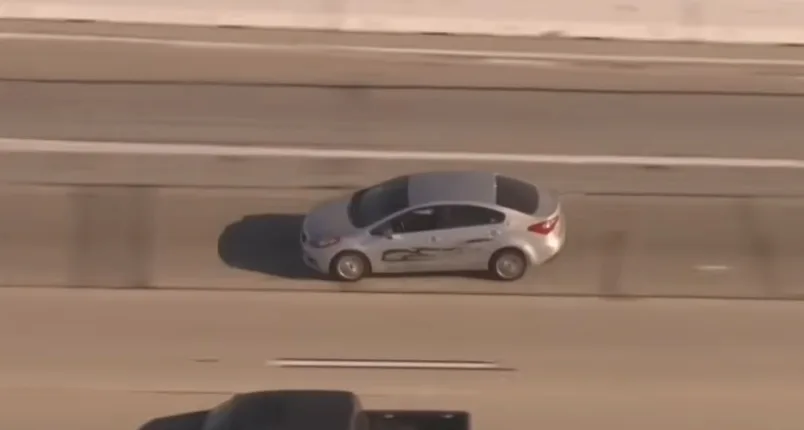
Four patrol units, two counties, two of Southern California’s busiest freeways, and a stolen Kia doing more than 100 mph through afternoon commuter traffic. That was Wednesday’s pursuit in a nutshell, and the part nobody saw coming is how it ended. Law enforcement did not stop this driver. A rear tire did.
The chase kicked off around 5:15 p.m. when Los Angeles County Sheriff’s deputies initiated the pursuit, and over roughly the next 30 minutes it stretched across Los Angeles and San Bernardino counties. Aerial footage showed the car hitting triple-digit speeds on the 605 and 10 freeways while weaving across every lane available, with at least four patrol units staying in pursuit. Anyone stuck in rush hour on those corridors Wednesday was suddenly sharing pavement with a driver who clearly had nowhere good to be.
When the Speeds Got Too Dangerous, the Strategy Changed
Here’s the part that matters. At certain points, deputies backed off the chase entirely because of the speeds the driver was reaching, and the California Highway Patrol stepped in to take over. That is standard practice in California, where agencies constantly weigh the value of staying on a suspect’s bumper against the odds of causing a crash that takes out innocent drivers.
At better than 100 mph in heavy freeway traffic, that math gets ugly fast. Pushing a fleeing driver even harder in those conditions risks turning a stolen car case into a multi-vehicle tragedy, so the pressure eased and the CHP managed the pursuit on state freeways. The driver probably read that as winning. He was wrong.
A Rear Tire Made the Arrest
Midway through the pursuit, the tire separated from the Kia’s rear passenger wheel. That forced the suspect to slow down considerably, and most people would have taken the hint at that point. He did not. He kept going on a compromised wheel for several more minutes, grinding along Los Angeles freeway pavement in a car that was telling him the chase was over.
That decision matters, because running on a failed wheel is a reliable way to turn a felony evading charge into something considerably worse. Give him this much: it was commitment, however misguided. But there was only one way it was going to end.
Just before 6 p.m., the driver finally steered onto the freeway shoulder. CHP officers came up from behind with weapons drawn, ordered him out of the car, and took him into custody without further incident. News helicopters caught the whole thing from above, which means his very public bad decision now has a very public ending attached to it.
Of Course It Was a Kia
The car involved appeared to be a Kia, reportedly stolen, and if you have followed automotive news at all over the past few years, that detail will not shock you. Starting around 2021 and 2022, a social media challenge spread widely online and exposed a security flaw in certain Kia and Hyundai models, particularly those built between 2011 and 2022. The vulnerability allowed the cars to be started without a key using nothing more than a USB cable.
The theft wave that followed was bad enough that multiple cities took both automakers to court, and the companies eventually pushed out software patches for the affected vehicles. The fixes helped, but they did not close the book. Stolen Kias still show up in police pursuit reports with regularity, and the Los Angeles area sees more than its share. Wednesday’s chase is one more entry in a file that should have been closed years ago.
How California Decides When to Chase
California law gives agencies wide discretion on pursuits, but most departments operate under policies that weigh vehicle speed, traffic density, and risk to the public before committing to a chase or staying in one. When a local agency pulls back over safety concerns, the CHP is often better positioned to manage or monitor the pursuit on state freeways. In some cases, officers skip close contact altogether and track the suspect from the air, waiting for a safer moment to move in.
Wednesday’s ending, where a failed tire made the decision for everyone, is the kind of outcome agencies genuinely count on when a driver pushes into triple digits. Cars do not run at those speeds forever, and fleeing drivers rarely have a plan for what happens when the machine quits.
That is the hard truth underneath the helicopter footage. This driver bet that speed and a freeway full of commuters would buy him an escape, and the bet failed the moment his own car gave out. Every innocent driver on the 605 and the 10 was put at risk for a stolen Kia that was always going to end up on a shoulder surrounded by officers. The chase lasted 30 minutes. The consequences will last a lot longer.
Source
Images Via Fox 11 Los Angeles