
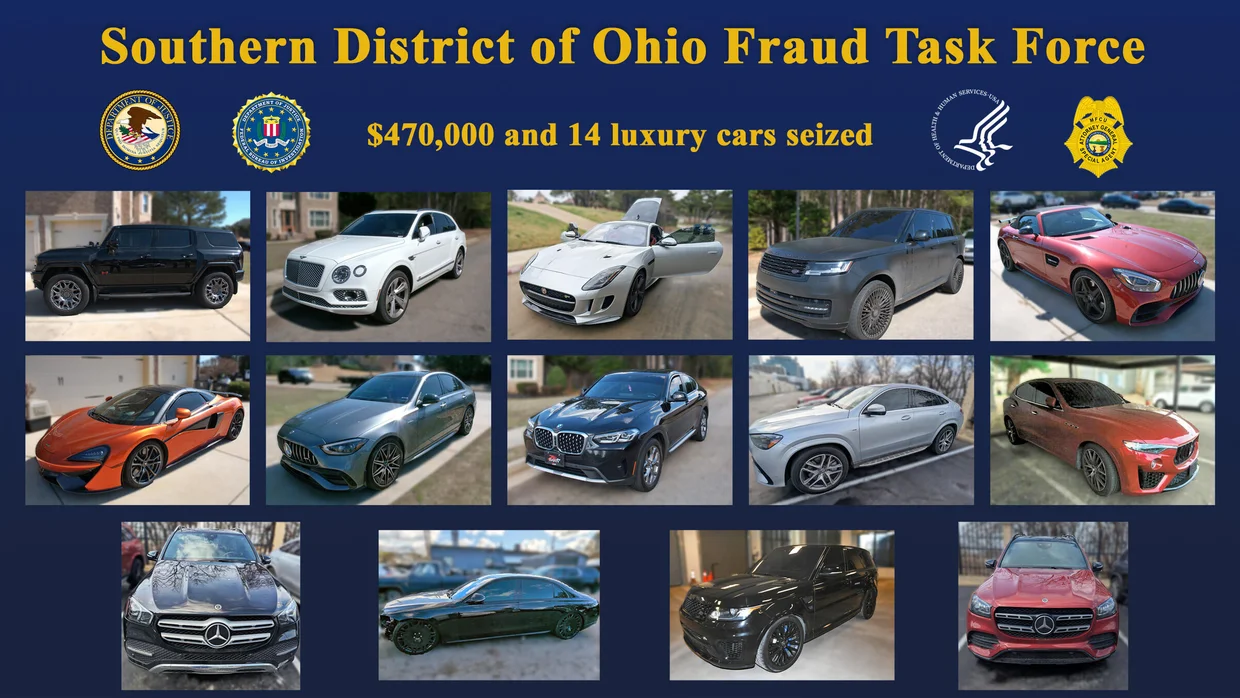
A Maserati, a Mercedes, a Bentley and a McLaren are now sitting in government custody, and the money that allegedly bought them was supposed to pay for behavioral health care for children. Federal officials announced Thursday that two Ohio state employees and two co-conspirators have been indicted in connection with an alleged $30 million Medicaid billing fraud scheme built on children’s behavioral health services that were never delivered. In total, investigators seized 14 vehicles tied to the case, according to a source familiar with the investigation.
That garage full of exotics is the detail that should make your blood boil. These were not cars earned by building anything. If the allegations hold up, they were bought with tax dollars meant for kids who needed real help and got nothing.
How the Scheme Allegedly Worked
According to the source, the defendants offered therapeutic behavioral services and psychotherapy to children and young adults attending summer camps, church groups and recreational programs. Participants had to fill out intake packets and hand over their Medicaid recipient numbers, which is exactly what is needed to bill the program for services.
This is where the story turns. The alleged ringleaders diagnosed every single recipient with a behavioral adjustment disorder, a blanket label that opened the door to billing on the backs of vulnerable kids. A medical assessment was required, but the source said the defendants never conducted a single test. No assessment testing was done, the behavioral services never happened, and the children never received any care. The paperwork existed. The treatment did not.
All four defendants turned themselves in to authorities this week, the source told CBS News. What they left behind, in part, was a fleet of luxury machinery that prosecutors now hold as alleged proceeds of the scheme.
A Press Conference With a Bigger Agenda
The announcement came at a press conference in Ohio from the Justice Department, state officials and members of President Trump’s Task Force to Eliminate Fraud, which is led by Vice President JD Vance. Acting Attorney General Todd Blanche said the Medicaid case was one of several unsealed over the past week targeting roughly $50 million in fraud, including a $1.4 million COVID-19 loan fraud scheme. Blanche, who is expected to be formally nominated by Trump as permanent attorney general as soon as Thursday, framed the department’s mission as a relentless pursuit of law and order against violence and fraud.
A spokesperson for Vance called the Medicaid allegations disgusting, saying fraudsters deprived American children of essential developmental services and that millions in stolen tax dollars that could have improved lives went toward luxury cars instead. On that point, it is hard to argue. Whatever your politics, a McLaren funded by fake therapy for kids is indefensible.
FBI Director Kash Patel used the event to unveil a new list of what he described as the most wanted fraudsters, now live on the FBI’s website, pointing to tens of millions and even billions of dollars in fraud tied to the individuals on it. The Justice Department also created a new National Fraud Enforcement Division that merged several offices, including its healthcare fraud section. Colin McDonald, the assistant attorney general who leads the division, announced a data-sharing agreement with the Ohio secretary of state giving the department access to corporate registration data. The goal is proactive analysis that can trace ownership links between the plants, labs and billing entities fraudsters hide behind.
The Fight Over Who Is Actually Stopping Fraud
The event was not all unity. Task force members accused some Democratic-led states of failing to crack down on fraud and cooperate with federal partners, and Republicans and Democrats have been trading blame over who created the conditions for fraud and who is doing more to fix it.
Federal Trade Commission Chairman Andrew Ferguson announced the federal government was formally decertifying Hawaii’s Medicaid Fraud Control Unit, saying it had received millions to fight fraud while consistently ranking among the lowest performing units in the country, and that the inspector general had ended its grants. Hawaii pushed back hard, saying it strongly disagrees with any suggestion it has not taken Medicaid fraud seriously, that it has mobilized additional personnel for a comprehensive review, and that it intends to seek reconsideration of the decision. Blanche separately accused Minnesota of failing to cooperate, saying Gov. Tim Walz claims to be working with the Justice Department while actually suing it.
The Ohio case also lands amid broader reporting on fraud against government programs. CBS News investigations found that more than 700 of the roughly 1,800 hospices operating in Los Angeles County trigger multiple state-defined red flags for fraud. In Minnesota, the network has covered the alleged $250 million COVID-era scheme to defraud a federal child nutrition program, including a jailhouse interview with alleged mastermind Aimee Bock, who defended her conduct, admitted regrets and argued state officials should share blame. The Justice Department has also secured indictments in romance fraud schemes targeting older Americans online.
Here’s the hard truth. Car enthusiasts dream about Bentleys and McLarens, and there is something uniquely insulting about seeing them allegedly purchased with money stripped from a program meant to care for children. Those 14 seized vehicles are evidence now, but they are also a measure of exactly what was taken and from whom. The political fight over fraud enforcement will rage on. The kids who never got the care billed in their names already lost.
Source
Images Via: U.S. Department of Justice