
For roughly two decades, the American new-car market has been quietly transforming into a luxury showroom while pretending nothing changed. The average new vehicle now costs around fifty thousand dollars, genuinely affordable base trims keep disappearing, and “affordable” became a word automakers used right before revealing a $48,000 crossover with a subscription fee for heated seats.
Slate Wants to Be Your Blank Canvas
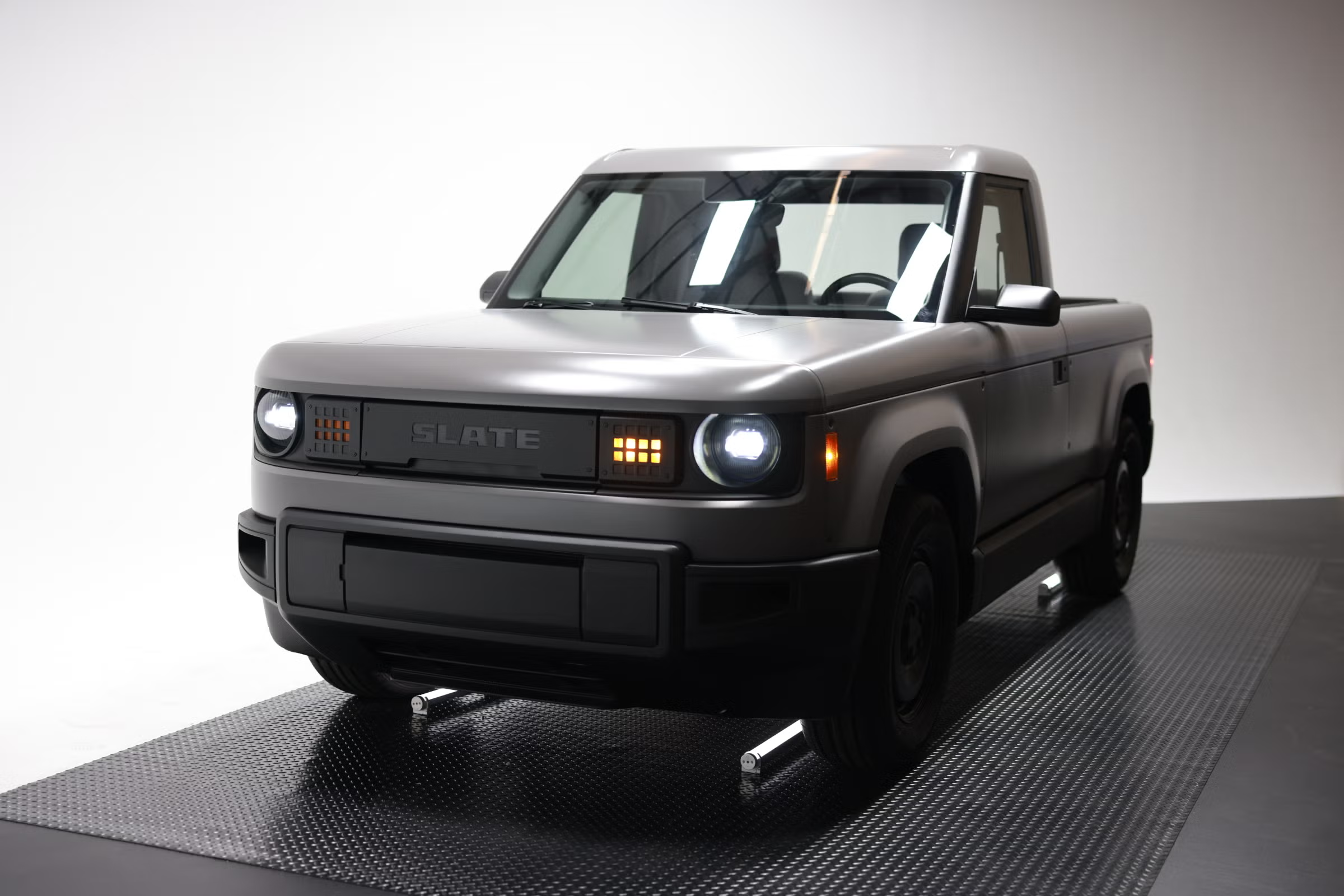
Slate Auto, the Jeff Bezos-backed EV startup that had been teasing a deliberately bare-bones electric truck, finally attached a number to it: $24,950 to start, with preorders opening the same day the price was announced. The truck immediately picked up the “America’s most affordable new car” label, the kind of headline that tends to unsettle every legacy automaker’s product planning team.
The base truck, which Slate calls the “Blank Slate,” is stripped down by design. It features hand-crank windows, no infotainment touchscreen, and a single gray composite body with zero factory paint options, since Slate skips the paint shop entirely in favor of selling vinyl wraps instead. There are reportedly over a hundred wrap colors available at launch, with most full-vehicle wraps priced under $500, alongside roughly 200 accessories, about 80 percent of which also come in under $500. It’s a two-seat pickup that owners can reportedly convert into a five-seat SUV themselves, with a payload capacity up to 2,000 pounds, and Slate is skipping traditional dealership networks in favor of selling directly to customers, similar to Tesla’s approach.
Now for the asterisk, because there’s always one. That $24,950 figure excludes destination charges, taxes, title, registration, and the usual assortment of additional fees, meaning the actual out-the-door price will run higher. More notably, Slate originally pitched this truck as costing “under $20,000,” a promise that quietly assumed buyers would receive the $7,500 federal EV tax credit. That credit no longer exists following policy changes under the Trump administration, which is also part of why several automakers have reportedly shelved their own affordable EV plans. So the sub-$20,000 vision is off the table, and $24,950 is the new starting reality. First deliveries are still targeted for the end of 2026.
Reaction online has been predictably split. Discussion threads on forums like r/electricvehicles have filled with the usual divide between people excited about “finally, a truck that isn’t a $90,000 land yacht” and skeptics waiting to see the final out-the-door price once destination fees land. A recurring point of debate: owners of the Ford Maverick Hybrid note that their truck already handles this job while getting 45-50 mpg, while supporters of the bare-bones approach argue that landscapers, pool service companies, and recent graduates represent a real and underserved market. Both perspectives have a reasonable case, which is part of what makes the debate interesting.
Ford’s $30K Truck Is Catching Up by Recruiting Formula 1 Engineers
Here’s where this stops being a single-startup story and becomes an actual competitive fight. Ford is entering the same space with a roughly $30,000 four-door midsize electric pickup built on its new Universal EV (UEV) platform, headed for the Louisville Assembly Plant in 2027.
Ford’s framing has been notably combative. CEO Jim Farley has been openly critical of competitors’ engineering while explaining how Ford intends to beat low-cost Chinese automakers at their own game. According to Farley, Ford recruited for this effort the way a racing team would: more than half of the aerodynamics team working on the UEV platform in California reportedly comes from the Formula 1 world. Farley described that group as “one of the biggest gifts that Formula 1 ever gave Ford,” and claimed that F1-background engineers view the project’s engineering as more sophisticated than what goes into a hypercar.
The engineering claims are substantial, assuming they hold up in practice. Ford says the platform delivers aerodynamic and efficiency gains of 20-30% over conventional approaches, and claims the same battery pack in its most aerodynamically efficient midsize gas truck would translate into nearly 50 additional miles of range, or about a 15% highway range improvement. The truck uses prismatic LFP battery cells, which are cheaper and more space-efficient than alternatives, though there’s a notable irony here: Ford is building these batteries in the US using technology licensed from China’s CATL, meaning the truck positioned to out-engineer Chinese competitors runs on Chinese battery technology under license. Ford is also leaning on gigacasting, which it calls “unicastings,” to reduce the part count for the equivalent of a current Maverick from 146 pieces down to just two, and claims the new truck will offer more passenger interior space than a Toyota RAV4 before even factoring in the frunk or bed storage.
So Who Actually Wins?
The honest answer is that these two trucks aren’t really competing head-to-head yet, which is the most interesting wrinkle in this story. Slate undercuts nearly everything else on price, including the Chevrolet Bolt (around $29,000) and Nissan Leaf (around $32,000), and it’s arriving first, with deliveries targeted for the end of 2026. Ford’s truck is a more conventional, more capable four-door vehicle that costs about five thousand dollars more and doesn’t arrive until 2027. One is essentially a philosophy statement about radical simplicity. The other is a legacy automaker trying to prove it can still build an affordable vehicle without losing money on every unit sold.
What the two trucks share is the thing that actually matters here: both turned a price announcement into a genuine news event. When a sub-$30,000 starting price feels shocking to the public, that says far more about the current state of the new-car market than it does about either individual truck. For years, the industry insisted American buyers simply wouldn’t purchase small, cheap, no-frills vehicles. We’re about to find out whether that assumption was ever actually true, or whether nobody had bothered to build one recently.
Either way, the affordable EV pickup competition currently has zero actual sales and two very different combatants preparing to enter the ring. The opening moves have been made. Now it’s a matter of seeing whether buyers actually show up for hand-crank windows in 2026.