
California flipped the switch today on a new $3,500 discount for first-time electric vehicle buyers, and the state’s press release wants you looking at the money. Look instead at the guest list. Three automakers are handing out the rebate at the dealership right now: Tesla, Hyundai, and Lucid. A fourth name is conspicuously missing from that trio, and it happens to be the one automaker whose entire California business this law was quietly built to rescue.
The program is called MyFirstEV, and the mechanics are simple enough. Buy or lease a first zero-emission vehicle in California and a participating dealer knocks $3,500 off a new one, or $1,750 off a used one, right at signing, no rebate application and no waiting for a check. California is putting up $135.5 million, automakers are matching it dollar for dollar, and the state is calling the combined $271 million a replacement for the federal EV tax credit that Washington killed off last year. Ford, Rivian, Chevrolet, and Kia are supposed to join this month. Toyota, Honda, and Subaru follow in September. Mitsubishi in November. Nissan and Volvo haven’t committed to a date at all.
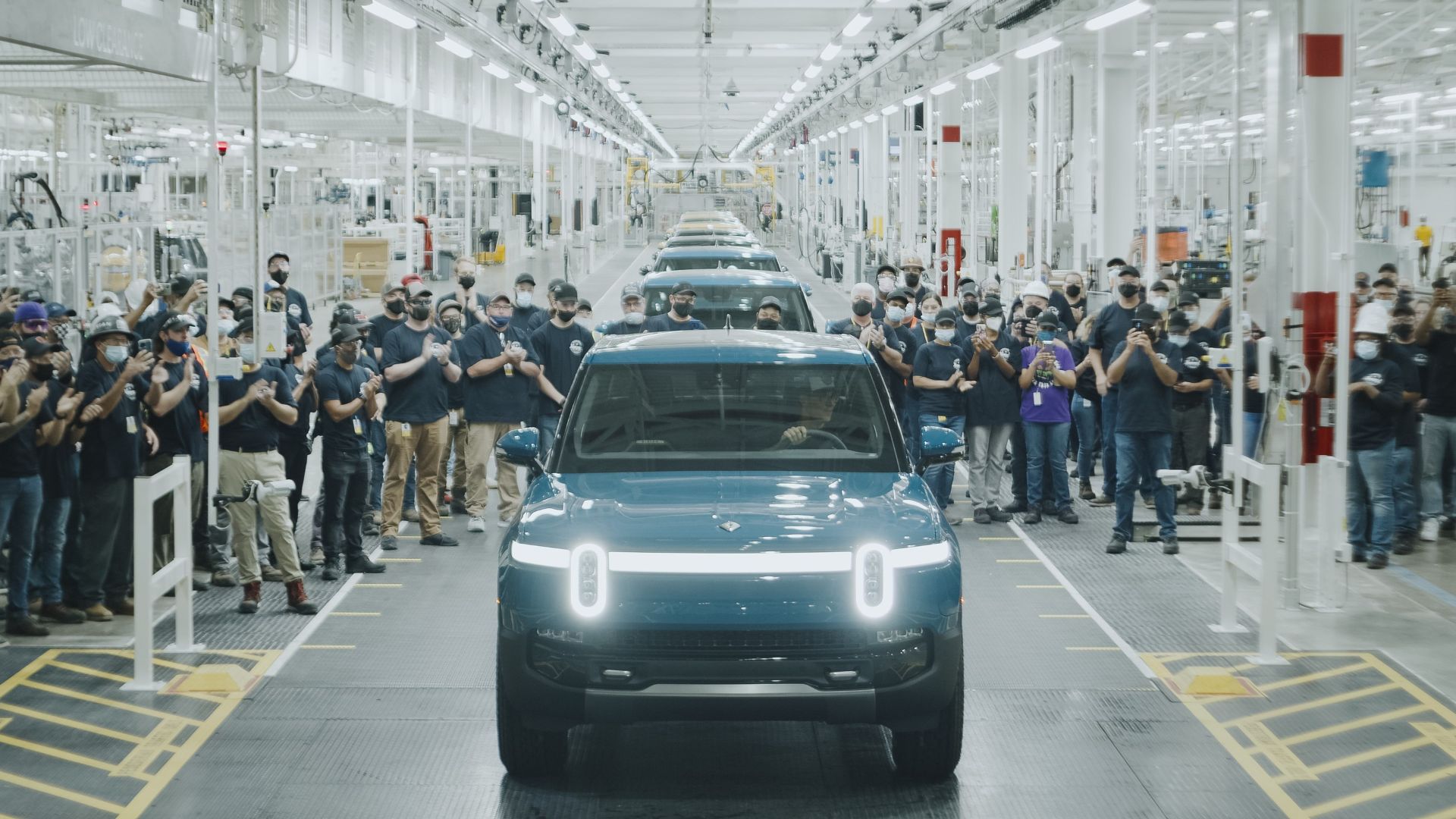
Rivian’s absence from day one is the detail worth sitting with, because this paper broke down in July how unusually generous Rivian’s deal is supposed to be. When Governor Newsom signed the underlying law, Senate Bill 168, it capped most new EVs at a $50,000 sticker to qualify, then carved out an exception for any zero-emission-only automaker headquartered in California as of January 1, 2026. Exactly two companies fit that description: Rivian, in Irvine, and Lucid, in Newark, California. That exemption lets Rivian put the same $3,500 toward a $95,000 R1S that a shopper elsewhere gets for a $35,000 economy car. Tesla, despite still building more cars and employing more Californians than Rivian and Lucid combined, doesn’t qualify for that carve-out, because its corporate address now reads Austin. Tesla is only in this program today because its Model 3 and Model Y already sell under the $50,000 line without any help from the legislature.

Here’s the detail that rarely survives a press-release rewrite. The law doesn’t ask where an automaker is headquartered today. It asks where it was headquartered on one specific date that had already passed by the time the bill was signed. Even if Tesla relocated its headquarters back to Palo Alto tomorrow, it would still fail this test, because the statute freezes the clock permanently. Lawmakers also attached an unusually specific severability clause to that one exemption, the kind of legal insurance policy you write when you already suspect a court might strike down the very provision you just wrote. None of that is normal legislative housekeeping. It’s a program built to survive its own legal weak point.
And yet, on the day this favorable treatment actually became usable at a cash register, Rivian is nowhere to be found. That’s not a small irony. Rivian’s California registrations fell 28.3% in the first half of 2026, even with this rebate already signed into law and waiting to take effect, a steeper drop than every other brand in the state except Dodge, as this paper reported last month. A custom-built discount didn’t stop the bleeding before launch day, and now the company isn’t even first through the door once the discount is finally live at the dealership. Lucid, which got the identical price exemption, grew California registrations by nearly 23% over the same stretch, and it’s handing out the rebate starting today.
There’s a second, quieter design choice buried in MyFirstEV that deserves more attention than it’s getting. The rebate applies only to a buyer’s first zero-emission vehicle, not their fifth. California’s prior EV incentive, the Clean Vehicle Rebate Project, wound down in 2023 after years of income caps meant to steer money toward buyers who needed convincing to switch. MyFirstEV drops any income test entirely and uses ownership history as the filter instead. That’s a bet that the state’s remaining EV holdouts, not its existing EV households, are the audience worth spending $271 million to move, and it’s a tacit admission that California’s easiest EV converts already converted years ago.
The point-of-sale mechanism itself has a strange history worth knowing. The federal government only started letting buyers take the $7,500 EV credit as an instant discount at the dealership, instead of waiting to claim it on a tax return, beginning in January 2024. That change made the credit far more useful to buyers who needed the savings immediately rather than the following April. Congress killed the underlying credit anyway before that mechanism had much time to prove itself nationally. California just resurrected the exact delivery method for a program a third the size, which means the smartest part of a dead federal policy outlived the policy itself, just wearing a state flag instead of a federal one.
It’s also worth remembering that California already broke a version of this promise once. Newsom pledged a state-level $7,500 EV tax credit to replace the expiring federal one back in 2025, and that pledge quietly died without ever becoming a program. MyFirstEV is the actual follow-through, eleven months later, at less than half the amount originally promised, restricted to first-time buyers instead of everyone, and capped well below what plenty of EVs on the market actually cost. Real money finally showed up. It showed up smaller, narrower, and slower than advertised the first time.
None of this makes MyFirstEV meaningless. A guaranteed $3,500 off at signing is real money for a first-time buyer trying to make an EV’s math work, and unlike a tax credit, it can’t get held hostage by a slow refund or a bad accountant. But the program’s opening days are proving something its press release never will. Writing a law around a company’s mailing address doesn’t guarantee that company shows up to collect. California spent a year custom-fitting an incentive around Rivian’s and Lucid’s corporate registry entries. Only one of them is actually standing at the register today.