
Lotus wants the headline this week to be about a supercar. A new hybrid V8 coming in 2028, code-named Type 135, packing more than 1,000 horsepower, built to remind everyone that a company now majority-owned by a Chinese industrial conglomerate still remembers what Colin Chapman’s name is supposed to mean. It’s a good story, and it’s working. But the more interesting number in Lotus’s newly announced Focus 2030 strategy isn’t attached to the supercar at all. It’s the one revealing that the factory built to be the foundation of Lotus’s entire modern existence is running at roughly a fifth of its designed capacity.
Start with what Lotus actually announced. In a release filed with the U.S. Securities and Exchange Commission, Lotus Technology Inc. (Nasdaq: LOT) laid out four pillars for the next several years: reinforcing the brand’s identity, chasing a roughly 60/40 split between plug-in hybrids and full electrics, leaning harder on its relationship with majority shareholder Geely Holding, and restoring financial discipline. The splashiest piece is the Type 135, an all-new hybrid V8 supercar due in 2028. There’s also X-Hybrid, a new hybrid powertrain arriving on the Eletre SUV in Europe by the end of 2026, plus confirmation that the gas-powered Emira will get a lighter, more powerful update. All fine details. None of them are the real story.
The real story is the math. When Lotus went public on the Nasdaq in 2024 through a SPAC merger, it disclosed to investors that its electric models would be built at a Geely-owned factory in Wuhan, China, with a planned production capacity of 150,000 units annually. Focus 2030 now points toward a gradual ramp to just 30,000 units sold worldwide per year as the company’s target for sustained profitability. Read that again: a factory sized for 150,000 cars annually, aiming for 30,000. That’s not a rounding error. That’s a company that built a stadium and is now hoping to fill the parking lot.
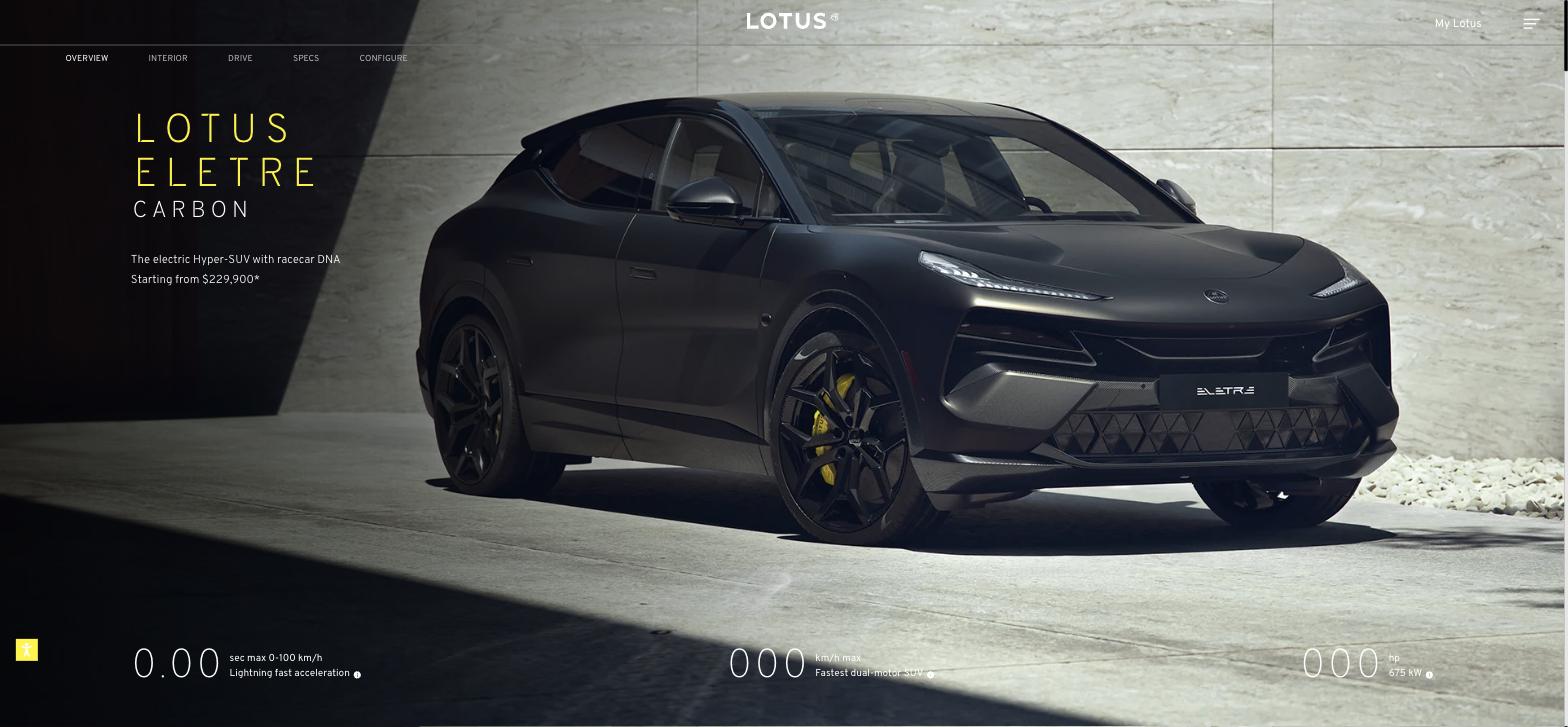
Here’s the detail most casual readers miss entirely. The cars that were supposed to fill that stadium, the Eletre SUV and Emeya sedan, are Lotus in badge only. Despite the British engineering pedigree Lotus leans on in every ad, both are manufactured in Wuhan, not in Hethel, Norfolk, where Lotus has built sports cars since 1966. That distinction used to be trivia. In 2026, it’s the whole ballgame. Any vehicle built in China and imported into the United States runs into Section 301 tariffs on Chinese-made EVs, set at 100 percent by the Biden administration in 2024 and left in place by the Trump administration since. According to MotorTrend’s reporting on Lotus Americas’ own account, additional duties layered on top of that have pushed the effective rate on some configurations north of 150 percent.
That’s the second surprise worth sitting with. For a brief window, Lotus could still bring a fully loaded Eletre Carbon into the U.S. under the earlier 100 percent rate, starting at $229,900, according to Lotus’s own American pricing page. Once the rate climbed further, even that narrow, ultra-wealthy lane closed. What’s left for American Lotus dealers going forward is, effectively, the gas-only Emira, a car built in Britain rather than China, and therefore unaffected by any of this.
That’s why Focus 2030 reads less like a brand renaissance and more like a retreat dressed up in racing green. The hybrid V8 supercar isn’t so much a return to form as a hedge. Lotus’s own release specifies that Type 135 is slated to be built in Europe, not Wuhan. That’s not nostalgia talking. That’s a company that just learned, the expensive way, that where a car is built now matters as much as what’s under the hood.
None of this is unique to Lotus. Geely’s other Western-facing brands are wrestling with the same tariff walls, and the irony runs in both directions. Volkswagen, which lobbied against European Union tariffs on Chinese-built cars back in 2024, is now pushing Brussels to move faster after watching its own bestseller get outsold at home by a Chinese-owned brand called Jaecoo. Congress, meanwhile, is drafting legislation that would go further than tariffs and ban Chinese-made vehicles from American roads outright, robotaxis included. Trade policy isn’t even the only pressure campaign aimed at Chinese-built vehicles: regulators in Norway spent months trying to prove a Chinese-built city bus could be remotely disabled, and what they found out applies to far more than buses. Tariffs are the visible fight over these vehicles. Data and control are the quieter one running underneath it.
There’s also a strange counter-trend worth noting. While Lotus retreats to a hybrid V8 partly for tariff cover, Chinese manufacturers like Great Wall Motors are moving in the opposite direction domestically, building big-displacement V8 supercars of their own to chase Ferrari at home, where nobody is taxing them for it. Lotus’s V8 comeback and China’s V8 ambitions are, in a strange way, mirror images of the same instinct: performance still sells, and everybody wants a piece of it, tariffs be damned.
Forget the horsepower figure on the Type 135. Forget 2028, which is a lifetime away in car-industry years. The number that actually explains where Lotus stands right now is 30,000 versus 150,000. Building a factory that can turn out 150,000 cars a year proves a company believes in the future. Running it at a fifth of that proves the future had other plans. Everything else in Focus 2030, the supercar, the hybrid tech, the brand talk, is Lotus making peace with that gap in public, one press release at a time.