
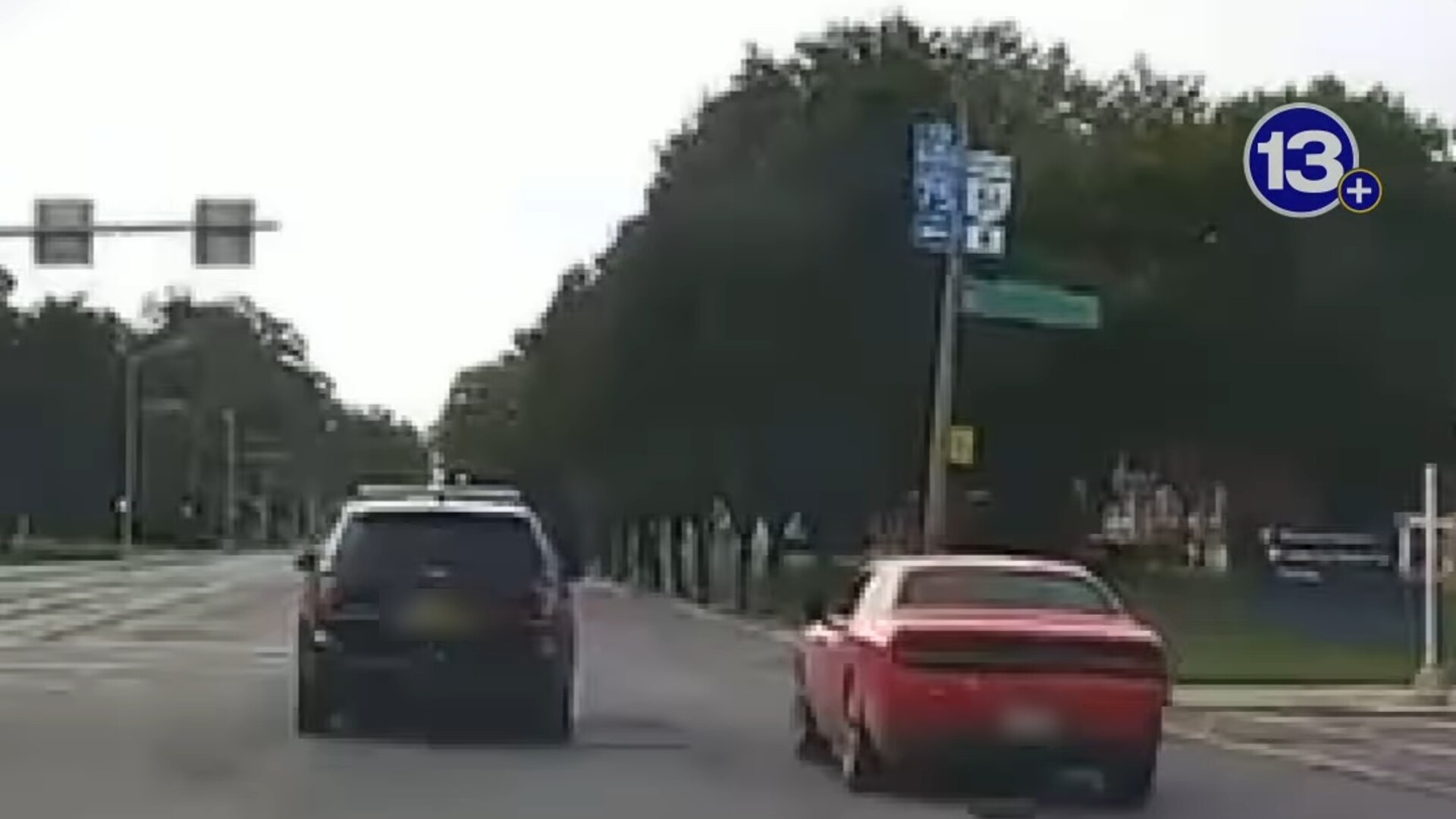
A Toledo, Ohio, repair shop had a marked Lucas County Sheriff’s Office vehicle in for maintenance on Sept. 8 when one of its employees, 22-year-old Matthew Means, took it out for a test drive. According to the sheriff’s office, the test drive turned into a drag race against another car on Monroe Street at Collingwood Boulevard, by the Toledo Museum of Art.
A woman driving behind them had a dashcam running, and she filed a complaint. The sheriff’s office released her video, and Toledo station 13abc/WTVG posted it. It shows a dark sheriff’s SUV and a red coupe stopped side by side at a red light, then both pulling hard up Monroe. WTOL reported that the two sat at the light for about 30 seconds before taking off northbound. Detectives traced the SUV to the shop, where it had been dropped off hours earlier, 13abc reported.
Video: Witness dashcam footage released by the Lucas County Sheriff’s Office, via 13abc/WTVG on Instagram.
The sheriff’s office turned the case into a Facebook routine. Its “Pro Tip Tuesday” post, which appears in the 13abc video, compared Means to Ricky Bobby, Will Ferrell’s character in Talladega Nights, joked that the witness had filmed the evidence, and closed by promising a victory lap “around the courtroom after Exhibit A hits the big screen.”
Exhibit A never got its screening. On Oct. 21, according to the Toledo Municipal Court docket in case CRB-26-08214, the prosecutor recommended amending the charge from unauthorized use of a vehicle, a first-degree misdemeanor, to disorderly conduct, a minor misdemeanor. The officer on the case was in court and consented. Means, represented by attorney Thomas Stebbins, withdrew his not-guilty plea, pleaded no contest and was found guilty by Judge Khoury. The sentence was a $100 fine plus court costs. The clerk’s online record shows $229 due by Dec. 1.
The Joyriding Charge Filed in Toledo and the Street Racing Law It Didn’t Use
The complaint filed Sept. 15 charged Means under Ohio Revised Code 2913.03(A), which bars knowingly using or operating a motor vehicle without the owner’s consent. It is Ohio’s joyriding law, and it sits in Chapter 2913, the state’s theft and fraud chapter. As a first-degree misdemeanor it carried up to 180 days in jail under ORC 2929.24 and a fine of up to $1,000 under ORC 2929.28. Charging documents cited his alleged admission, the video and witness statements, 13abc reported. He was issued a summons rather than booked.
Consent is the hard part of that charge when the defendant works at the shop. The sheriff’s office handed over the keys, and driving a car to confirm a repair is part of what a fleet pays a shop to do. The case, as charged, treated a race on a city street as use beyond anything the owner agreed to. The statute gives defendants an affirmative defense if they reasonably believed the owner would have authorized the use. That is a tough argument to make about a stoplight launch in someone else’s police vehicle.
The case was never charged under the statute Ohio wrote for side-by-side launches. ORC 4511.251, in its current form since House Bill 56 took effect Oct. 24, 2024, defines street racing to include “operation of two or more vehicles from a point side by side at accelerating speeds.” Taking part is a first-degree misdemeanor, and the court must suspend the driver’s license for 30 days to three years. A judge cannot suspend the first 30 days of that. Anyone who assists faces the same charge as the drivers. Ohio’s definition doesn’t require a finish line or a top speed, much as Florida’s racing statute can reach a pass at a light. The Toledo docket shows one count, and it was never this one.
Amending the joyriding count to disorderly conduct under ORC 2917.11 cut the maximum fine from $1,000 to $150 and removed any jail exposure, since Ohio law sets no jail term for a minor misdemeanor. It also moved the conviction out of the theft chapter, which matters to anyone whose job involves holding customers’ keys. And it left his license alone. A street racing conviction would have taken it for at least 30 days. The docket entry says the amendment was made “for good cause shown” and gives no further explanation.
Detectives Identified the Sheriff’s SUV Driver but Not the Red Car’s
Lucas County Sheriff’s Capt. Robert Chromik told 13abc that Means decided to run “qualifying laps on Monroe Street,” and said nobody was hurt. Chromik credited Means with being honest with investigators from the start and praised the shop, which he said took internal action. A shop manager declined to comment on camera to the station. In September, 13abc reported that investigators knew who owned the red car but not who had been driving it. 13abc did not name the shop.
Police Fleets Have Pulled Work From Shops Over Test Drives Before
In 2014, the Star Tribune reported that two employees of Suburban Auto Body in Little Canada, Minnesota, drove two marked Roseville police Dodge Chargers along County Road C in what a resident reported as a race. The shop said the cars only accelerated quickly from a stop sign and that no citations were issued. Roseville police ended their business relationship with the shop anyway, and the shop fired one employee.
In 2023, Houston station KPRC reported that a 24-year-old porter at Parkway Chevrolet in Tomball, Texas, took a marked Harris County Precinct 4 Chevy Tahoe that had been left for service to an unsanctioned car meet, where a Metro Police officer pulled it over. He was charged with unauthorized use of a vehicle and received two years of deferred adjudication and 40 hours of community service, according to the station.
None of them got caught by the shop. Somebody outside noticed a marked cruiser doing something cruisers don’t do, and in Toledo that somebody had a dashcam rolling. A civilian’s commuter car on a test drive gets no such attention, which leaves the odometer as the main record.
What the Toledo Case Means at the Service Counter
Shops test-drive cars to confirm a repair worked, and the permission for it often appears on the repair order signed at drop-off. Writing the odometer reading on that order, and asking how far a test drive normally goes, gives an owner a record if the car comes back with more miles than the job explains. In Ohio, driving a customer’s car well beyond what the customer agreed to can bring the same 2913.03 charge Lucas County filed here, and as this case shows, the charge filed is not always the one that sticks.
For Means, what remains on the docket is the Dec. 1 deadline to pay the $229 balance.
Should a side-by-side launch in a borrowed sheriff’s vehicle have been charged under Ohio’s street racing law, with its mandatory license suspension, or was a $100 disorderly conduct fine enough when nobody was hurt?