
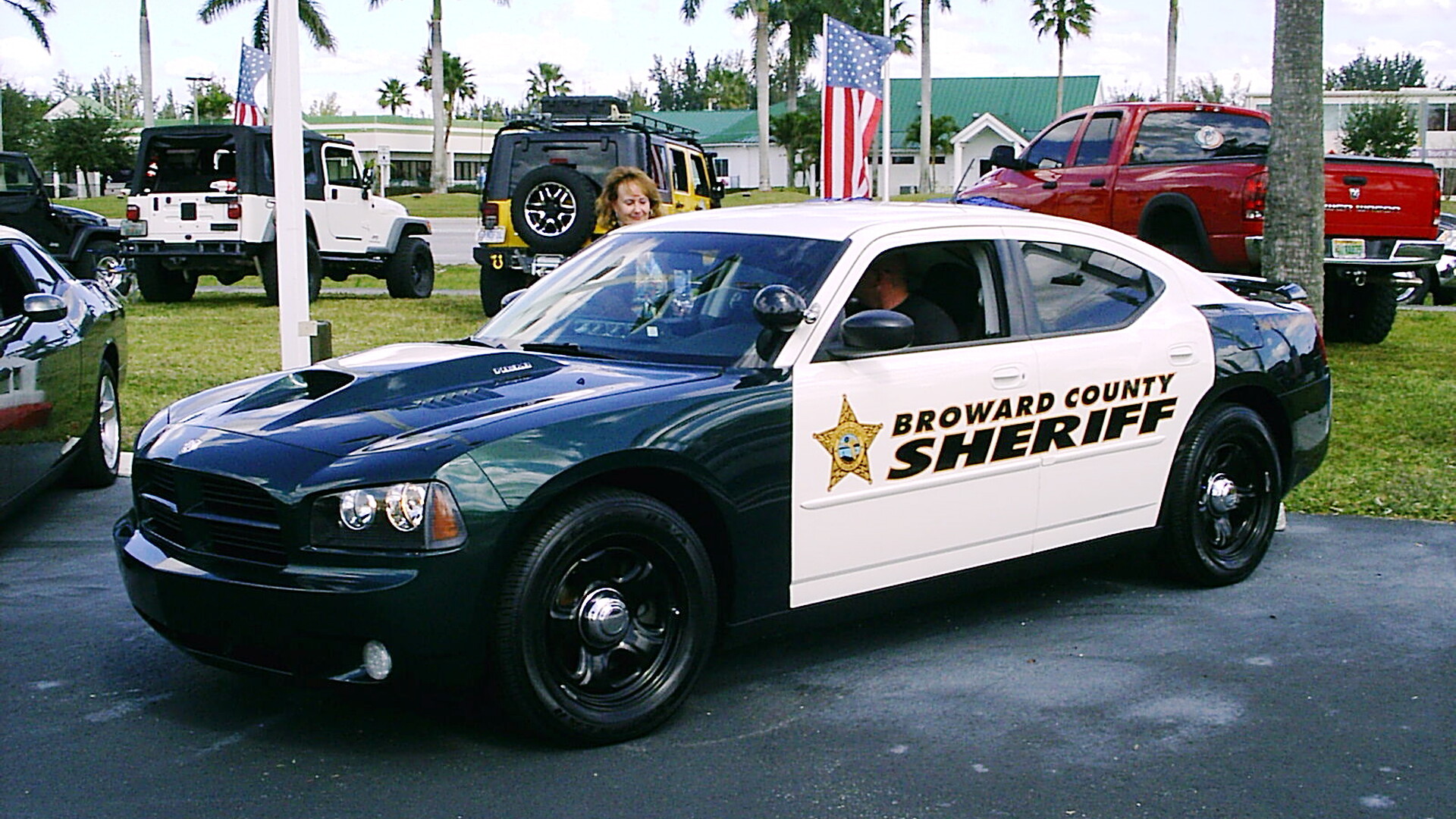
In this stolen police car case, the clip everyone is sharing is the wrong clip. Sorry, internet.
A Fort Lauderdale woman accused of taking a marked Broward Sheriff’s Office Dodge Charger made an odd, rambling appearance in a St. Lucie County bond court, and the video took off online. But the moment that should bother anyone who thinks about cars for a living happened hours earlier, in a parking lot at 2601 W. Broward Boulevard, the address of the county’s Public Safety Building.
A fully marked patrol car, parked at the sheriff’s own headquarters complex, apparently drove away with someone who had no business behind the wheel. That’s what deserves attention, and the likely answer has more to do with how police cars are built to be used than with one bad night.
What authorities say happened
According to authorities, the Charger was taken on the night of Tuesday, Sept. 22, from the public parking area of the Public Safety Building. By about 9:30 p.m., a be-on-the-lookout alert had gone out for a stolen BSO Charger heading north on Interstate 95. St. Lucie County Sheriff’s Office deputies, Port St. Lucie police and Florida Highway Patrol troopers converged near Gatlin Boulevard, more than 90 miles up the interstate, and found the car abandoned on the northbound exit ramp at mile marker 118.
Deputies say they found Shannon Marie Dillon, 42, in a wooded area nearby, wearing an outer ballistic vest bearing BSO insignia. She was taken into custody at gunpoint, booked into the St. Lucie County jail, and faces a list of charges that includes grand theft of law enforcement equipment, unlawful use of a police badge or law enforcement vehicle, possession of a weapon or ammunition by a convicted felon, driving with a suspended license and resisting an officer without violence. Broward County has filed its own grand theft counts. The charges are accusations, and she is entitled to the presumption of innocence.
Authorities haven’t publicly explained how the car was taken. Whether it was running, unlocked, or had a key fob sitting inside has not been disclosed in the accounts released so far. That missing detail is the actual automotive story, and it’s a lot less meme-able than a bond hearing.
Police cars are designed to be left running
Civilian cars are engineered around a simple assumption: when the driver walks away, the car shuts down and locks. Patrol cars are engineered around the opposite assumption.
A marked unit is a rolling electrical load. Radios, the in-car computer, cameras, lighting and the climate control that keeps all that electronics (and sometimes a K-9) from cooking in a Florida parking lot all want power, and the alternator is the only thing that reliably provides it for a full shift. So engines idle for much of a shift, which is great for the radio and less great for anyone counting on the car staying put.
Dodge built for that reality. The 2023 Dodge Charger Police supplement describes a Secure Park anti-theft system intended to let officers leave the car unattended with the engine running while preventing it from being driven off. The officer enables it with a button on the back side of the steering wheel; once the transmission is in Park, the system arms. Press the brake after that and the dash reports that Secure Park is active.
Two details in that manual matter here. First, it has to be switched on. Second, when someone presses the Secure Park button, the car searches for a valid key fob, and if it finds one, the system deactivates. The feature is only as strong as the distance between the fob and the car.
That is not a design flaw so much as a design tradeoff. Police vehicles have to start instantly, stay running indefinitely, and move the second an officer drops into the seat. Every layer of security added to that process costs seconds in the exact moments when seconds matter. Manufacturers give agencies tools. Agencies decide how, and whether, they are used every shift.
To be clear, there is no public information yet showing that this particular Charger was idling, that Secure Park was off, or that a fob was aboard. BSO has not said, though it has opened an Internal Affairs investigation, and Broward PBA President Rod Skirvin told CBS Miami this car was not equipped with the hidden safety switch some police vehicles carry to prevent exactly this. But those are exactly the questions an agency review will have to answer, and they apply to every sheriff’s office and police department running a keyless patrol fleet.
Civilian Charger owners got a PIN code. Police got a procedure.
Dodge’s own history offers a contrast. When high-powered Chargers and Challengers became favorite theft targets, Dodge did not tell civilian owners to be more careful. It shipped hardware and software.
According to Dodge’s own theft-protection announcement, 2021 Chargers and Challengers with the 392 or supercharged Hellcat Hemi could get an Enhanced Security Mode that requires a four-digit code and, without it, holds the engine at idle with output limited to 2.8 horsepower, even if the thief has a key. Dodge also added a lockdown that stops thieves from programming new fobs through the car, plus an intrusion module for 2022 models that watches for broken glass, cabin movement and tilting.
So a civilian Hellcat can be configured so that possessing the key is not enough. A patrol car, by necessity, is built so that possessing the key is exactly enough.
The industry has been learning this lesson the expensive way for years. Anti-theft engineering that assumes everyone behaves perfectly tends to fail in public, as we saw when Kia and Hyundai’s immobilizer decisions ended up in federal court, and sometimes the only “security” that works is the mundane kind, like a stolen Mercedes that was ultimately undone by its fuel gauge.
A marked car is a badge with a V8 in it
The reason a stolen police car is treated differently from a stolen sedan has little to do with sticker price. It is the authority the car projects.
Florida lawmakers recognized that long ago. Under Section 843.085 of the Florida Statutes, owning or operating a vehicle marked with words such as “police,” “sheriff” or “deputy” without authorization and with intent to mislead is a crime, a first-degree misdemeanor, in the same statute that covers wearing badges and uniforms to mislead people. The law treats the paint job on a patrol car as a credential, not decoration.
That is why the ballistic vest detail in this case lands harder than the court video. A marked Charger with lights, plus a vest with sheriff’s insignia, is most of what a driver on a dark interstate would use to decide whether to pull over. That the car ended up abandoned on an exit ramp, with no public reports of anyone being pulled over by it, is the good news here.
Speed is part of the risk too. These are purpose-built cars; our look at Michigan State Police testing of every pursuit vehicle sold in America shows how much performance agencies are buying. Handing that to an unauthorized driver on I-95 at night is not a trivial property crime.
The Charger itself is a disappearing asset
There is a fleet-management angle that rarely makes the local news. Dodge launched the Charger police car with production beginning in fall 2005 at its Brampton, Ontario, plant, and it became one of the defining patrol-car silhouettes of the past two decades. Dodge then announced that the Charger and Challenger “in current form” were coming to an end, billing its 2023 lineup as the “Last Call.”
That means agencies still running Charger fleets are running cars that cannot simply be reordered like-for-like. Every unit that is wrecked, damaged, or tied up as evidence has to be replaced with something else, and that something else means new upfitting, new equipment mounts, and new training. A recovered patrol car is not automatically a returned patrol car.
Readiness versus security
Beyond the courtroom video, this is a story about a basic tension in vehicle security. The more a car is built for instant readiness, the more its security depends on human habit rather than hardware. Dodge could turn a stolen Hellcat into a 2.8-horsepower lawn ornament with a PIN. It cannot build a patrol car that refuses to move for whoever is holding the right fob.
How did this Charger leave the lot? BSO has the answer, and the rest of the country’s patrol fleets should want to hear it.
Should patrol cars be required to lock themselves down every time an officer steps away, even if that costs a few seconds in an emergency? Or is the occasional stolen Charger an acceptable price for speed? Let us know in the comments.