
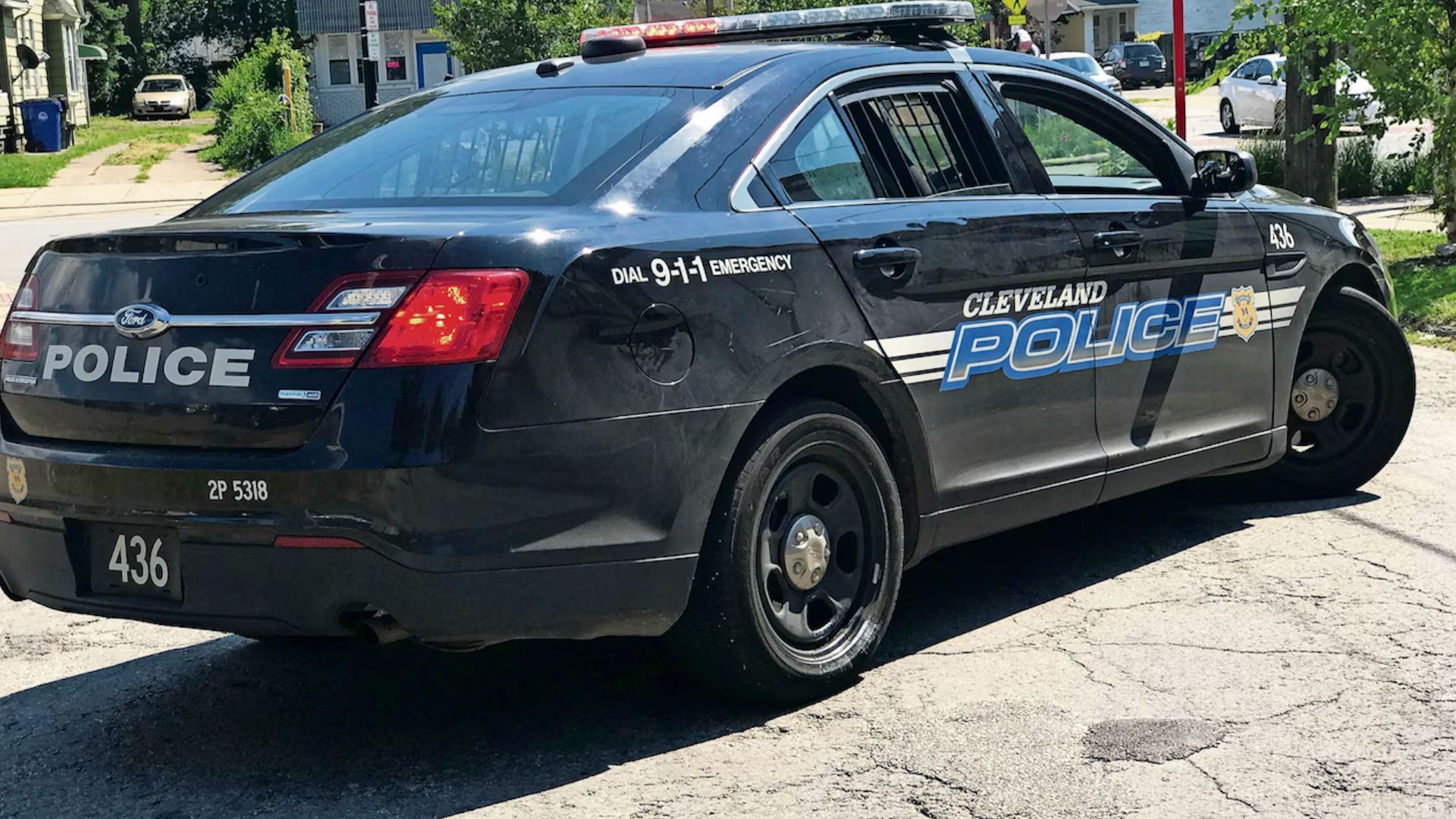
The helicopter is the story.
Dashcam footage circulating this week appears to show a Corvette running from Michigan State Police at well over 100 mph through Detroit, with a state police helicopter overhead and two people bailing out on foot near Livernois and Joy. The Auto Wire has not been able to confirm those details through the Michigan State Police, and we are treating the specifics as unverified until an official account exists.
The larger point does not depend on them. Watch enough pursuit video and a pattern shows up that nobody narrates: somewhere above the chase there is an aircraft, and from the moment it settles into an orbit, the patrol cars on the ground stop mattering very much.
That is not luck. It is policy, and underneath the policy is arithmetic that the Michigan State Police publish themselves every autumn, in a document almost nobody outside a fleet purchasing office ever opens.
The most honest performance test in American motoring
Each fall the MSP Precision Driving Unit gathers every police-model vehicle the manufacturers will sell in this country and measures them without sentiment. Acceleration to 60, 80 and 100 mph and top speed at the Chelsea Proving Grounds. Braking on the straightaway. Handling at Grattan Raceway, a two-mile road course with ten turns. Then the unglamorous half: ergonomics, radio interference, how easily the thing accepts a cage and a light bar, fuel economy.
Michigan has been testing patrol cars in some form since the 1950s. The modern program dates to 1974, when competing bids came in four dollars apart and the department concluded that price was a useless way to choose a car somebody would eventually have to drive at triple digits. Fifty years later, the resulting book is not really a Michigan document. It is the American one. Agencies in other states buy their cruisers off those numbers.
MSP is careful to note that the report is “not an endorsement of products, but a means of learning what is available to law enforcement for effective and safe job performance.” Read as a buyer guide, it is dry. Read as a scoreboard, it is something else entirely.
Thirteen patrol vehicles. Zero sedans.
The 2026 model year evaluation was run in September 2025. Thirteen pursuit vehicles went through it, plus five motorcycles.
Not one of the thirteen was a four-door sedan.
Three Ford Police Interceptor Utilities. Two Chevrolet Tahoes. Two Dodge Durangos. Two Silverado pickups. A Ram 2500. An F-150 Police Responder. A Blazer EV. A Mustang Mach-E. Every vehicle submitted was an SUV, a crossover or a truck. The purpose-built American police sedan, the silhouette that defined law enforcement for six decades, no longer shows up to its own audition.
Now the numbers. The fastest thing in the entire 2026 police catalog is the Ford Police Interceptor Utility with the 3.0-liter EcoBoost: 148 mph, and 5.95 seconds to 60. The quickest off the line is the Ford Mustang Mach-E GT at 4.03 seconds, which means the fastest-accelerating police vehicle sold in the United States is now battery electric. It also stops pulling at 124 mph.
Hold onto that number.
What Chevrolet sells everybody else
In June, Chevrolet announced that the cheapest Corvette it builds had been validated at 200 mph. Not the Z06. Not the ZR1. A 2027 Stingray 1LT without the Z51 package: 535 horsepower from the new 6.7-liter LS6, 2.8 seconds to 60, a quarter mile in 11.0 seconds at 124 mph, and a starting price of $73,495.
There it is. The quickest police vehicle in America tops out at precisely the speed a base Corvette is traveling when it crosses the quarter-mile line.
Put it another way. In the 10.63 seconds it takes that Mach-E GT to reach 100 mph on the MSP stopwatch, the Corvette has finished a quarter mile and is still pulling. And if that comparison feels unsporting, Chevrolet will also sell you a 1,250-horsepower ZR1X that runs 8.675 seconds at 159 mph. No police package on earth is relevant to that car.
Sit with the irony for a moment. General Motors is on both sides of this. The company that builds the Tahoe PPV and the Blazer EV PPV has been selling factory police packages since 1955, when a One-Fifty sedan could be ordered with a 265-cubic-inch V8. It will also sell any adult with a credit approval a car that none of its own police products can follow.
That 148 mph ceiling is a decision, not a limit
Here is the part that gets missed. Those top speeds are not what the vehicles can do. MSP notes that the vehicles it tested were equipped with electronic speed limiters. The Interceptor Utility stops at 148 because Ford decided it should, given the tires, the brakes, the roll center and the liability of a two-and-a-half-ton SUV at that speed.
The braking column says the same thing in plainer language. The Ram 2500 needed 170.13 feet to stop from 60 mph. The Silverado PPV Z7X needed 149.81. Those are not the numbers of a machine designed to chase a mid-engine sports car through a city. They are the numbers of a work truck that can also run lights and siren.
Which is the actual engineering story. Police fleets did not get slower by accident. They got taller, heavier and more versatile because that is what the job demands on the 364 days a year that do not involve a chase, and the manufacturers built to the job instead of to the movie.
Michigan already conceded the argument
In March 2024, MSP director Col. James F. Grady II rewrote the department pursuit policy. Troopers “may only engage in a pursuit if there is probable cause to believe the driver or occupant of the pursued vehicle has committed a life-threatening or violent felony.” Grady put the reasoning plainly: “High-speed pursuits are one of the most dangerous circumstances police officers face.”
MSP had logged 235 pursuits in 2022 and 236 in 2023. The federal picture behind that decision is worse than most drivers assume. The department cited Justice Department figures putting the crash rate in pursuits at a minimum of 30 percent, with injuries or deaths in 5 to 17 percent. The Bureau of Justice Statistics counted roughly 68,000 pursuits by state and local agencies in a single year, and pursuit-related crashes that killed more than 7,000 people over two decades. That works out to about one death a day, every day, for twenty years.
This is also, overwhelmingly, not a violent-crime problem. The Police Executive Research Forum, whose 2023 guidance Michigan followed, found that more than 90 percent of pursuits begin with a traffic violation.
The helicopter is not backup. It is the off switch.
PERF is explicit about what the aircraft is for. Agencies should request aviation “at the earliest time possible,” and once an aircraft is tracking the vehicle, “the officers should discontinue their pursuit.” The helicopter does not join the chase. It replaces it.
Michigan has the hardware to do exactly that. The MSP Aviation Unit flies Bell 206L3, 407GX and UH-1H helicopters alongside fixed-wing aircraft and drones, based in Lansing with satellite offices in Flint and Ypsilanti and staffed by full-time pilots and tactical flight officers. It has thermal imaging, and a downlink truck that puts live video in front of commanders on the ground.
A car that can outrun a Police Interceptor Utility cannot outrun any of that. It can only drive until it runs out of fuel, road or nerve.
The other off switch is already inside the car
This is the detail that should interest enthusiasts most, because it does not live in the sky. It lives in the dash.
GM offers law enforcement a service called Stolen Vehicle Slowdown. According to OnStar public safety documentation, once a theft report exists and an officer confirms visual contact and indicates conditions are appropriate, OnStar can bring the vehicle down to “an idle speed of 3-5 mph with steering and braking functions intact.” A companion feature, Remote Ignition Block, stops the engine restarting once it is shut off.
Read those conditions carefully, because they are the whole story. The service needs an active subscription and a filed theft report. It is not a general-purpose traffic tool, and it does nothing about a driver fleeing in a car that is legally his. The connected-car kill switch enthusiasts argue about already exists, has existed for years, and is narrower than either its fans or its critics tend to claim.
Everything else in the pursuit-ending toolkit is mechanical and imperfect, which is why it keeps generating headlines. Colorado deputies have used a grapple device that costs $399 a shot. The PIT maneuver occasionally gets used in the other direction. And spike strips, the oldest answer of all, are the subject of a federal lawsuit after a deployment on I-64 killed an uninvolved mother. Every one of those carries a risk that an aircraft circling at altitude does not.
What this actually means for people who like fast cars
The gap in the MSP test book is not going to close. Consumer performance keeps climbing because customers pay for it, while the police ceiling is fixed by weight, height, tire compound, liability exposure and a software limiter set in Dearborn or Detroit. No purchasing decision fixes that. There is no budget line that buys a 200-mph pursuit vehicle, and no agency would want the exposure if there were.
So the ground pursuit is being retired by arithmetic, and what replaces it is patience. Aircraft. Plate readers. Phone records. The registered owner. The video. A driver who hits 156 mph getting away from troopers has not escaped anything. He has bought himself a few quiet days before the paperwork arrives.
The police did not lose the horsepower war. They stopped fighting it.
If you own something quick, the thing to take from all this is not that your car could walk away from a Police Interceptor Utility. Michigan already told you that, in public, with a stopwatch. The thing to take from it is that walking away from the patrol car stopped being the question anyone was asking.
So here is the argument worth having. If aircraft and telematics can end a chase without anyone crashing, should ground pursuits be restricted even further than Michigan has already taken them, or does pulling patrol cars back simply teach every driver with a fast car that running works? Make your case in the comments.
What do you think it would actually take for a cop car to catch a Corvette? Let us know in the comments.