
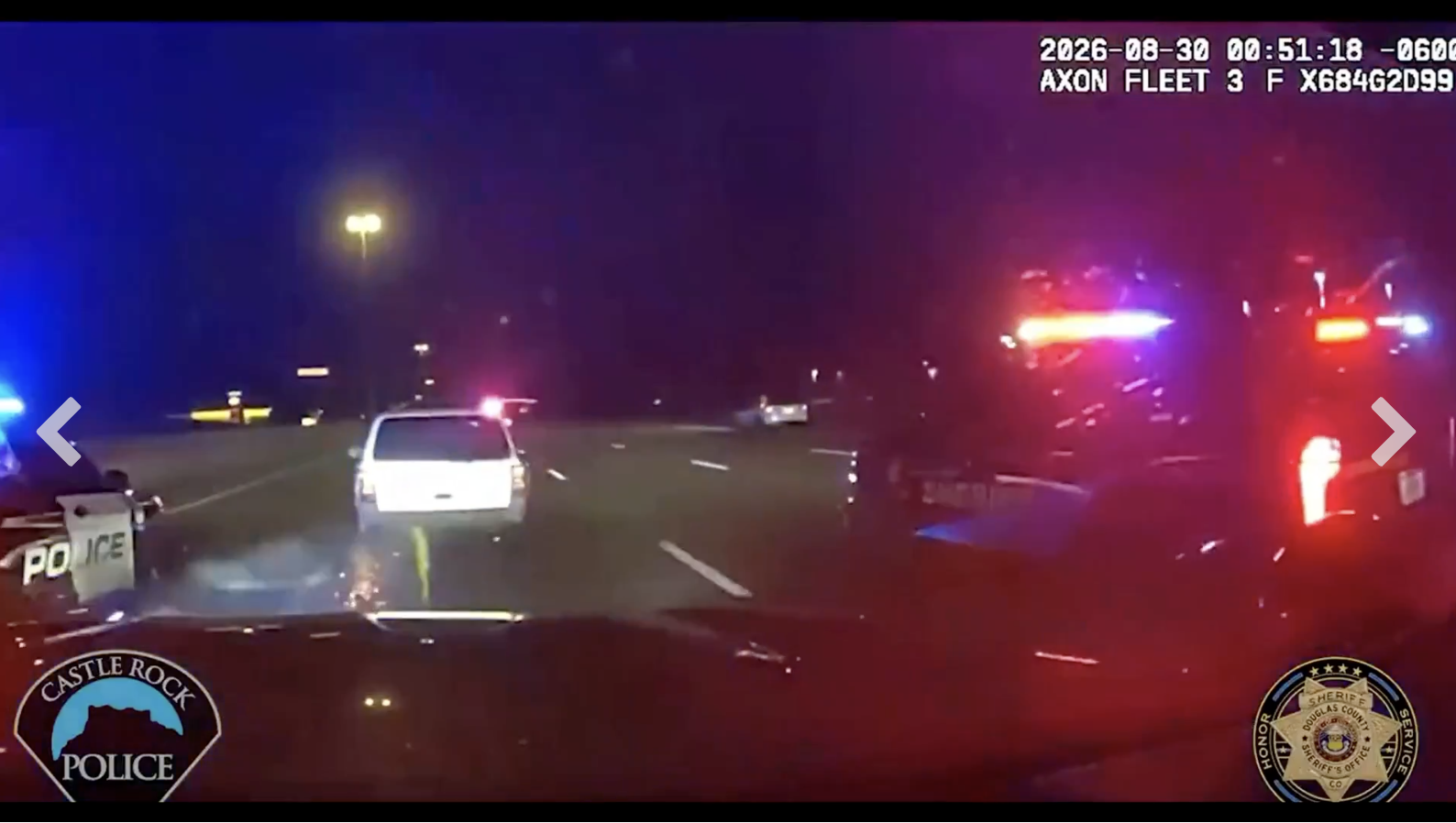
A Douglas County deputy and a Castle Rock police officer ended a car chase on August 30 by firing a net at the rear wheel of a fleeing car. The robbery suspect behind the wheel stopped fast. His passenger didn’t get much further: he bailed out and ran, and officers had him in cuffs within seconds. Both suspects went into custody without further incident, according to the two departments’ account of the incident.
That’s the clip everyone in Douglas County will be sharing this week. It’s also the least interesting part of the story.
The interesting part is what’s mounted to the front of that truck, what happens to it every time it fires, and why a growing number of American police departments have decided this is worth building into next year’s budget the same way they budget for ammunition.
The device is the Grappler Police Bumper, engineered and built near Phoenix by Stock Enterprises. Douglas County and Castle Rock are two of more than 165 agencies across 34 states now running it, and the company counts more than 1,500 successful roadway captures to date. An officer trips the system from a switch inside the cab. Two arms swing out from the front bumper and fire a net that wraps around a wheel or axle. A break-away tether keeps the pursuing truck from getting dragged into the mess and can be released from inside the cab at any time. Reload takes about five minutes with nothing more than a small bag of hand tools.
A grappler truck that just made a capture is out of the fight for the next five minutes, tool bag or not.
Here’s the detail that didn’t make the local newscast: the net is not reusable. Every deployment burns a single-use cartridge that costs $399, and the company runs a return program that pays departments back between $30 and $100 for a spent net, depending on how mangled it comes back, so it can be refurbished into a training net. It is, functionally, ammunition, not a metaphor, an actual line item a procurement officer has to reorder after every real deployment. A PIT maneuver costs a department nothing extra on paper, whatever it costs in cruiser repairs and injury claims later. A grappler catch comes with a receipt attached before the suspect is even booked.
The hardware itself runs $5,270, and it doesn’t bolt to just any cruiser. The current Grappler only fits four platforms: the Ford Expedition (2018 and newer), the Ford F-150 (2015 and newer), and the Chevrolet Tahoe and Silverado 1500 (2014 and newer). A sheriff’s office can’t simply add this capability to the Chargers, Explorers, and Tahoes already running radar and light bars. It has to designate specific full-size trucks as grappler units, train a crew on them, and keep them positioned where a pursuit is likely to need one. The tool doesn’t just change tactics. It changes what a department has to buy.
None of this happens in a vacuum. Crash data compiled through NHTSA’s Fatality Analysis Reporting System shows pursuit-related crashes have killed more than 500 people a year recently in the United States, more than one death a day nationwide. The Auto Wire has covered plenty of chases that ended the traditional way, including one where a fleeing Silverado driver’s own wheel flew off mid-PIT maneuver. Those endings look dramatic on dashcam, but they carry real odds of a rollover, an injured officer, or an innocent bystander’s car getting hit. A device that ends a chase without a collision is, on that math, worth paying for, even at $399 a shot.
It isn’t a solved problem, either. The Auto Wire reported in February on a Texas case where a grappler ended a 90-mph chase with children riding inside the fleeing car, a capture that worked exactly as designed and still touched off a real argument about whether any intervention belongs anywhere near a car full of kids at highway speed. Harris County, Texas, adopted its own grapplers after receiving state funding, a reminder that this hardware doesn’t spread just because every department independently decides it’s the best tool. It spreads because someone writes a grant.
The origin story is stranger than the spec sheet. Inventor Leonard Stock says he got the idea after watching a police chase on television and seeing bystanders hurt once it ended. He welded a prototype to his own truck within a week. To test it, he talked his wife, Frances, into driving the family Suburban down a desert road outside Phoenix while he chased her down. That backyard test is the direct ancestor of the hardware now riding around Douglas County.
None of that made the dashcam highlight reel, and none of it needed to. The video is genuinely satisfying to watch: a truck closes in, a net fires, a car full of bad intentions goes nowhere. But the video is the marketing.
The net is the part everyone notices. The invoice behind it is the part that’s actually changing policing.