
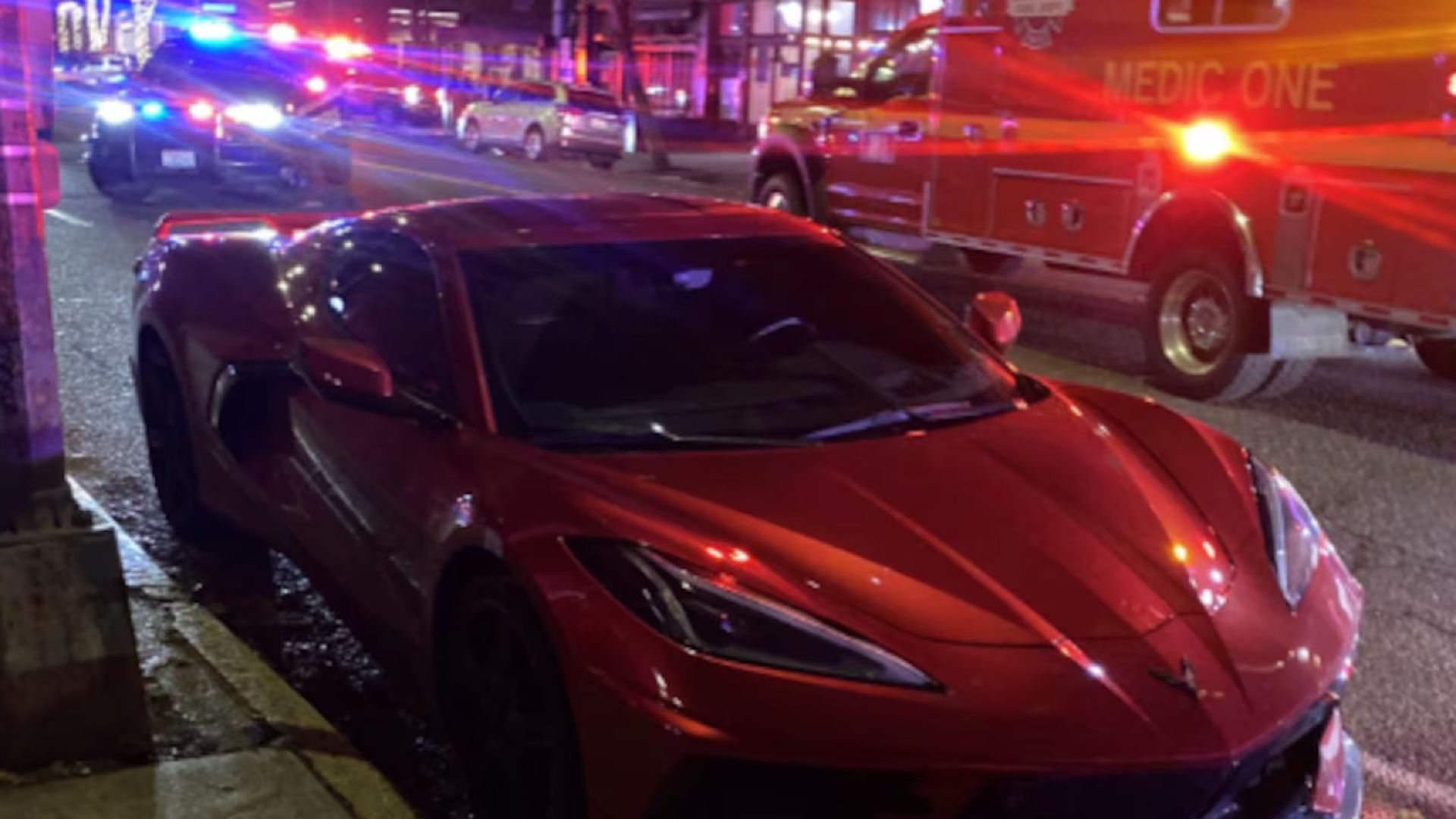
The thing that ended a 156-mph run through two states wasn’t a faster patrol car, a spike strip, or even the crash. It was a sticker. Jayden Atreeyian Smith’s Corvette was riding on registration tags that had expired back in March, hidden under a license plate cover, on Interstate 55 near Blytheville, Arkansas. That’s what caught a trooper’s eye on the morning of June 15. Everything that happened over the next several miles, at speeds most owners never see outside a drag strip, only happened because nobody bothered to renew a registration.
According to the Arkansas State Police account of the pursuit, the trooper ran the plate through the state’s crime information center and found the registration had lapsed. When he switched on his lights, the driver of the red C8 Corvette Stingray didn’t pull over. He accelerated, hard enough that the trooper’s radar locked onto a reading north of 150 mph, topping out at 156. That isn’t a spirited pass on an empty backroad. That’s a 3,600-pound car moving nearly as fast as a Cup Series stock car, on a public interstate, at 8:30 on a weekday morning.
Missouri troopers were waiting near the state line with tire deflation devices, the strips most drivers call stop sticks. Here’s the detail worth knowing: the spikes on those strips are hollow, on purpose. A conventional blowout at 150-plus mph can send a car into an uncontrolled spin. A hollow spike punctures the tire and lets air bleed out over twenty to thirty seconds, trading a violent failure for a slow, survivable one. It’s a clever, almost old-fashioned piece of engineering, and it’s the reason a length of plastic and steel can eventually out-think a supercar’s tire-pressure margins better than a chase car ever could.
The stop sticks shredded the Corvette’s left-side tires, but Smith kept driving on the rims until a trooper pulled alongside to attempt a tactical vehicle intervention, essentially a controlled nudge meant to end a pursuit without a violent, high-speed impact. Instead, the Corvette braked hard, the trooper’s cruiser clipped its rear quarter panel, and both cars were done. Smith ran through a nearby field. He didn’t get far.
What he was carrying is the detail that should bother you more than the speed. Inside his backpack, troopers found his driver’s license, a small amount of marijuana, and three key fobs: two for Ram TRX pickups, one for a Dodge product wearing an SRT badge. None of them belonged to the Corvette he’d just wrecked. A spare fob with no matching car nearby is exactly the kind of loose thread investigators pull on, the same way orphaned fobs and VINs cracked open a much bigger theft ring earlier this year. We don’t yet know what those two Ram TRXs and that Dodge SRT connect to. That’s a question for a Missouri courtroom, not for us.
Then came the line everyone’s repeating. After crashing a car that starts north of $68,000, fleeing on foot, and getting cuffed in a field, Smith reportedly told troopers he wasn’t worried, because he’d “simply buy another one.” It’s the kind of line that sounds like wealth. It reads differently once you get to the actual charge sheet.
Smith is facing felony fleeing charges that carry real prison time, along with reckless driving, drug possession, and the pile of paperwork violations that started this whole thing. But the charge that should matter most to anyone who owns a car is the quiet one: no liability insurance. That means the crash, to the patrol cruiser, to the Corvette, to anyone else who happened to be on I-55 that morning, was never backed by a policy. Insurance exists precisely to pay for moments like this one, and Smith’s didn’t, because there wasn’t a policy to begin with.
Arkansas State Police has already said it will seek restitution for the damage to its cruiser. Restitution is not an insurance claim. It’s a court-ordered debt, collected slowly, sometimes over years, sometimes never in full, and it doesn’t evaporate because someone drives off in a new car. Standard auto policies are built around accidents, not felonies, and that gap is where drivers like Smith get left holding a bill no dealership can write them out of.
There’s a reason this particular stretch of highway and this particular car keep showing up in these stories. Interstate 55 through northeast Arkansas has hosted more than one triple-digit pursuit this year alone. And the C8 Stingray is arguably the best performance-per-dollar deal General Motors has ever built: the first mid-engine Corvette, roughly 490 horsepower, a sub-three-second run to 60 mph, for a price that undercuts a base Porsche 911 by tens of thousands of dollars. Chevrolet spent decades chasing that kind of performance. The side effect of finally getting there is that supercar-grade acceleration is now within reach of a much wider, and not always more careful, group of buyers.
That risk isn’t abstract. Researchers working from federal crash data recorded more than 5,400 fatal pursuit-related crashes nationwide between 2009 and 2023, killing over 6,300 people, an average of roughly 420 deaths a year. Most of the people killed aren’t the ones behind the wheel of the fleeing car. They’re bystanders, passengers, and officers. A trooper’s decision to keep chasing a car at 156 mph through morning traffic isn’t just a bet on catching one driver. It’s a bet involving everyone else on that road, too.
Smith may well buy another Corvette someday. What he can’t buy back is a clean history with an insurance underwriter. A felony evading conviction follows a driver into every future policy application, typically as an outright denial of standard coverage, and if he’s lucky enough to find a high-risk carrier willing to write one, a premium several times what he was paying before any of this happened. The car is replaceable. The record isn’t.