
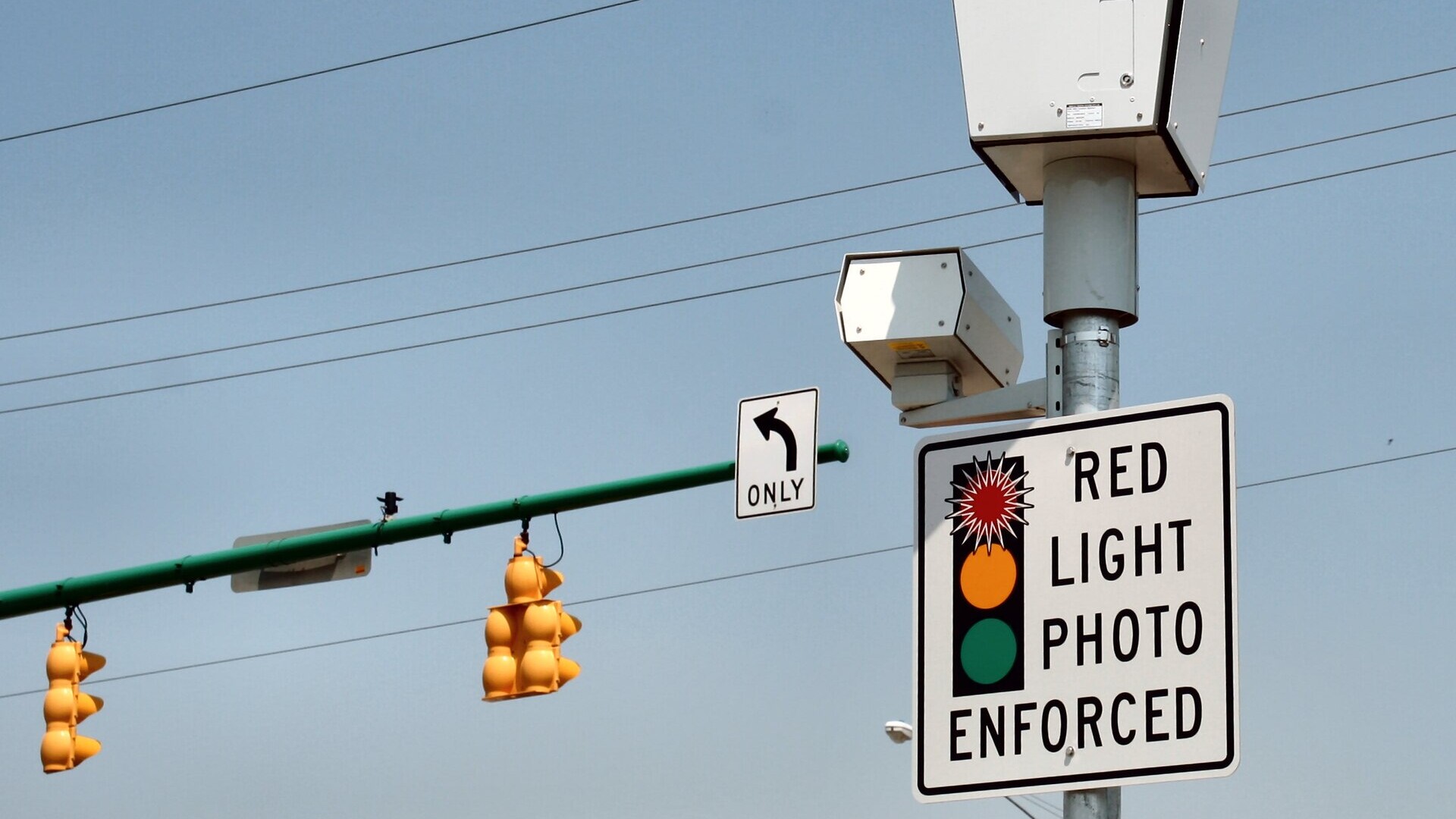
Florida spent September pulling license plate cameras off its highways. Drive through Broward, Palm Beach or Tallahassee this week and cameras will still photograph you at the stoplight, in the school zone and beside the stopped school bus. The state didn’t get rid of traffic cameras. It got rid of one kind.
Which kind survived says a lot about Florida’s priorities: cameras that mail you a bill are fine, while cameras that keep a record of where you’ve driven are not.
You can argue that’s a reasonable line to draw. But the plate readers weren’t banned. They were ordered off state property, which is a much narrower thing.
What the state did to Florida traffic cameras
On Aug. 31, the Florida Department of Transportation issued Engineering and Operations Memorandum No. 26-01, signed by Chief Operating Officer Will Watts and addressed to local agencies holding permits. It revoked every approval FDOT had granted local law enforcement to mount automated license plate recognition systems within the right-of-way of the State Highway System. Agencies got 30 days to take them down, after which FDOT says it will remove whatever is left. The memo also stops the department from taking new requests.
The stated reason was blunt for a transportation bureaucracy. The memo points to an “exponential increase in deployments,” reports of misuse and “surveillance schemes.” It applies to every brand of plate reader on state right-of-way, not only the Flock Safety units that have drawn most of the attention. We covered why the roadside itself turned out to be Flock’s weak point last week.
Lawmakers wrote the off switch into the law from the start. Section 316.0777 of the Florida Statutes lets FDOT allow plate readers on state highways at a police agency’s request and expense, and then says the systems “must be removed within 30 days” once FDOT tells the agency to pull them. The memo calls such approvals “temporary by nature.” Police never had a right to that roadside, only permission that could be pulled.
The same statute contains a second line worth knowing: a plate reader in Florida “may not be used to issue a notice of violation” or a traffic citation. The cameras coming down could never write you a ticket. That is why they were the easiest to remove, and why their removal says so little about the cameras that can.
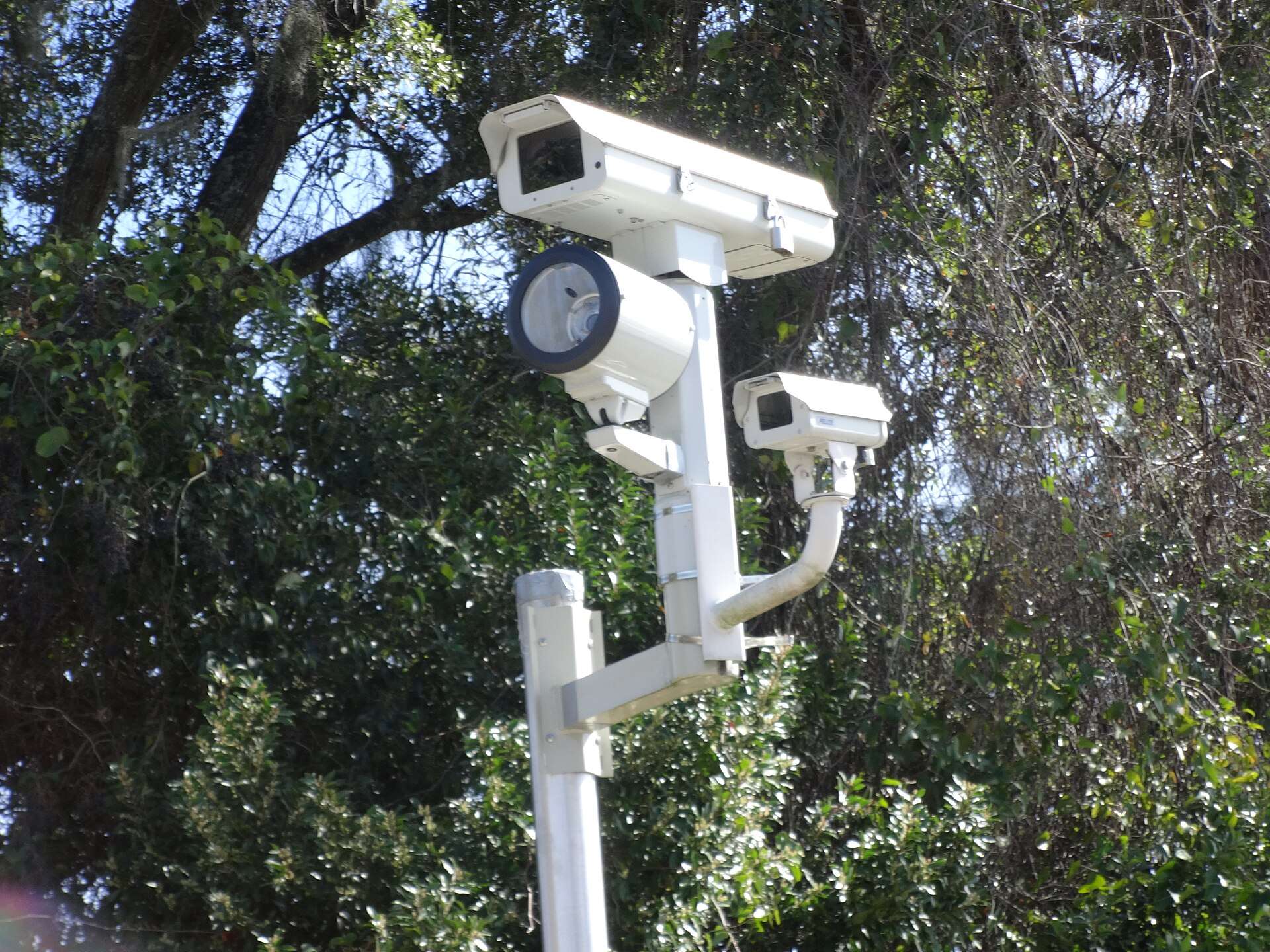

The cameras that stayed get a different rulebook
Florida regulates automated enforcement under three separate statutes, each with its own fine, its own revenue split and its own paperwork. The FDOT memo touched none of them.
Red-light cameras. Under the Mark Wandall Traffic Safety Program, a camera-issued notice costs $158. When a city or county enforces it, $75 stays local, $70 goes to the state’s General Revenue Fund, $10 to the emergency medical services trust fund and $3 to the Brain and Spinal Cord Injury Trust Fund. The state highway safety department’s most recent program report counted 38 jurisdictions running 493 cameras in fiscal 2023-24. They issued 1,013,761 notices of violation. About 627,000 were paid. Another 298,015 went unpaid long enough to turn into uniform traffic citations.
School-zone speed cameras. A 2023 law, now Section 316.1896, lets local governments ticket drivers going more than 10 mph over the school-zone limit, and outside the reduced-speed windows the cameras may keep running for the entire school session, ticketing drivers more than 10 mph over the regular posted limit. The fine is $100: $60 to the local program, $20 to the state’s General Revenue Fund, $12 to the county school district, $5 to a crossing-guard recruitment program and $3 to the state’s Criminal Justice Standards and Training Trust Fund. In the program’s first full year, the state’s preliminary FY 2024-25 summary counted 34 jurisdictions and 646 cameras producing 645,104 notices. Small towns have discovered what that math looks like, as Lake Helen’s numbers showed.
School bus cameras. Under Section 316.173, stop-arm cameras catch drivers who pass a stopped bus. Under state law, those drivers pay $225, a $200 penalty plus a $25 add-on, and the money goes to the school district. The same state report counted five districts with 2,635 bus cameras and 304,220 notices in a single year.
Florida traffic cameras: tracking shrinks, billing grows
Put the pieces side by side and the trend is hard to miss. Plate readers are coming off state roads, while ticketing cameras, school-zone units especially, keep spreading. Privacy advocates got a win this month. Drivers’ wallets didn’t.
Why your insurer never hears about any of it
That helps explain how ticket cameras survive politically. Under Section 322.27, a red-light camera violation adds no points to your license and “may not be used for purposes of setting motor vehicle insurance rates.” School-zone speed camera and school bus stop-arm camera tickets get the same two protections.
Florida designed the camera ticket as a fee, not a record. Pay it and, as far as your driving history and your premium are concerned, it never happened. That is a very different deal from a trooper writing the same red-light ticket by hand, which can follow you to your next renewal.
There is a catch for owners. Camera notices go to the registered owner, not the driver. If your teenager, your roommate or a service loaner driver had the car, the law puts the burden on you to file an affidavit saying who was in control of it. Parents, small-business fleets and anyone who lends a car should know that before the envelope arrives.
The plate reader works in the opposite direction. It never sends a bill and never touches your record. What it builds instead is a timeline of where your car went. At a Sept. 23 Senate Judiciary subcommittee hearing on Flock’s network, ACLU senior policy counsel Chad Marlow testified that the company collects more than 20 billion plate scans a month. A red-light camera only records a car that runs the light. A plate reader records every car that passes.
That difference is why the two kinds of cameras ended up on opposite sides of Florida’s line.
The safety math on Florida traffic cameras is messier than the signs suggest
None of this means the Florida traffic cameras that survived have a clean record on the thing they are supposed to deliver. The highway safety department’s own red-light report compared 174 intersections before and after cameras went up. Total crashes rose from 17,093 to 18,615. Rear-end crashes, the classic side effect of drivers panic-stopping, climbed from 8,429 to 9,121. Angle crashes, the T-bone collisions cameras exist to prevent, also rose, from 3,630 to 4,180. Injury crashes did fall slightly, from 4,109 to 3,986, though serious-injury crashes, counted separately, rose from 363 to 432. Fatal crashes went from 35 to 36.
Raw before-and-after counts do not account for traffic growth or other changes at those intersections, so they do not prove cameras cause crashes. But they are not the unambiguous safety win the “photo enforced” signs imply, and they come from the state, not from camera critics.
The same report found that 22 of the 38 programs, or 57.9 percent, issued notices for improper right turns on red, even though the statute bars tickets for right turns made “in a careful and prudent manner.” Where one city draws that line and the next city doesn’t is exactly the kind of inconsistency that fills traffic courts. Other places have wrestled with the same tradeoffs, from Charlotte bringing red-light cameras back to Ontario killing speed cameras outright.
What the memo doesn’t cover
The FDOT memo covers only one thing: equipment inside the right-of-way of the State Highway System. City streets, county roads, shopping centers, gated communities and private lots are outside its reach. The memo does not touch a plate reader bolted to a city-owned pole one block off a state road. Nor does it touch the one watching the Publix parking lot.
The data rules did not change either. Section 316.0778 does not set a retention period at all; it hands that job to a schedule written by the Department of State. How long a scan of your car can sit in a database is the same today as it was on Aug. 30. And as our running record of reported plate-reader misuse shows, the problems have mostly been about who searches the data, not which pole the camera hangs on.
Florida drivers also have a right most don’t know about: plate-reader images and data are exempt from public records law, but Section 316.0777 allows disclosure to the person the plate is registered to, unless it is part of active criminal intelligence or an active investigation. If you want to know what a local agency has logged about your own vehicle, the law gives you a way to ask.
A permit fix, not a privacy law
Florida’s move is real and it will change what police can see on the state’s busiest roads. But FDOT did it by pulling permits on property it controls. No new privacy protections came with it.
Meanwhile, the Florida traffic cameras that fine you are multiplying, carefully fenced off from your license and your insurance premium so drivers are less likely to fight them. Florida has decided that being charged is tolerable and being tracked is not. If lawmakers mean it, the next step is writing that principle into the rules for the data itself, wherever the camera happens to stand.
Should a camera that logs where you drive face tougher rules than one that mails you a $158 bill? Or is Florida fooling itself by treating one as harmless and the other as a threat? Tell us in the comments.