
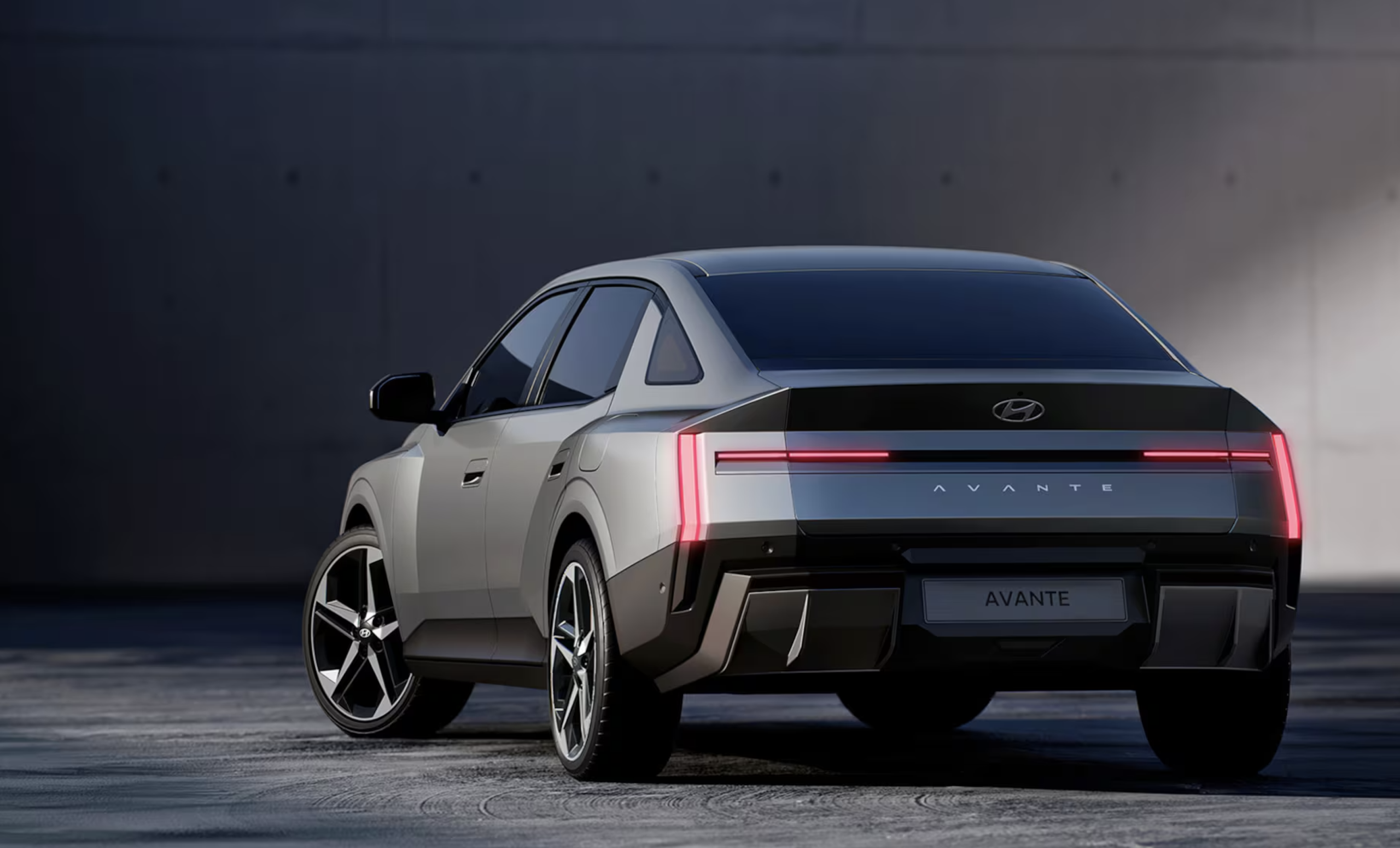
Hyundai just pulled the wraps off the eighth-generation Elantra in South Korea, where it’s sold as the Avante, and the headline is that the company apparently decided its compact sedan needed to look considerably more aggressive. Six years after the outgoing model debuted, the new car ditches the swoopy, origami-inspired look for something Hyundai is branding “Art of Steel,” which is a stylized way of saying the fenders now bulge noticeably more than before. Hyundai has openly said the sculpted haunches take inspiration from the Lamborghini Urus, which is a genuinely surprising comparison for a car that will eventually sell for compact-sedan money.
Up front, the Avante gets split LED headlights with ultra-slim daytime running lights, with the primary headlight function relocated down into the bumper intakes. Around back, Hyundai went with a distinctly futuristic look: vertical and horizontal LEDs forming an H-shaped signature, a dual splitter, and a boxy ducktail spoiler that suggests some inspiration from touring car aesthetics. Eighteen-inch five-spoke wheels round out the exterior package, and buyers will have six new paint colors and three interior themes to choose from.
It’s Bigger Now, Because Of Course It Is
The new Elantra stretches to 4,765 mm (187.6 inches) long, 1,855 mm (73 inches) wide, and 1,425 mm (56.1 inches) tall, riding on a 2,750 mm (108.3-inch) wheelbase. That makes it 2.2 inches longer, 1.2 inches wider, and roughly 1.2 inches longer in wheelbase than the outgoing model. Hyundai says the added dimensions translate into cabin space that approaches midsize-sedan territory, continuing a familiar industry pattern of each new generation quietly outgrowing the class it was originally designed for.
Inside, Hyundai’s stated design brief was reportedly “furniture,” leaning into rounded shapes and soft-touch surfaces throughout the cabin. The dashboard is dominated by a 14.6-inch display (a smaller 12.9-inch unit is also available), running Hyundai’s new Pleos Connect software with a generative AI assistant called Gleo AI capable of holding an actual conversation, the same feature found in the brand’s flagship Grandeur sedan. Hyundai did keep a row of physical buttons and knobs beneath the touchscreen, meaning owners won’t have to navigate a voice assistant just to adjust the climate control. A smaller digital instrument cluster sits near the windshield, and available options include a Bang & Olufsen sound system, a factory-integrated dash cam, dual wireless charging pads, and 100-watt fast-charging USB ports.
On the safety front, the Avante comes equipped with 10 airbags and an extensive suite of driver-assist technology, including navigation-based Smart Cruise Control 2, Memory Reversing Assist, Remote Smart Parking Assist, emergency braking compatible with the shift-by-wire park mode, and a Pedal Misuse Safety Assist system designed to catch accidental pedal mix-ups.
Gas or Hybrid, Pick Your Flavor
At launch in Korea, the Avante is offered with two powertrains. The base engine is a reworked 2.0-liter naturally aspirated four-cylinder making 147 horsepower, a 26-horsepower increase over the outgoing car, a meaningful jump for what has historically been a budget-focused commuter engine. The alternative is a self-charging hybrid pairing a more efficient 1.6-liter engine with a stronger electric motor and larger battery for a combined 155 horsepower.
The hybrid variant uses Smart Regenerative Braking 3.0 alongside a system Hyundai calls the Hybrid Hierarchical Predictive Control System, which aims to improve fuel efficiency by anticipating the route ahead using navigation data. There’s also a Stay Mode that keeps climate control and infotainment running while the car is parked and unoccupied, a feature well-suited to long waits or extended stops. Hyundai hasn’t confirmed it yet, but a performance-oriented Elantra N variant seems like a near-certainty down the line, with early rumors pointing to a turbocharged 2.5-liter engine and a sharpened chassis.
When Can You Get One
Hyundai stayed vague on exact timing, but the Avante is expected to reach Korean dealerships later this year before expanding to other markets. North America will likely see the car arrive as the 2027 Hyundai Elantra within the coming months, and the sedan is reportedly set to return to European showrooms after a lengthy absence there. Hyundai Motor President and CEO José Muñoz described it as a model that sets a new standard for its class across design, interior space, safety, and digital experience. That’s a bold claim for a compact sedan, but if the finished product really does channel a baby Urus from certain angles, it’s a claim worth taking seriously.