
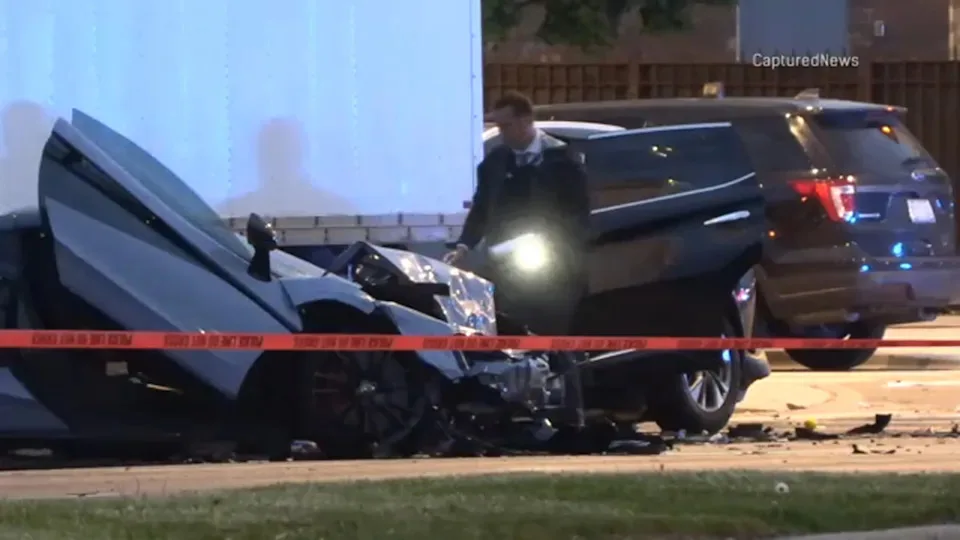
A six-figure supercar, an empty pre-dawn intersection, and one ignored traffic signal. That’s the arithmetic that ended in tragedy in Chicago this week — and it’s since spiraled into a criminal case, a fatality, and a manhunt for a second driver who reportedly vanished from the scene.
Chicago police say 38-year-old Garland Spikes now faces charges after a violent early-Sunday wreck in the Grand Crossing neighborhood killed a 56-year-old woman. Investigators allege Spikes was piloting a McLaren that ran a red light and broadsided a black SUV around 1:45 a.m. near the 7400 block of South Stony Island Avenue.
The Cook County Medical Examiner’s Office identified the victim as Detrice D. Wortham. Per police, Wortham was traveling northbound in the SUV when the eastbound McLaren failed to stop and slammed into her. She was pronounced dead at the scene.
A Suspended License Changes Everything
It gets worse from there. Authorities say Spikes was piloting the six-figure supercar despite a suspended license. He’s charged with reckless homicide, reckless driving, and driving on a suspended license, and was set to appear in court Tuesday.
Then there’s the SUV driver, who police say fled the scene. That detail matters, because the destruction didn’t stop at the initial impact. Footage from the scene reportedly showed the mangled black Nissan SUV plowing into a box truck afterward, ricocheting into still more vehicles. One alleged red-light run snowballed into a fatal chain reaction.
A McLaren is engineered to live at the absolute limit, with savage acceleration and top-end speed far beyond anything a public street was built to absorb. Drop that kind of machine into a dense urban grid full of signals, cross-traffic, and box trucks, and the margin for error evaporates. Police haven’t released speed figures or said whether impairment played a role, and no additional charges have been announced. Still, the allegations alone hit a nerve a lot of enthusiasts feel: dangerous driving paired with someone who, on paper, had no business behind the wheel.
A suspended license isn’t just a bureaucratic footnote. It changes how people read a crash and stacks up accountability questions that exist before the moment of impact. If the allegations stand, prosecutors are likely to hammer the claim that Spikes was already barred from driving long before anyone was killed — the kind of fact pattern that tends to turn a reckless-driving case into a harder-fought homicide prosecution, since it undercuts any argument that the crash was a momentary lapse rather than someone who had no legal business on the road at all.
The Culture Tax on Every Enthusiast
Here’s the part that grates on car people. Every time a high-profile McLaren or other exotic lands in a fatal headline, the heat ramps up on performance cars and the whole culture around them: calls for tougher enforcement, harsher penalties, more cameras, and broader suspicion of drivers who had nothing to do with the incident. Genuine enthusiasts understand that loving a fast car comes bundled with responsibility, and a case like this hands critics easy ammunition to aim at everyone.
It also spotlights a problem cities keep fighting: intersections rank among the most lethal spots on urban roads. A red-light violation is uniquely dangerous because it destroys the one predictable system every driver depends on. The instant one person ignores the signal, everybody else in the box is suddenly exposed.
What Happens Next
For Wortham’s family, the legal slog begins while they’re still grieving a death police say never should have happened. For prosecutors, the case hinges on whether reckless decisions directly caused the loss of life. For Chicago drivers, it’s another grim reminder of how fast a routine drive can turn fatal.
The missing SUV driver remains an open question. Police haven’t said why the person left or whether more charges could follow, adding yet another layer to a wreck that already carries serious criminal allegations, a fatality, and one of the most recognizable supercar badges on the planet.
Performance cars aren’t the villain here. Reckless behavior is. But when someone allegedly blows a red light in a McLaren while their license is suspended, the wreckage spreads well beyond a single Chicago intersection. Spikes faces charges, not a conviction, and remains presumed innocent unless and until prosecutors prove their case in court. Whatever the outcome, the damage to public trust in performance-car culture has already been done, and that may be the most expensive part of this crash for everyone who had nothing to do with it.
Related Articles
- McLaren Repeatedly Rams A Maybach SUV
- Abu Dhabi Investment Group Takes Over McLaren
- McLaren Names A New Chief Executive
- McLaren 720S Driver Miraculously Survives Horror Crash