
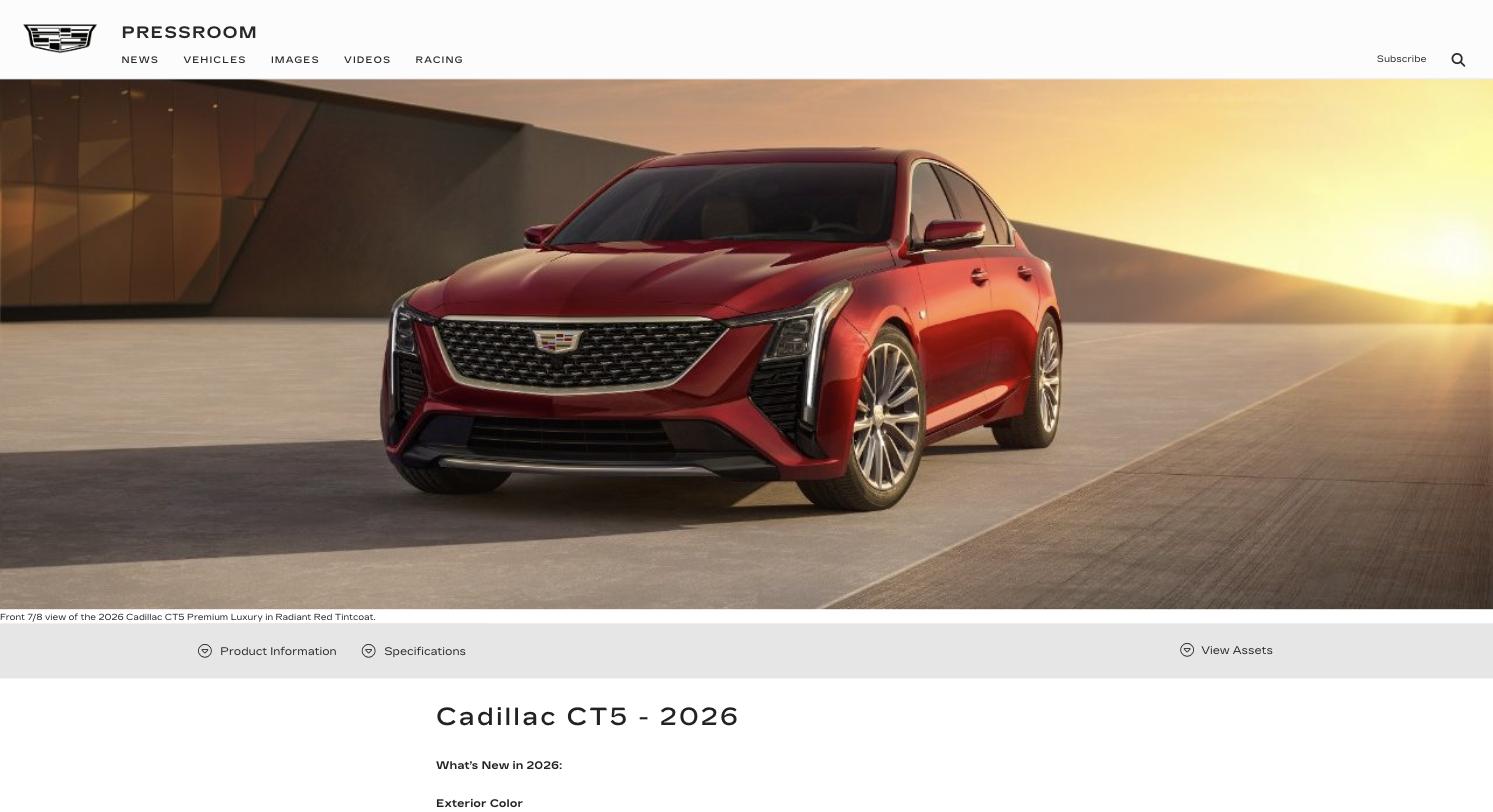
Cadillac’s newest CT5 just posted “Poor” ratings in two of the toughest crash tests the Insurance Institute for Highway Safety runs. Assume that means the car is simply built badly, and you’d be missing the actual story. Look at where the injuries landed instead. In the frontal test, the driver dummy came through clean: good marks on structure, head, neck, chest, legs, everything. It was the passenger sitting directly behind the driver who got hurt, with the dummy’s head coming dangerously close to the front seatback. Flip over to the side-impact test and the result reverses completely. The driver takes the beating this time, its head sliding beneath the side curtain airbag and hitting the window sill hard, while the second-row passenger sails through with good scores across the board.
Garage-worthy EDC gear, on sale this week.
Same car. Same testing cycle. Two completely different occupants failing two completely different crashes.
That isn’t a car that’s simply unsafe. That’s a car engineered with different priorities for different seats, and IIHS’s newer, sharper testing protocols are finally precise enough to prove it.
Two Different Cars Wearing the Same Sheet Metal
The 2026 CT5 rides on the platform Cadillac introduced for the 2025 model year, which matters more than it sounds like it should. This isn’t a decade-old design finally getting caught by a stricter test years after the fact. It’s brand new. Every one of these results reflects a choice GM’s engineers made recently, with full knowledge of exactly how IIHS grades cars in 2026.
IIHS’s own ratings page for the vehicle shows the moderate overlap front test, a 40 mph, 40 percent-offset frontal crash that’s been part of the Institute’s suite for two decades, was rewritten in 2022 specifically to add a second-row dummy and measure back-seat protection. IIHS made that change because crash data kept showing something uncomfortable: automakers had gotten so good at protecting the driver and front passenger that the people riding in back, often kids and grandparents, were quietly falling behind. The CT5 is a clean example. Its front structure held up perfectly. Its back seat, by IIHS’s own measurement, did not.
The side test flips the pattern, for a reason that’s arguably more revealing. That evaluation was updated in 2021 with a heavier, taller striking barrier built to mimic the front end of a modern SUV hitting the driver’s door at 37 mph. It isn’t an abstract engineering exercise. It’s a direct simulation of what’s actually sharing the road with a sedan in 2026. A low, sleek four-door built for a market that increasingly drives crossovers and pickups is, by design of the test itself, being crashed by the exact vehicle shape most likely to hit it in real life. IIHS’s own research into vehicle weight and size classes points at exactly this same shift in what’s actually colliding with what on public roads. The CT5’s structure held up only to a Marginal rating, and the driver’s head found the one gap in protection a taller vehicle would exploit.
The Headlights You Pay More For Are the Worse Ones
Here’s the detail that should annoy anyone working through the CT5’s options list. The standard LED headlights on the Sport and Premium Luxury trims earned a Marginal rating. Add the Technology or Platinum package, and the car switches to curve-adaptive headlights that bend their beam through turns, a feature that reads like an upgrade on the order sheet. That upgrade dropped the rating to Poor. On a straight road at night, IIHS measured the standard low beams as adequate on the right side and weak on the left. The curve-adaptive low beams, the ones buyers pay more for, measured inadequate on both sides.
That’s the quiet cost of engineering a headlight to perform a party trick. Bending light well around a curve can mean giving up some of the boring, straight-ahead throw that covers the overwhelming majority of actual night driving. Nobody puts that trade-off on the brochure.
IIHS Quit Testing Early, and That’s the Point
The CT5’s standard automatic emergency braking system, aimed at preventing rear-end collisions, also scored Poor under IIHS’s newer vehicle-to-vehicle 2.0 protocol. What’s easy to miss is how little of that test actually ran. IIHS closed on a stationary car target at 31 mph and recorded a 23 mph speed reduction, a legitimately solid result. Then, following the Institute’s own published protocol, testing simply stopped. Every offset-target run, every 37 and 43 mph trial, is logged as not tested. A vehicle that can’t clear the easiest version of a test doesn’t get the benefit of the doubt on the harder ones that follow.
The Poor grade here isn’t an average of several uneven results. It’s what happens when a test gets called early.
One more line item worth knowing about: the CT5’s rear seats carry no seatbelt status alert of any kind. IIHS still rates that category only Marginal overall because the front seats’ reminder system is solid, but nothing tells a driver or a passenger whether a back-seat belt is even buckled. Nothing in federal law requires that yet. IIHS started grading it anyway, the same instinct behind the vehicle-to-vehicle 2.0 test the CT5 already failed to earn a Top Safety Pick+ nod over: raise the bar privately, years before Washington gets around to making it mandatory.
What Buyers Should Actually Remember
None of this makes the CT5 a disaster. Its pedestrian braking system rated Acceptable, and a car built on a genuinely new platform can absolutely climb in later rounds of testing. But it’s worth noticing what Cadillac’s own pressroom is actually promoting this year: the Celestiq, the Lyriq, the Optiq, the Escalade IQL, Cadillac’s electric lineup, and the bespoke, low-volume direction the brand keeps talking about. The CT5 is one of two traditional sedans still left in the catalog. A crash test doesn’t know or care which vehicle a brand considers its future. Buyers cross-shopping a gas-powered sedan in 2026 might want to.
A crash-test rating used to be one grade for one car. It isn’t anymore. It’s a seating chart. Right now, the 2026 CT5 is only holding up half of it.