
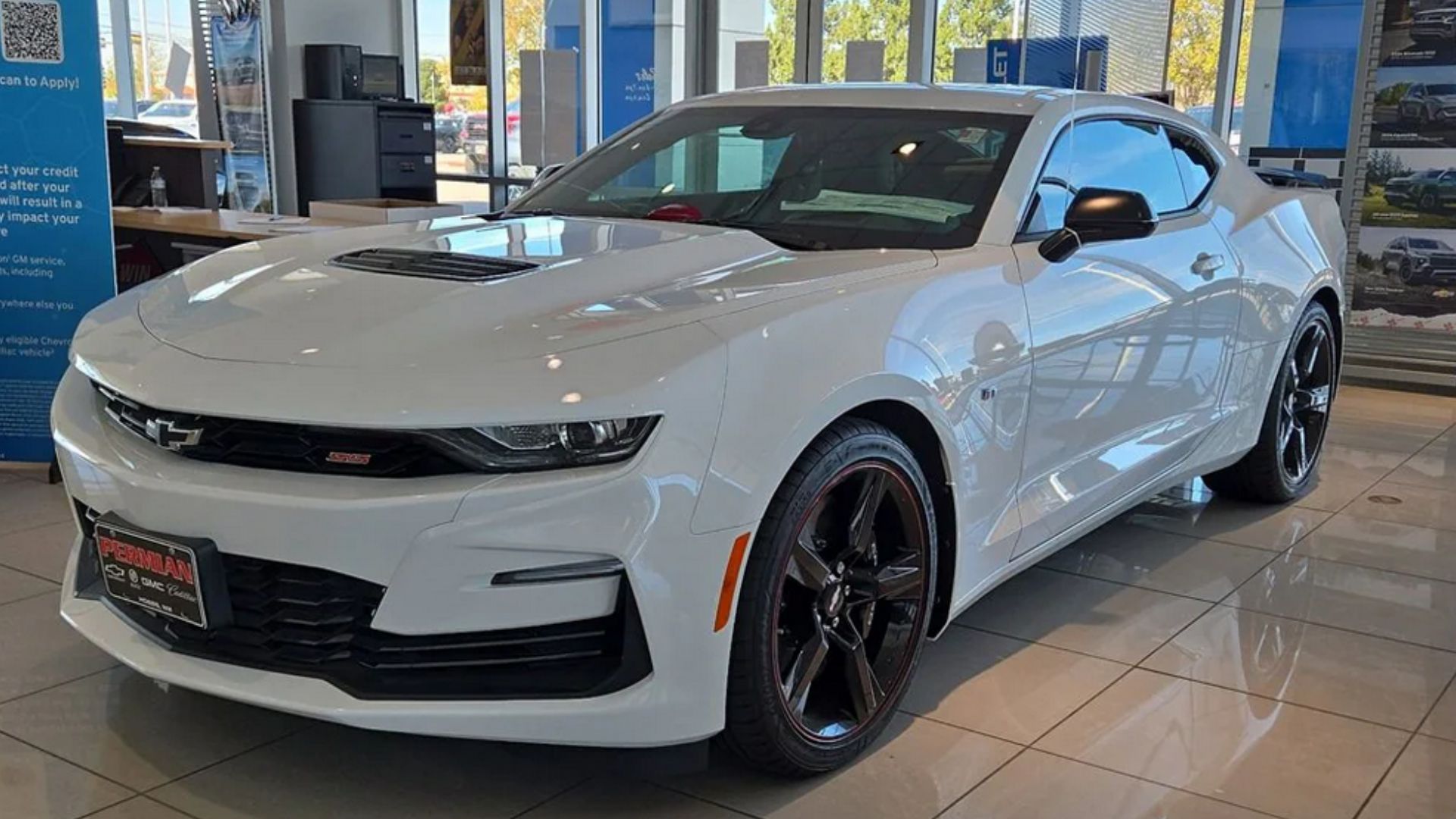
Chevrolet fans are melting down over a rumor that the next Camaro might show up with four doors and a manual gearbox. They are arguing about the wrong thing. The transmission and the extra doors are not the real story here. What is underneath them has been hiding in plain sight since 2015.
According to GM Authority, which broke the news, the next-generation Camaro has slipped from the 2028 model year to 2029. The car is reportedly returning to internal combustion and rear-wheel drive, the formula enthusiasts have wanted back ever since Chevrolet built the last sixth-generation Camaro at Lansing Grand River Assembly in January 2024. A manual transmission is said to be available, and Chevrolet is reportedly planning a high-performance variant that could lean on GM’s newly revived Gen 6 Small Block V8 family, which debuts as the 6.7-liter LS6 in the 2027 Corvette. GM has confirmed none of it publicly. When the company retired the outgoing Camaro, Chevrolet’s global vice president offered only that “this is not the end of Camaro’s story,” a promise vague enough to cover almost any outcome.
The detail buried inside that same report matters more than the delayed timeline. The next Camaro is reportedly riding on an updated version of GM’s Alpha 2 architecture, the same rear-wheel-drive underpinnings expected to carry the next Cadillac CT5 and an unnamed Buick sedan. Production is reportedly returning to Lansing Grand River, the same Michigan plant that built the car GM just finished burying.
Here is what the online outrage keeps missing. The Camaro that sat on dealer lots until last year already shared its bones with a pair of Cadillacs. GM Authority’s own coverage of the Cadillac CT4’s final month of production pointed out that the outgoing CT4 shares its rear-wheel-drive Alpha platform with both the CT5 sedan and the sixth-generation Camaro coupe. The car with a Camaro badge and a hood long enough to land a small plane on was never a bespoke design. It borrowed its chassis from a pair of Cadillac sedans from day one. Four doors would not be some radical departure. It would just be Chevrolet admitting out loud what the floor pan has said since 2015.
This is not new behavior for the nameplate, either. The fifth-generation Camaro rode on GM’s global Zeta platform, shared with the Pontiac G8 and the Holden Commodore, an arrangement that only worked while GM had an Australian factory building rear-wheel-drive sedans at scale. Once GM shut down Holden manufacturing, that shared volume disappeared, and the sixth-generation Camaro landed on Alpha instead, tied to Cadillac’s sedan program because there was nowhere else left to borrow from. A dedicated, low-volume coupe platform funded entirely by coupe sales has not existed at GM for a generation. It survives only by hitching a ride on someone else’s business case.
That is the part worth understanding. Stamping unique body panels, certifying a unique crash structure, and tooling an assembly line for a car that only comes in two doors is extraordinarily expensive when annual volume is measured in the tens of thousands rather than hundreds of thousands. Spreading a validated four-door structure across three brands and badges divides that cost among every Cadillac, Buick, and Chevrolet built from the same tooling. A four-door Camaro is not really a styling decision. It is the cheapest available way to keep the name alive at all.
Dodge has already run this exact play, in public, and put its name on it. When Stellantis introduced the 2026 Dodge Charger Daytona, it did not quietly slip a four-door version into the lineup. It marketed the car as the world’s only four-door muscle car, built on the same STLA Large structure, front clip and all, as the two-door version. When electric-only demand fell short of expectations, Dodge did not design a new platform to fix it. It bolted a twin-turbo Hurricane inline-six, badged Sixpack, onto that same shared architecture and sent buyers back to dealers with up to 550 horsepower and no plug required. If GM follows through on a four-door, gas-powered Camaro built alongside two other brands’ sedans, it is not innovating. It is running Dodge’s fix a few years behind schedule, and continuing the same hedge-your-bets approach to electrification we have already tracked across Detroit.
The manual-transmission detail deserves the same scrutiny. Cadillac’s CT5-V Blackwing has spent years validating a six-speed Tremec manual gearbox, complete with rev-matching and a twin-disc clutch, inside the same Alpha structure the next Camaro reportedly inherits. That car is being phased out this year as Cadillac retires the current CT4 and CT5 ahead of an updated, gas-powered replacement. The manual-transmission engineering does not need to disappear along with it. It can simply migrate to whatever badge asks for it next. Calling a manual option in a 2029 Camaro new would be generous. It is closer to a hand-me-down.
Ford is the one left exposed by all of this. If Chevrolet and Dodge have both concluded that a dedicated two-door platform no longer pencils out on its own, the Mustang becomes the last American pony car still paying full price to exist as a standalone coupe. That is either a point of pride for Ford or a very expensive one. Probably both.
None of this is really about doors, or a stick shift, or a 2029 on-sale date. It is about how little of Camaro is actually Camaro-specific anymore, and how a badge quietly became worth more than the structure bolted underneath it. GM did not design a four-door Camaro. It designed a Cadillac years ago and only now decided a bowtie would fit on the trunk lid too. When the 2029 model finally arrives, remember that the two-door American pony car, engineered from a clean sheet just to be a coupe, is closer to a museum piece than a product category. What is left in its place is a very good shared-platform sedan wearing a very old name.