
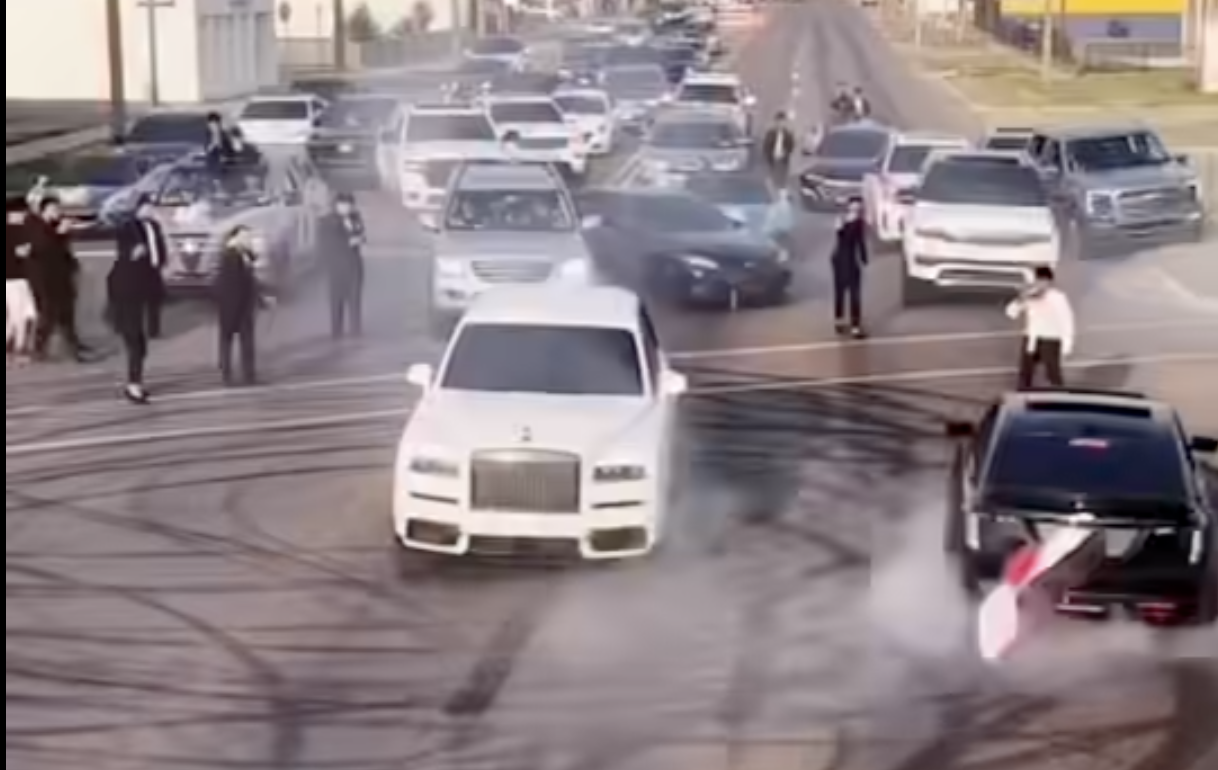
Dearborn Heights police impounded a Cadillac CT5-V in late July after investigators say its driver blocked Warren Avenue and filled the intersection with tire smoke during a wedding celebration. Cell phone footage of the stunt, which also shows a white Rolls-Royce fishtailing through the same crowd, spread across social media within hours. Mayor Mo Baydoun says the department is still working to identify the other vehicles involved, and that the city intends to keep tracking down drivers who stop traffic to perform stunts that put other motorists at risk.
Online, the reaction has settled on one idea: that the Cadillac is gone for good, hauled away as punishment for someone else’s wedding getting out of hand. It’s a satisfying story.
It’s also probably not the ending, and it’s not even the most interesting part of what happened here. Dearborn Heights has run this exact play before, on a different car, at a different wedding. And Michigan lawmakers are, right now, trying to write a law because the one already on the books wasn’t built for what keeps happening on streets like Warren Avenue.
A Repeat Performance, Not a One-Off
This isn’t the department’s first wedding-adjacent tow job. In September 2024, Dearborn Heights police impounded a white Dodge sedan after guests leaving another wedding tore up a freshly paved parking lot with burnouts, tires screeching while passengers hung out the windows. Officers tracked the car by its plate and had it towed from directly outside the reception hall while guests watched.
Department spokesman Paul Vanderplow summed up the philosophy at the time bluntly: “It’s one thing to be dumb. It’s another thing to be dumb in public.”
Swap the make of the car and the name of the venue, and you have the CT5-V case almost exactly. That’s not a coincidence. Dearborn-area police have leaned on unconventional tactics before, including deploying unmarked patrol cars to blend into traffic and catch reckless drivers off guard, and this looks like the same instinct applied to a very specific kind of crowd: one that films everything and posts it before the tow truck even arrives.
Impounded Doesn’t Mean Gone
Here’s the part most of the comment sections online are getting wrong. Under Michigan law, an impounded vehicle and a forfeited vehicle are not the same thing, and the distance between them is significant.
Michigan’s vehicle forfeiture statute, MCL 257.625n, only lets a court permanently take a defendant’s car for a fairly narrow set of offenses: repeat drunk driving convictions, and reckless driving that causes death or serious injury. Garden-variety reckless or exhibition driving, the kind that produces a viral donut clip, isn’t on that list. Unless the driver already has a record of suspensions or a similar prior conviction, the realistic outcome looks less like a permanent loss and more like an expensive inconvenience: towing and storage fees, a citation, court costs, and possibly points against a license. In most cases, the car eventually goes home.
That doesn’t make the tow truck meaningless. It makes it something else: a message.
The Tow Truck Is the Real Punishment
Watch the footage from either Dearborn Heights case and the strategy becomes obvious. A flatbed rolling up to a wedding reception and hooking a Cadillac in front of a hundred dressed-up guests is built to be seen. It produces its own video, one that competes directly with whatever clip got the car in trouble in the first place. A city without the legal firepower to stop a takeover before it starts can still win the argument that follows, one viral tow at a time.
Other cities have gone further. San Diego has taken to seizing and destroying vehicles used in takeovers outright, while Ohio prosecutors used a forfeiture case to take a car and a driver’s freedom in the same sentencing. Dearborn Heights, so far, is playing a shorter game: publicity now, paperwork later.
The Law Is Still Catching Up
The bigger reason this case matters has little to do with one Cadillac. Michigan’s reckless driving statute was written with a single driver and a single vehicle in mind. It has no real answer for a coordinated convoy of a dozen or more cars blocking an intersection together, which is exactly what keeps happening at wedding sendoffs and at the street takeovers cropping up across the state. State Representative Bryan Posthumus introduced legislation this summer aimed at that specific gap, targeting the reckless or negligent operation of groups of two or more vehicles in public. It’s a nearly identical lesson to the one prosecutors just taught with an entirely different crime, using a law that predates the muscle car itself: the statute on the books is frequently older than the behavior it’s now being asked to police.
What the CT5-V Says About the Driver, Not the Car
One detail is worth sitting with. The Cadillac CT5-V isn’t a stripped-down toy built for burnouts. It’s Cadillac’s answer to the BMW M3, a twin-turbo, 360-horsepower sport sedan engineered with genuine track ambitions, and it isn’t the model’s first brush with a police report either; a CT5-V was clocked at 143 mph on a Georgia highway back in 2024. Getting one to hold a donut instead of correcting itself means deliberately switching off the stability control first. Nothing about this car is designed to end up sideways in an intersection full of wedding guests. Somebody drove it there on purpose.
Cars didn’t get more reckless. Owners started filming.
Five years from now, nobody will remember which Cadillac got towed from which wedding in Dearborn Heights. What will still be true is that the tow truck, not the courtroom, has become the most effective deterrent a city has for behavior the law hasn’t quite figured out how to punish yet.