
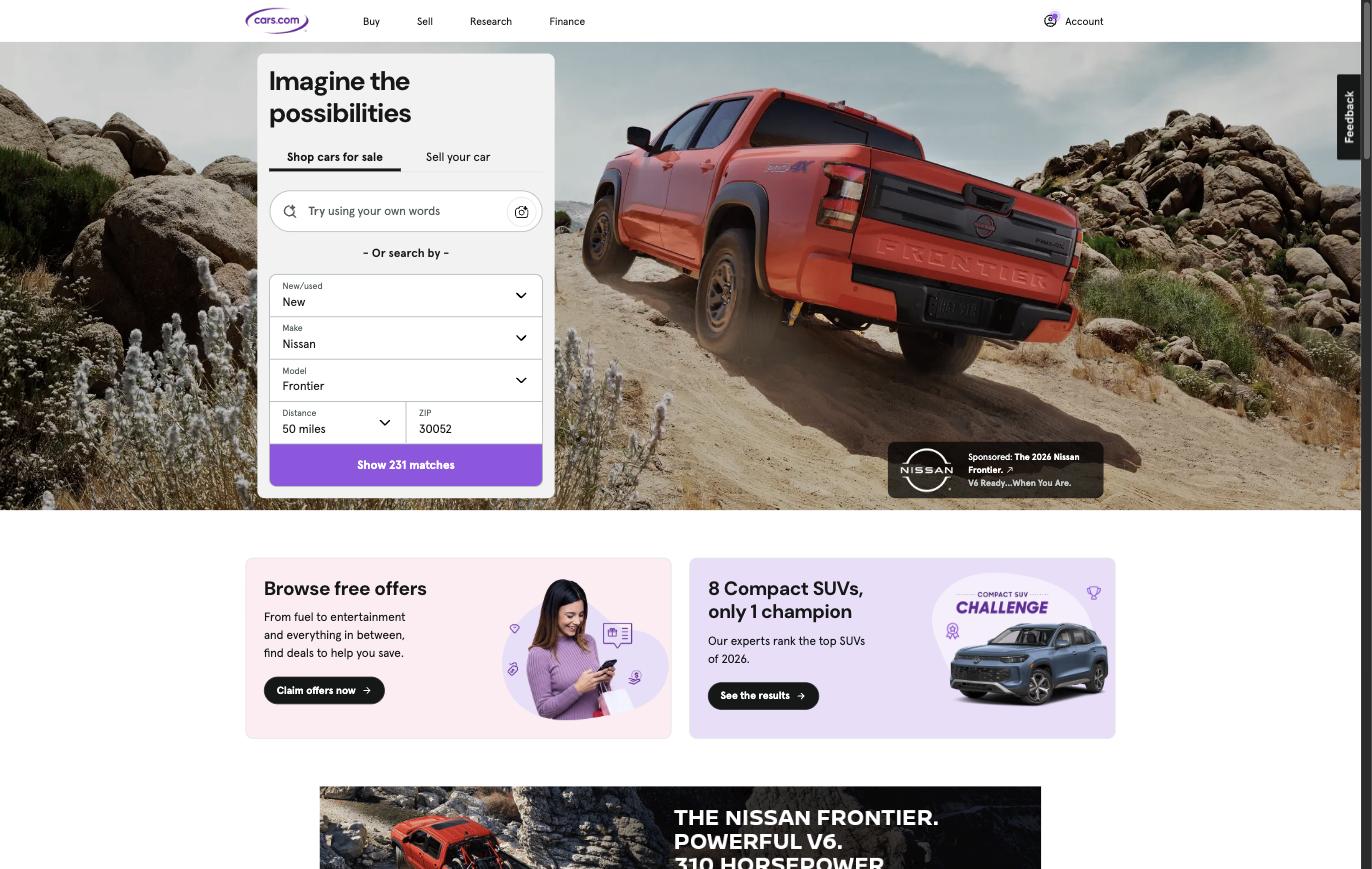
Cars.com told investors this week that it just posted the fastest revenue growth in its history as a public company, excluding the freak rebound after the pandemic. Then, a few slides later, it told them something that should have been the headline instead: fewer people are actually visiting Cars.com than before. Management didn’t bury that fact. They bragged about it.
That’s not a contradiction. It’s the whole strategy. This isn’t really a story about a good quarter for a car-shopping website. It’s a story about the entire online marketplace business quietly giving up on the one number it used to build its whole pitch around, audience, and replacing it with something dealers can’t see and shoppers rarely think about: an algorithm deciding who’s worth talking to.
The basics, according to the company’s own second-quarter release: marketplace revenue grew 7% year over year, the best pace Cars Commerce has posted as a standalone company outside pandemic-recovery comparisons. Adjusted EBITDA margin came in at 29.4%, ahead of guidance. The company retired more than 10% of its own shares this year. And yet full-year guidance still sits at flat to 2% revenue growth, hardly the number you’d expect from a record quarter, and a gap worth remembering before anyone gets too excited.
The audience is shrinking, and that’s the point
Here’s the detail that should stop you: total visitors fell during the quarter. Leads and lead conversion rose by double digits anyway. For a company whose own investor site still advertises more than 30% traffic growth over the past 5 years as a core reason dealers should pay for exposure, quietly shrinking the audience and calling it progress is a genuine reversal, dressed up in the language of discipline rather than decline. It says the era of biggest-audience-wins in online car shopping is ending, and something narrower and more automated is taking its place.
An AI named Carson is now closing deals before a human ever answers the phone
The narrower, more automated part has a name: Carson. Cars.com’s AI shopping assistant is now involved in one out of every five active searches on the site, and it accounted for nearly 30% of all leads submitted to dealers in June. Sit with that for a second. When a shopper fills out a check-availability form on a listing today, there’s a real chance an AI already asked what they wanted, gauged how serious they were, and helped decide which dealer gets the notification, before anyone on a sales floor knows the customer exists. Car dealers have complained for two decades that marketplace leads are low-quality or fake. Cars.com’s answer wasn’t to send more leads. It was to have software pick better ones, and take credit for the resulting conversion numbers.
That distinction matters to anyone who’s ever worked a dealership internet desk. Dealers don’t pay Cars.com for eyeballs anymore, not really. They pay for a shot at a sale, and the entire economics of digital retail hinge on how warm a lead is by the time a human answers it. An AI that pre-qualifies shoppers can genuinely raise close rates. It can also quietly set expectations on price, on availability, on trade value that the dealer never approved and now has to honor or walk back. Nobody on the earnings call mentioned that part.
The trade-in tool that used to work against you now works for you, sort of
The same call introduced Dealer Verified Listings, the first real product built on AccuTrade’s appraisal engine to face consumers instead of dealers. That’s a notable pivot, and a slightly ironic one. AccuTrade was built to help dealers estimate what a trade-in is actually worth so they don’t overpay a customer at the curb, a tool historically aimed at protecting the dealer’s margin, in an industry shoppers have long accused of lowballing trades. Now that same appraisal data is being repackaged as a trust signal to reassure buyers that a used listing’s condition is accurate. It may well help; undisclosed condition problems are a real and long-standing complaint in used-car retail. But a verified listing here means a dealer-run appraisal, not an independent inspection, and that distinction is worth knowing before anyone assumes verified means what it sounds like.
The margin story is partly an accounting story
Then there’s the part of the release written for accountants, which happens to be the most revealing part for anyone judging whether this business is actually getting more efficient. Depreciation and amortization fell sharply this quarter because the company finished amortizing the customer-list intangibles created when Cars.com spun off from its former parent, Gannett/TEGNA, back in 2017. Translation: a recurring, non-cash accounting expense that’s been quietly shrinking the bottom line for nine years just rolled off the books, on schedule, with zero connection to how well the business is actually run. Pair that with a buyback that retired more than a tenth of the share count, and a decent chunk of this record story is arithmetic, not innovation.
Even the corporate language hints at where the actual pressure is. Management said the company’s Marketplace Playbook will be applied to Dealer Inspire, its dealer website and marketing arm, in the back half of the year specifically to reverse recent unit declines. Translation, again: dealers have been leaving Dealer Inspire for other vendors, and the company needs a turnaround plan to stop it. That’s a normal, unremarkable business problem. It’s just not the sentence a company chooses to put in bold on an earnings call.
This pattern is bigger than one company
None of this happens in a vacuum. National and OEM advertising on the platform reportedly bottomed out this quarter before an expected rebound, consistent with what happens when automakers are absorbing higher costs and trimming marketing budgets first, the same dynamic we broke down in GM’s own tariff guidance. And the record-quarter-oddly-muted-reaction pattern isn’t unique to Cars.com either. Carvana just posted its own blowout numbers and got hammered by investors anyway, once the details behind the headline got read closely.
Zoom out further and this is really a story about what marketplace means in 2026. Amazon is now selling used cars directly. Facebook has pushed dealers off its own marketplace entirely. Every major platform touching car sales is narrowing who gets to participate and how, while adding software to decide who’s worth the platform’s time. Cars.com didn’t get better at attracting shoppers this quarter. It got better at deciding which ones it needs.
That’s the sentence worth remembering longer than any percentage in the earnings release: the company that spent two decades selling dealers on bigger audiences just told Wall Street, in public, that smaller and machine-filtered is the new growth. If you’re a dealer paying for leads, ask how many of them talked to an algorithm before they talked to you, and what that algorithm promised on your behalf. If you’re a shopper, know that the site you think is a neutral place to browse is increasingly built to sort you, quickly, and for someone else’s benefit.