
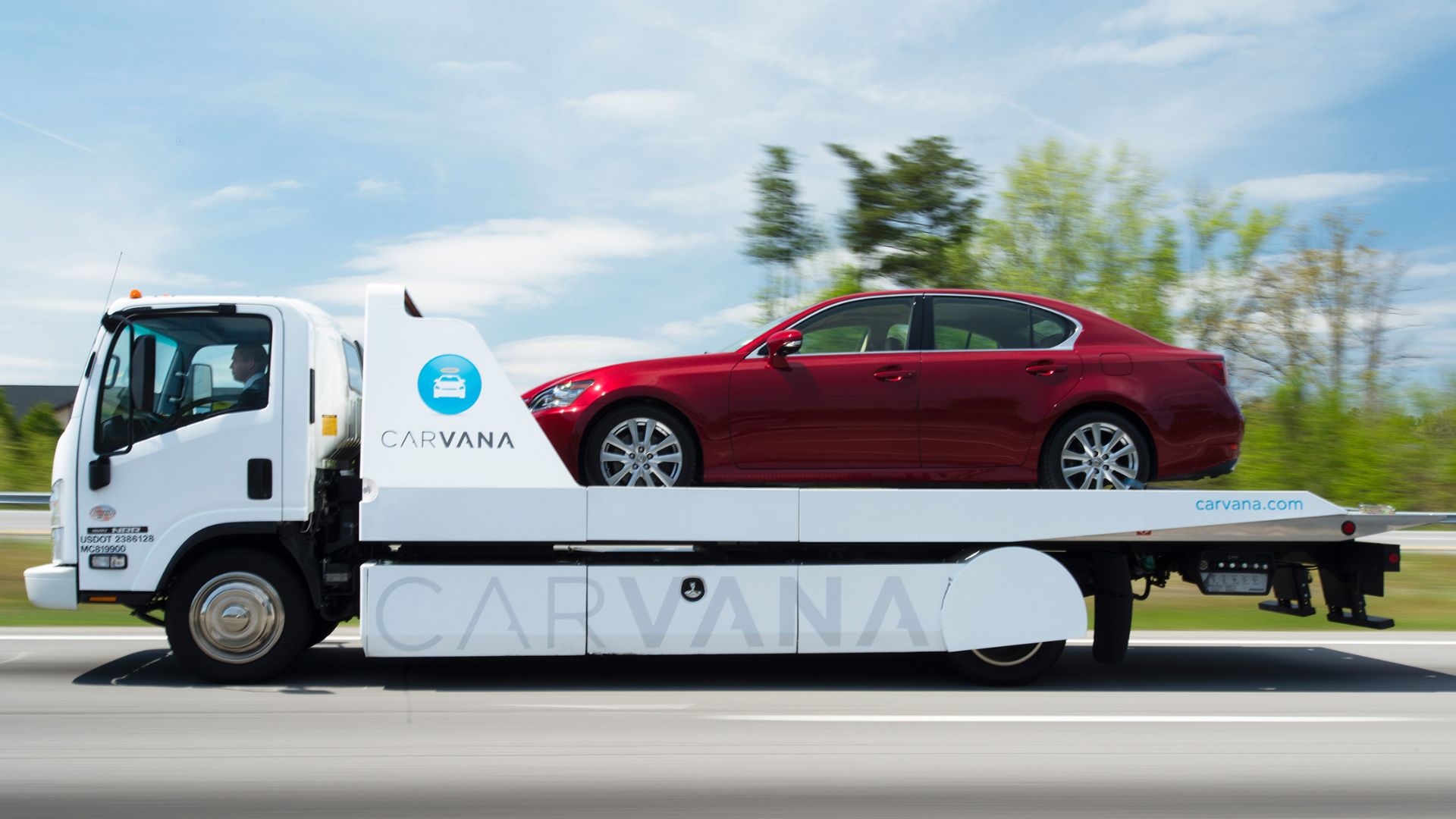
Carvana had the best quarter in its history on Wednesday and got its head kicked in for it. Nearly 200,000 cars retailed, revenue up more than half, record operating income, record SG&A efficiency — and the stock dropped double digits the moment the guidance line hit the tape. If you only read the headline number, that looks irrational. If you read the filing, it isn’t.
Here’s what actually happened, and why the interesting part has nothing to do with the stock price.
The numbers, then the problem
Per the shareholder letter filed with the SEC, Q2 retail units hit 197,325, up 37.7% year over year. Revenue was $7.376 billion, up 52.4%. Net income landed at $513 million on a 7.0% margin, and adjusted EBITDA came in at $769 million. Ernie Garcia’s framing in the press release was that “our model gets better as we get bigger,” which the growth line supports.
Related Articles
- BYD’s Humanoid Robot Debuts in August, and the Robot Isn’t the Part That Should Worry Everyone Else
- Brazil Is Buying Chinese Cars By the Billions. The Real Fight Is Over Screwdrivers
Then the outlook: full-year 2026 adjusted EBITDA of $2.7 billion to $3.0 billion, against $2.24 billion for all of 2025.
Do the arithmetic nobody does out loud. Q1 delivered $672 million and Q2 delivered $769 million, so the first half already banked $1.441 billion. The top end of full-year guidance leaves roughly $1.56 billion for the back half; the bottom end leaves about $1.26 billion. Carvana simultaneously told investors to expect higher unit volume sequentially in Q3.
More cars, flat-to-lower profit. That combination is the entire story.
Where a Carvana car’s profit actually comes from
Total gross profit per unit was $7,014, down $412 from a year ago. But the composition matters far more than the headline, and this is the part most people get wrong about the company.
Of that $7,014, retail vehicle gross profit was $3,547. Wholesale contributed $801. The remaining $2,666 sits in a bucket labeled “other,” and “other” is overwhelmingly the loan.
Look at the cash flow statement. In the first half, Carvana originated $9.005 billion in finance receivables, sold $9.323 billion of them, and booked $703 million in gain on loan sales. Spread across 384,718 retail units, that’s roughly $1,827 of gross profit per car generated by writing paper and selling it — before you count a single dollar earned on the vehicle itself.
Carvana is a subprime-to-prime auto lender with an extremely good logistics operation bolted to the front of it. The vending machines are marketing. The securitization desk is the business.
The squeeze is a rate squeeze, and it’s arguably good for you
Other GPU fell to $2,666 from $2,869 a year ago. The letter explains why with unusual bluntness: with benchmark rates and industry retail prices both drifting higher, “we followed the market on retail pricing but kept customer-facing interest rates stable.”
Translate that. Carvana originates a loan at a fixed APR, warehouses it, then bundles and sells it. The profit is the spread between what the borrower pays and what the bond market demands. When benchmark rates rise between origination and sale and you refuse to raise the customer’s APR to match, the spread compresses and the gain on sale shrinks.
Carvana ate that. Deliberately. It used retail price as the lever instead of rate — which is a meaningfully different choice than the one most dealer F&I offices would make. The margin damage shows up in the guidance the market just punished. If you financed a car there this spring, you were on the good end of that trade.
Why “used car prices went up” in 2026 is partly an accounting story
The other half of the GPU explanation is the one every car buyer should file away. Retail GPU improved sequentially, and the letter credits rising industry retail prices following FTC guidance that mandatory dealer fees must be baked into advertised prices — noting, pointedly, that Carvana doesn’t charge those fees.
That guidance is real. On March 13, 2026, the FTC warned 97 auto dealership groups that advertised prices must be “the total price—including all mandatory fees” a consumer will have to pay. Bureau of Consumer Protection Director Christopher Mufarrige framed it as stopping dealers from luring buyers with a low number and stacking mandatory charges on at the end.
Related Articles
- Audi Already Closed One EV Plant. The One It Might Close Next Builds an EV, Too.
- Trump’s Michigan Tariff Victory Lap Starred a Factory Built to Bury GM’s EV Trucks
So when you notice listing prices jumped this year, understand what part of that is inflation and what part is your $799 doc fee migrating from page four of the buyer’s order onto the windshield. The out-the-door number didn’t move. The advertised number caught up to reality. If you shopped in 2024 and are shopping now, compare out-the-door to out-the-door or you will conclude the market got worse than it did.
The mix shift nobody’s flagging
Carvana’s average retail selling price hit $27,908, up 17.4% year over year.
Now compare that to the actual market. The Manheim Used Vehicle Value Index closed June at 212.9, up 2.1% from a year earlier on a mix-, mileage- and seasonally adjusted basis, with wholesale days’ supply at 27. Wholesale values did not rise 17%.
The gap is mix. Carvana grew inventory hard — vehicle inventory on the balance sheet climbed to $3.263 billion from $2.408 billion at year-end — and the cars it added skew newer and better equipped. For someone shopping a three-year-old crossover with options, selection is genuinely better than it’s ever been. For someone hunting a sub-$15,000 commuter, the thinning at the bottom is real, and it isn’t unique to Carvana.
One wrinkle worth knowing if you’re EV-curious: Cox reported the Manheim EV index up 12% year over year in June against 1.7% for non-EVs, driven by more off-lease product arriving. Used EV values are firming while used EV supply grows, which is an unusual and probably temporary combination.
Reconditioning is the actual moat, and it’s where the capex is going
The least glamorous section of the letter is the most important one. Carvana integrated retail production at three more ADESA locations in Q2, bringing the total to 19, and started its first full buildout at an ADESA site with production targeted for early 2027. Current footprint supports roughly 1.5 million retail units of annual built-out capacity, with real estate on hand to eventually support three million.
Reconditioning is the part of used-car retail that separates operators from resellers — inspection, mechanical repair, tires and brakes, cosmetic work, photography, then getting the car listed before it depreciates in your own lot. Carvana measures it in labor hours per unit and says it’s holding near best-ever HPU while accelerating inventory growth, with its management tooling live at only five production sites in June.
Here’s the honest read on the guidance: the company explicitly said it’s building excess reconditioning capacity ahead of demand. Capacity costs money before it makes money. A soft-looking second half is what deliberate overbuild looks like on an income statement. Whether that’s discipline or optimism depends on whether the units show up.
There’s also a geographic tell buyers should note. Regions where production growth outpaced the company average posted above-average sales growth; the letter identifies the Midwest and Northeast as the top two and the Southeast and West as the bottom two. If you’re shopping from Georgia or California and the selection feels thinner than the ads imply, that’s why.
Two things to check before you value the company or buy from it
For investors: 718,978 thousand Class A shares are outstanding, but on full conversion of LLC units the letter puts the count at 1.127 billion — a legacy of the 2017 Up-C structure. There’s also a tax receivable agreement liability of $2.130 billion sitting on the balance sheet, of which $1.645 billion is owed to related parties. Neither of those appears in a headline EPS figure.
For buyers: the model still hinges on you being comfortable purchasing a car you haven’t driven. The seven-day return window is the real consumer protection here, and it’s only worth what you do with it. Book a pre-purchase inspection at an independent shop the day the car lands, not on day six. And since Carvana just told the world it’s holding customer APRs steady while the market moves up, spend fifteen minutes getting a credit union pre-approval anyway — the answer is less obvious than it was a year ago, which is exactly why it’s worth checking.
Images Via: Wikipedia