
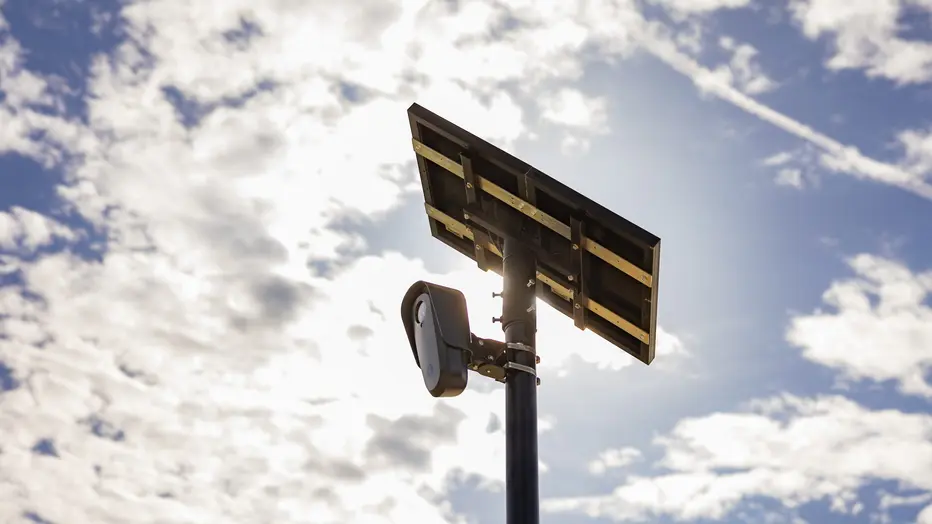
A minivan does not look anything like a pickup truck. Different silhouette, different proportions, different everything a human eye can process in half a second. But the algorithm reading a license plate at highway speed does not see a minivan or a truck. It sees a string of characters and a probability score. In Wichita, Kansas, that distinction reportedly got one innocent family pulled over at gunpoint, because a citywide camera network flagged their minivan as a stolen pickup. That mismatch, buried inside a new lawsuit against the city, is the real story here. Not the privacy debate everyone assumes this is about.
The lawsuit, filed July 30 in Sedgwick County District Court, comes from Mason Grimmett, a Wichita resident represented by the Kansas Justice Institute. His argument is simple: the city’s roughly 200 Flock Safety license-plate readers photograph, log, and database every vehicle that passes them, without a warrant, without probable cause, and without a judge ever signing off on any of it. Grimmett isn’t asking for money. He wants a court to declare the program unconstitutional under Section 15 of the Kansas Bill of Rights and order the cameras dismantled entirely.
Wichita is a small piece of a much bigger machine. Flock Safety says its network now spans more than 120,000 cameras across over 5,000 communities in 49 states, running something like 20 billion license-plate scans every month. Wichita alone shares its feed with more than 100 other law enforcement agencies, some of which reportedly share it again with agencies Wichita has never audited or even identified. The city’s own court filing concedes it has no real way of tracking where its data ends up once it leaves the building.
Here’s the number that should stop any car person cold. Grimmett’s complaint cites Wichita’s own logs: 904,603 license-plate searches run through its camera network in a single 32-day stretch this summer. Flock’s publicly stated accuracy runs 80 to 85 percent. Do that math and Wichita’s cameras were plausibly wrong somewhere between 135,000 and 180,000 times, in one mid-sized city, in one month. The lawsuit says one of those errors sent officers after a family’s minivan that the system had confused for a stolen pickup truck. Nobody recalls a license-plate reader when it misfires like that. There’s no defect investigation for a camera that gets the make and model wrong. It just tries again on the next car.
The deeper irony is what a license plate was actually built to do. States started mandating them in the early 1900s for one dull administrative reason: proving a vehicle’s registration and insurance were current. It was bookkeeping stamped onto aluminum. Grimmett’s lawsuit argues that bolting a century-old bookkeeping tool to an AI camera network has quietly turned it into something else, describing it in the filing as “the functional equivalent of affixing a GPS tracking device.” That phrase leans on the Supreme Court’s 2012 ruling in United States v. Jones, which found that physically attaching a GPS tracker to a car without a warrant is itself a search, whether or not the tracker ever transmits anything useful.
The lawsuit also points at a vulnerability no software patch can close: the officers who already have logins. It cites former Kechi Police Lt. Victor Heiar, sentenced to probation for using Flock cameras to track a woman, and a separate Sedgwick-area case in which an officer reportedly ran an ex-girlfriend’s plate through the system 164 times. When one of those abuses surfaced publicly in 2022, the Wichita captain who oversees the city’s ALPR program told a local reporter he wasn’t particularly bothered by it, framing the misuse as inevitable rather than as a failure. That’s not the kind of comment a city wants read aloud in court.
None of this is happening in isolation. The Auto Wire has already covered a parallel fight in California, where a private tow-truck network has scanned nine billion license plates with even less public oversight than any police department answers to. San Jose residents filed a class action over that city’s roughly 500 Flock cameras back in April, and in Congress, a small coalition of lawmakers has introduced bills that would cut federal funding to cities that keep running the cameras. Flock’s own founder has publicly described his ambition in blunter terms: a camera on every street corner in the country.
Car owners have spent the last few years watching automakers dream up increasingly elaborate ways to protect a parked vehicle, including Ford’s patent for cars that arrange themselves into a defensive ring against thieves. Meanwhile the public streets those same cars park on have been quietly re-equipped to watch every vehicle that drives past, guilty or not, at an error rate that would be treated as a serious defect anywhere else in the automotive world.
Whatever a judge in Sedgwick County eventually decides, the more interesting fact is already sitting inside Grimmett’s complaint. A piece of equipment every driver is legally required to bolt to their car has been quietly upgraded into a tracking sensor, with no accuracy standard, no recall process, and no vote. A license plate was built to prove you paid for the privilege of driving. Somewhere in the last few years, without anyone asking permission, it became the thing that watches you do it.