
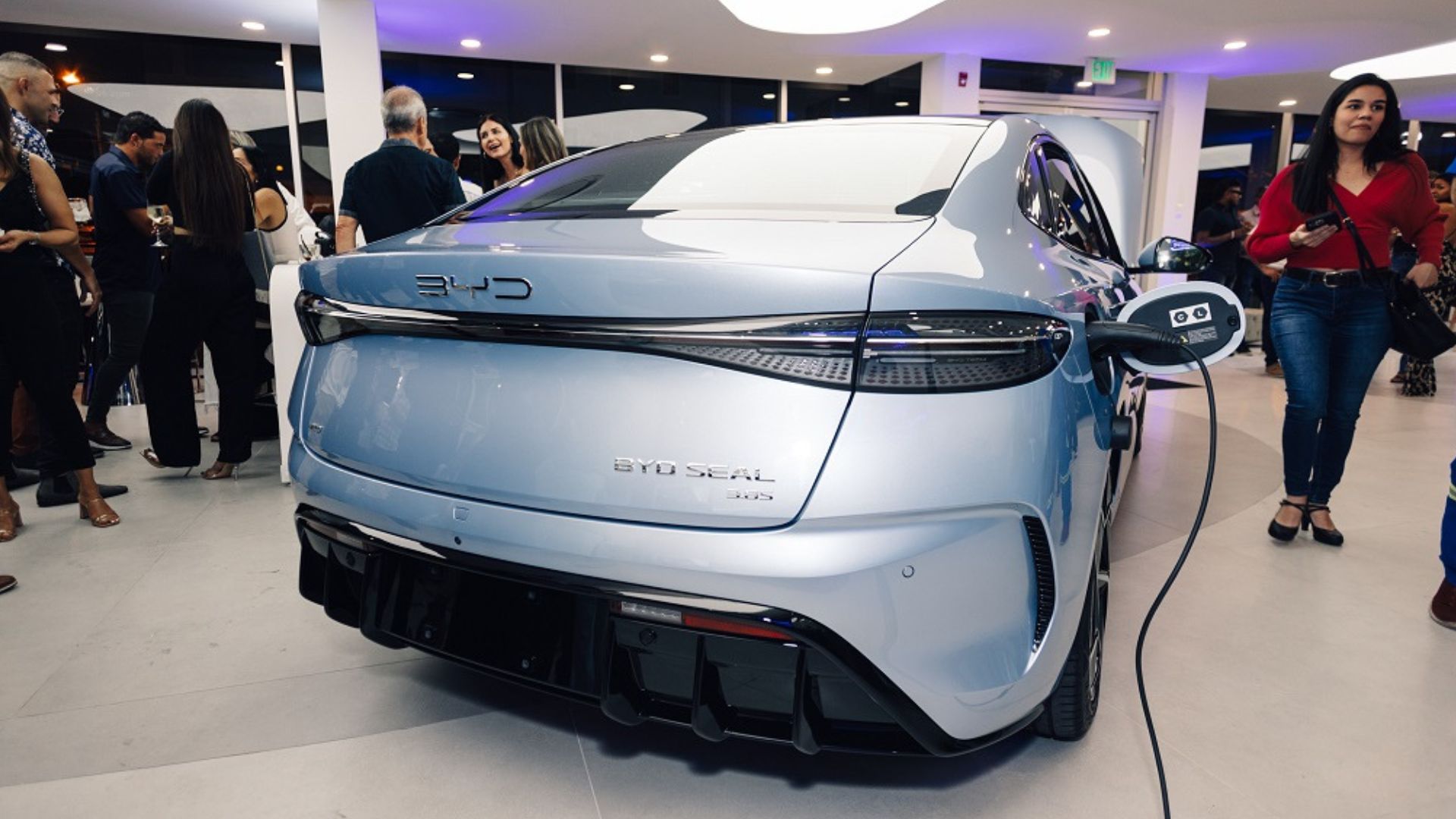
BYD has run this play twice before. In 1995, it started as a battery maker, winding lithium-ion cells for Nokia and Motorola handsets. In 2003, it took that battery and manufacturing know-how and bought its way into the car business, back when almost nobody outside China took a battery company turned automaker seriously. Now, starting in early August at a Di Space showroom in Zhengzhou, BYD is running the same play a third time. Only this time, the product rolling off the same manufacturing base walks, talks, and can point out the panoramic sunroof.
BYD confirmed this week that its first humanoid robot will debut at Zhengzhou Di Space in early August, following a teaser poster posted at the venue on July 25 that showed a robot silhouette emerging from a halo of light with the tagline “a new friend wants to meet you.” The company says this isn’t a sudden pivot. Its embodied-intelligence research team has existed since 2022, and by late 2024 its recruiting arm was actively hiring senior algorithm, structure, simulation, and hardware engineers for the program. BYD has already deployed process robots, collaborative robots, and autonomous mobile robots inside its own operations; the humanoid is simply the next rung up.
In May, BYD executive vice president Stella Li laid out the actual business plan in plain terms: two or three humanoid robots in every showroom, greeting customers, explaining features, and eventually performing live vehicle demonstrations, with mass rollout targeted within one to two years. Li also offered the company’s rationale for why this is easy: the motors, batteries, and control systems it already refines for cars, she said, carry over directly to robots, cutting R&D and manufacturing costs. BYD has also gone out of its way to shut down the rumors that tend to attach themselves to any Chinese robotics story, dismissing talk of a codename, a supposed seventh-generation prototype, and a 20,000-unit deployment this year as simply not matching where the program actually stands.
That claim of direct transferability is worth pausing on, because it’s doing more work in this story than it looks like.
Here’s the part that doesn’t get said out loud: an EV traction motor and a humanoid robot’s joint actuator are not the same kind of machine, even though both have a rotor, a stator, and copper windings. A traction motor is built to deliver continuous rotational torque at speed, through one or two fixed gear ratios, for hundreds of thousands of miles. A robot’s shoulder or ankle joint needs something closer to the opposite: low speed, extremely high torque density, and the ability to be back-driven and force-controlled in real time so the robot doesn’t crush whatever it’s touching. Bolting a car motor onto a robot arm doesn’t work. What actually transfers is everything underneath the motor: the ability to wind copper at gigafactory scale, design power electronics and inverters in-house, source and pack battery cells with a mature battery management system, and run perception and control software on chips BYD already designs itself through its own semiconductor unit.
That’s not a small advantage. It’s arguably the only advantage that matters in robotics right now. But it’s a manufacturing and supply-chain advantage, not a parts-bin swap. BYD isn’t building robots out of spare car parts. It’s building robots out of spare car-company infrastructure.
That distinction is the actual story, and it’s also BYD’s whole history in miniature. The company has never really been in the battery business, or the car business, or now the robot business. It’s been in the business of owning a manufacturing base end to end and finding new products to run through it. Batteries funded the pivot into cars. Cars are now funding the pivot into robots. The showroom greeter isn’t a new invention. It’s a receipt showing how cheap a new product line becomes once you already own the factory.
There’s a second thing nobody’s saying directly, and it’s less about engineering than about the sales floor. China’s EV market has spent the past two years in a brutal price war that has already forced a shakeout, and thin margins at the factory tend to show up eventually as thin margins at the dealership too. A showroom robot that greets customers, explains trims, and can run a demo doesn’t need a salary, a commission, or a shift schedule. Li didn’t frame the rollout as a labor-cost play in her comments, but two or three tireless “employees” per showroom, deployable at scale, is exactly the kind of fix a company reaches for when it’s trying to protect showroom economics without cutting the thing customers actually see. It’s the retail version of what Hyundai and Kia are doing by engineering interiors around cars nobody’s left to clean: quietly building around a labor problem instead of talking about it.
None of this is happening in isolation. BYD is late to this idea, not early. Tesla and Hyundai are already treating robot production as arguably more important than car production, and Hyundai’s full acquisition of Boston Dynamics was the clearest signal yet that automakers see humanoid robots as a business, not a science project. GM has run a smaller version of the same bet at its own Detroit plant, cutting more than a thousand jobs while adding robots and still posting a $4.25 billion quarterly profit. Xiaomi, which also builds EVs, already has humanoids working its own assembly line, hitting a 98% success rate on a self-tapping nut station within a single quarter of iteration, a hair behind human performance. That’s the detail worth sitting with. This isn’t a demo reel. It’s a production floor running mixed human-and-robot labor today, not on a five-year roadmap slide.
The supply chain is moving for the same underlying reason. RoboSense, which built its business selling lidar for driver-assist systems, saw its robotics-sector lidar shipments jump more than 500% year-over-year in the first half of this year, and it now counts nearly 50 humanoid and quadruped robot makers among its customers. That’s an automotive supplier discovering a second customer base for a sensor it was already mass-producing, the same logic BYD is applying to motors and batteries one tier further up the chain. When a car company’s own suppliers start selling identical parts into robotics, that’s usually a sign the car business itself has stopped growing fast enough to absorb them on its own. Tesla just posted $100 billion in trailing revenue with operating profit cut by more than half, which is the blunt version of the same pressure: when margins on the cars get squeezed, robots become the growth story a company tells instead.
That’s also why BYD’s insistence on shutting down its own hype matters more than it looks. Tesla’s Optimus has become a story that can move a stock independent of any robot actually shipping in volume. BYD, by contrast, is publicly knocking down inflated numbers about its own program before the robot has even walked on stage. That’s not modesty. It’s a company that has built its reputation on manufacturing credibility, not narrative, protecting that reputation by refusing to let a robot become a promise it can’t keep.
One more thing worth knowing before the robot rolls out in Zhengzhou: a car dealership is not a fenced-off factory cell. Industrial robots have spent more than 60 years working behind cages precisely because a machine that strong shouldn’t share space with an unprotected human. A robot greeting customers and popping open doors on a showroom floor is a cobot working in an uncontrolled public environment, which is a very different safety and liability category than anything BYD’s line workers deal with, and one regulators in China, and eventually elsewhere, haven’t fully written rules for yet. That’s not a reason to assume disaster. It’s a reason this rollout will be watched by more than just tech reporters.
Building a robot that can greet a customer proves an engineering team is clever. Building it almost as a byproduct of parts you were already stamping out by the million proves you own the factory floor, not just the resume. That’s the difference between BYD’s robot and a novelty act, and it’s the reason rivals without BYD’s vertical integration should be watching Zhengzhou more closely than the teaser poster suggests.