
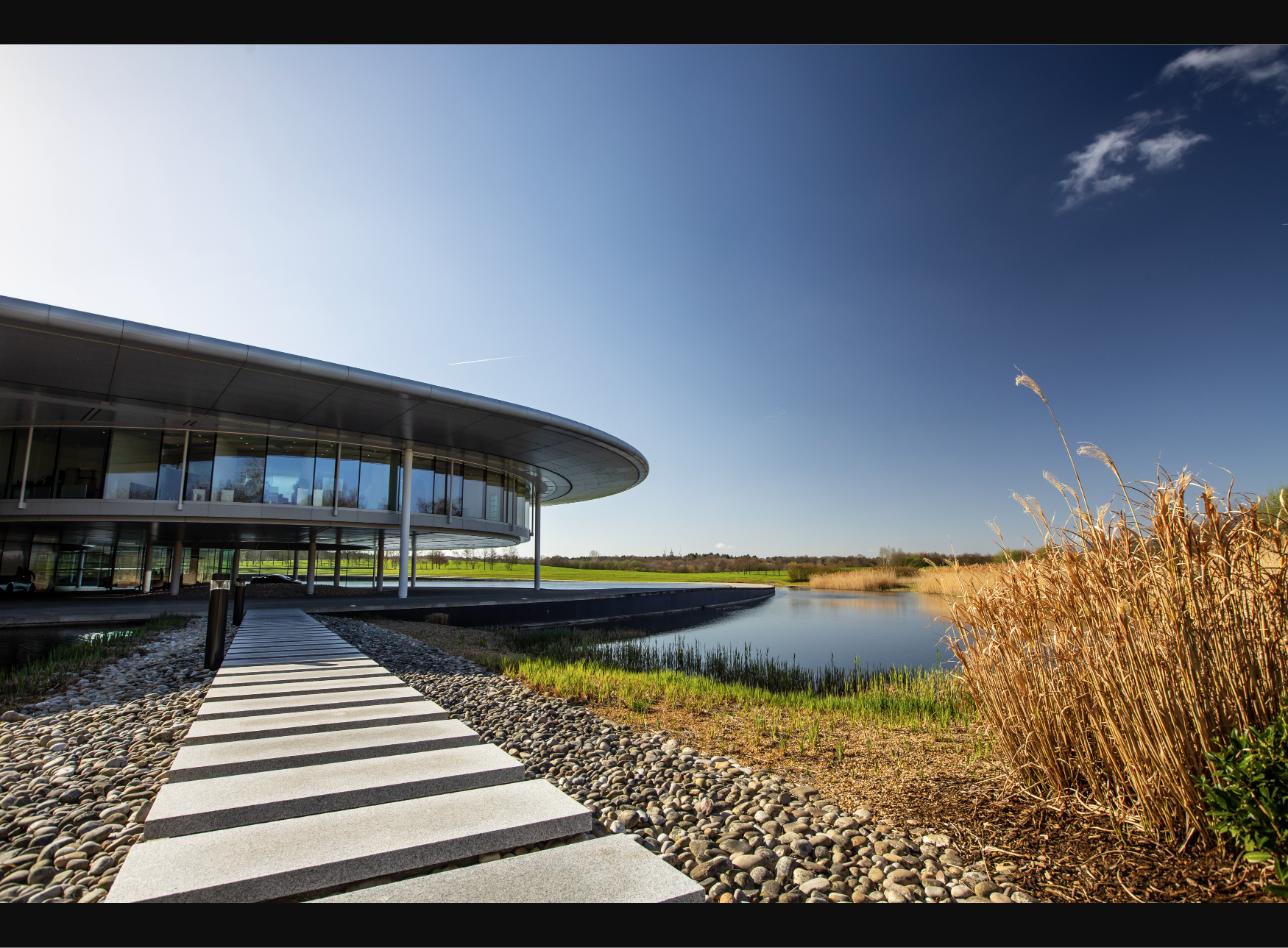
Somewhere in Woking, a hiring manager posted a job listing this week for a “Head of General Assembly and End of Line Manufacturing Engineering.” Nobody at McLaren has said, on the record, that the company is spending £450 million to build a bigger version of itself. But you don’t title a job “Head of General Assembly” for a business planning to keep building the same few thousand mid-engined coupes a year inside the same production hall it has used since 2011.
That is the real story here, and it is not the number everyone has been repeating this week. It is what McLaren is quietly doing while its official channels say nothing at all.
A reported £450 million commitment tied to the McLaren Technology Centre in Woking, with talk of roughly 1,000 new jobs, has circulated widely over the past several days. McLaren has not confirmed it. There is no release on the company’s own newsroom, no statement from the UK’s Department for Business and Trade, and no filing that puts a number on paper. What is actually attributable to McLaren, on the record, is thinner than a headline figure, and more useful: the company’s own careers site.
As of this week, McLaren’s UK job board lists more than 120 open positions, a large share of them tied to Woking and to manufacturing. Two senior manufacturing roles, Head of General Assembly and End of Line Manufacturing Engineering and Head of Body Assembly Manufacturing Engineering, were posted within the past two days, alongside openings for a manufacturing engineer, an inbound logistics leader, and an MPC Paint Principal Technician. MPC is shorthand for the McLaren Production Centre, the low-volume assembly hall that opened next to the Technology Centre in 2011.
That detail matters more than it looks. Assembly-line leadership is not a role you advertise to dress up a press day. It is a role you fill twelve to eighteen months before a line actually runs, because someone has to design the build sequence, order the tooling, and train the people who will stand at each station. If McLaren is hiring for that job now, a production timeline is already moving, whatever gets confirmed publicly, and whenever it gets confirmed.
Why now, and why McLaren can afford to stay quiet about it
The case for a bigger Woking campus is not really about ambition. It is about ownership.
In April 2025, CYVN Holdings, an Abu Dhabi government-owned investment vehicle, completed its acquisition of McLaren Automotive and folded the business into a newly created holding company, McLaren Group Holdings, run by chief executive Nick Collins. At the time, McLaren Racing’s executive chairman, Paul Walsh, said the deal would “provide long-term stability and help future-proof the business,” language a company does not usually reach for unless stability had genuinely been in question.
Sovereign capital changes what a company can commit to. A privately financed supercar maker servicing its own debt has to justify a nine-figure building programme to lenders every quarter. A subsidiary of a state-owned investment vehicle answers to a different set of incentives, ones built around decades rather than fiscal years. That is the quiet advantage a £450 million commitment, confirmed or not, would be leaning on.
Bucking a shrinking industry
Whatever McLaren ends up building, it would be doing so against a UK auto sector that is contracting, not expanding. According to The Society of Motor Manufacturers and Traders, UK car production fell 10.6 percent year-on-year in July 2026 alone, and is down 4.7 percent for the year to date. Export volumes, which make up roughly three-quarters of everything built in Britain, fell even faster, down 15.8 percent in July.
Set against that backdrop, a manufacturer hiring assembly-line leadership and logistics staff in Woking is not just a corporate news item. It is a genuine outlier in an industry that has spent the past year cutting more than it has built. Whether McLaren is expanding capacity for its existing supercar line, tooling up for an entirely new vehicle category, or both, the direction of travel on its own job board runs opposite to the market it operates in.
What actually changes, and what does not
For current owners, none of this changes anything about parts, service, or warranty support in the near term. McLaren Automotive Limited keeps running exactly as it has. What does change, if the hiring pattern holds, is the long-run case for buying into the brand at all. A manufacturer investing in permanent production and validation infrastructure, rather than leasing capacity or outsourcing it, is a manufacturer signaling it expects to be building and supporting cars for a long time. For a marque whose resale values have occasionally been dinged by exactly the opposite worry, that is not a small thing.
The number everyone is quoting this week might turn out to be accurate, inflated, or simply premature. Auto Wire has already traced the property paper trail behind that figure in detail, from the 2021 sale-leaseback of the Technology Centre to last year’s change of landlord. What is harder to argue with is a company posting real manufacturing leadership vacancies in real time. A press release can be delayed indefinitely. A build schedule cannot.