
Genesis wants this to read as a warm local-news item: $65,000 split across five youth groups in coastal Georgia, plus a robotics-and-design workshop for a room full of middle schoolers. That is the press release. It is not the interesting part.
The interesting part is who Genesis is actually trying to reach, and how far in advance it started.
Follow the money, not the mission statement.
On paper, the donations are straightforward. Genesis split $65,000 among First Tee Savannah, the Frank Callen Boys & Girls Club, Girls on the Run South Georgia, Savannah United, and the Savannah College of Art and Design, extending partnerships that in some cases date back to 2022. Separately, Genesis staff and designers ran a workshop with the nonprofit Child Creativity Lab at Ebenezer Middle School in Rincon, where students studied vehicle design and built future mobility concepts out of upcycled materials.
Buried in the announcement is the detail that explains everything else: this stretch of coastal Georgia is home to Hyundai Motor Group Metaplant America, the company’s dedicated electric vehicle and battery manufacturing complex in Bryan County. That is not scene-setting. It is the reason the check exists.
By Hyundai Motor Group’s own account of the site, HMGMA sits on a 2,900-acre megasite about 30 miles west of downtown Savannah, anchored by an economic development agreement worth more than $7.5 billion, the largest in Georgia’s history. Once fully staffed, the plant and its on-site partners will employ more than 8,500 people, with another 6,900 jobs created at outside suppliers.
Set against those figures, $65,000 isn’t a rounding error. It’s the shadow one casts. But it’s aimed with real precision.
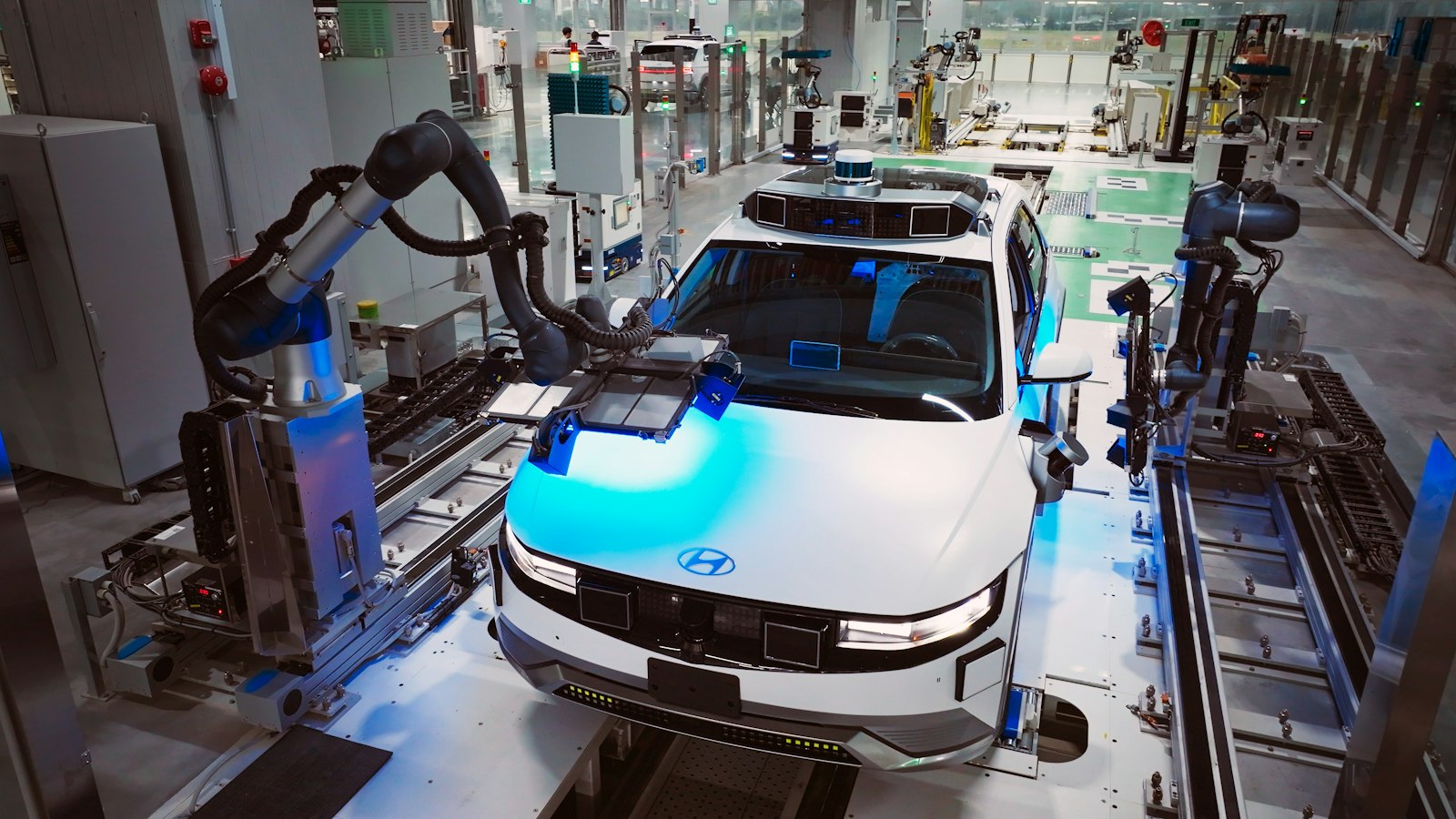
HMGMA isn’t a conventional stamping-and-welding assembly hall. Hyundai built it to run up to ten different vehicle models down a single flexible line with minimal retooling, using robots for heavy lifting, automated guided vehicles to move parts, and AI-driven systems to manage everything from ordering to production scheduling. A plant like that doesn’t need more hands on the line. It needs people who can read a control panel, troubleshoot a robot, and think in systems, which is a different hiring pool than the one automakers drew from a generation ago.
That is precisely what the Ebenezer Middle School workshop was teaching. Not a generic science fair, but vehicle design and where transportation technology is headed, led by people who build cars for Hyundai Motor Group’s brands. Genesis isn’t funding STEAM education in the abstract. It’s introducing the exact discipline it will need staffed a decade from now, in the school district closest to the plant that will need it.
Fifty years ago, an automaker recruited its workforce out of a local high school’s shop class. Genesis is starting in middle school, with sketchbooks instead of wrenches.
Here’s a detail Genesis left out of its own release: Hyundai Motor Group has said HMGMA was designed from the start to eventually build vehicles for all three of its brands, Hyundai, Kia, and Genesis. The plant currently builds the Hyundai IONIQ 5, the IONIQ 9, and the Kia Sportage Hybrid. When Genesis-badged production eventually arrives in Bryan County, the brand won’t just be donating near its parent company’s factory. It will be recruiting for its own.
That distinction is worth sitting with. The same site is already scheduled to put a very different kind of new hire to work in 2028: an Atlas humanoid robot from Boston Dynamics, handling parts-sequencing on the floor, as The Auto Wire reported this summer. Hyundai’s unionized plant in Ulsan spent this year fighting over jobs, pay, and how much say workers get over exactly that kind of automation. HMGMA never has to have that fight. It’s a non-union plant with no legacy workforce to protect and no bargaining table for the argument to land on. Every job there, human or robotic, is being defined from scratch, and Genesis clearly wants a say in who fills the human half of that ledger.
There’s a market hedge buried in here too. Electric vehicle sales pulled back sharply after the federal $7,500 tax credit disappeared last year, and patience with multibillion-dollar EV plant promises has grown noticeably thinner across the industry. The Bryan County agreement isn’t going anywhere because of one soft sales quarter, but the local goodwill that keeps a project this size supported by school boards, technical colleges, and county commissioners for the next twenty years is not something a company can assume it will keep. A youth golf league and a middle school workshop are cheap insurance against losing it.
None of this makes the donation cynical. Girls on the Run, the Boys & Girls Club, and SCAD’s design students will genuinely benefit from real money doing real good this month. But it’s worth reading corporate community-investment announcements like this one as workforce and site-planning documents wearing a friendlier font, not as charity coverage. The $65,000 clears immediately. The dividend, a technically literate labor pool within commuting distance of a 2,900-acre megasite, doesn’t mature until the kids at Ebenezer Middle School are old enough to badge in.
Does a donation like this change how you see a brand, or is it just good PR? Tell us in the comments.