
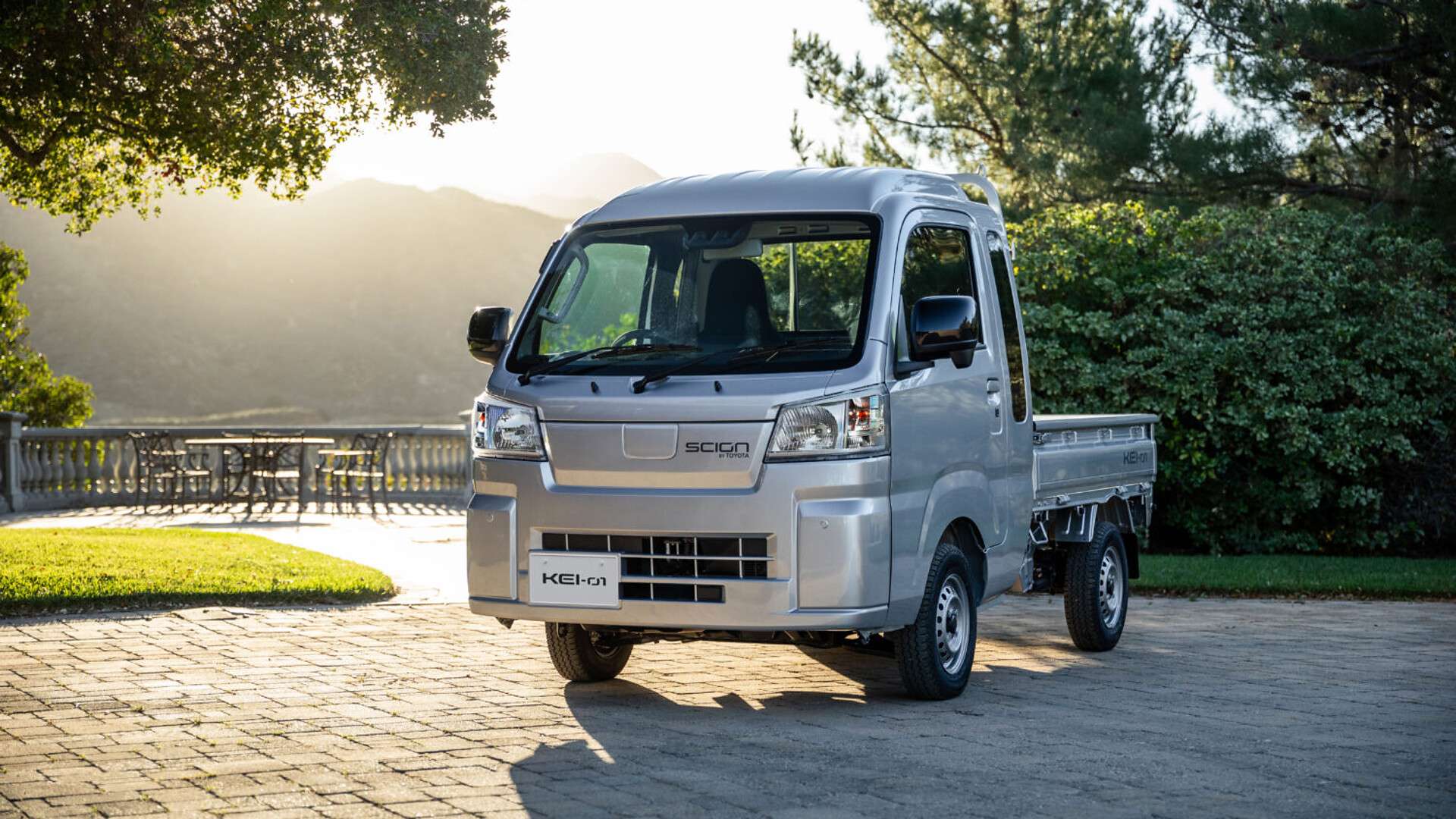
Toyota is bringing a kei truck to America, just not the one enthusiasts have spent years importing. The KEI-01 does 25 mph, sells to fleets only, and has no price yet. Georgia, meanwhile, still won’t budge on the real ones.
Toyota announced the Scion by Toyota KEI-01 on November 10 and will assemble it in Indiana, expecting to reach U.S. fleet customers in the second half of 2027. It pairs a 660cc engine with four-wheel drive in a body just over 11 feet long. What Toyota didn’t say: price, horsepower, fuel economy, towing rating, seating capacity. It calls the truck intentionally low-volume and niche, which is one way to explain a thin spec sheet.
In Georgia, owners of imported Japanese kei trucks are still fighting to title and register them. Toyota gets an Indiana assembly line for its kei-style truck. The people who proved there was a market still can’t count on a tag.
So who gets a small truck on American roads: the automaker with a press release, or the owner who already bought one?
What Toyota Has Confirmed, and What It Hasn’t
Scion is back, sort of. The KEI-01 debuts under the new Scion by Toyota banner, a name that used to mean cheap compact cars and now means a fleet truck.
Toyota says the revived brand exists to try unconventional mobility ideas. First up: a small utility truck for farms, businesses, campuses, and municipalities.
A 660cc three-cylinder drives it through a CVT, with selectable four-wheel drive that has an auto mode and a push-button lock.
It’s just over 11 feet long and under five feet wide, so it fits places a normal pickup doesn’t. The steering wheel sits on the right, which will look odd to anyone used to American roads.
The bed folds down on three sides and carries up to 600 pounds, Toyota says. Inside the enclosed extended cab you get heat, A/C, adjustable seats, and storage behind them. The release also says the structure is stiff enough for towing small trailers and equipment, but it publishes no towing rating.
Toyota is putting $34 million into its Indiana operations for the KEI-01, a move expected to create about 50 jobs. That’s small by automaker standards, and it fits Toyota’s own low-volume description.
Sales start with a fleet-focused pilot at selected Scion by Toyota dealers. Toyota says limited retail sales may come later, depending on market conditions and demand, but it has confirmed no consumer launch date. It hasn’t announced a price either, though it describes the truck as affordable.
Then the number that decides everything: 25 mph, flat out.
Why Toyota’s Kei Truck Is Different From Japanese Imports
Toyota’s KEI-01 borrows the kei idea but not the way imports get here.
Kei trucks from Suzuki, Honda, Daihatsu, and Mitsubishi won American fans by being small and cheap to own, and by hauling more than they look like they should. The Honda Vamos shows how odd that corner of Japan’s market gets.
Many come in under the federal rule that lets vehicles 25 years or older skip the safety standards that applied when they were built.
Federal import eligibility only gets a truck to the border, though. Whether a state will register it is a separate fight.
Toyota skips the 25-year exemption and says it engineered the KEI-01 to meet FMVSS No. 500, the federal standard for low-speed vehicles. That’s a design goal. Its release doesn’t claim the truck has been certified.
That classification explains the 25-mph limit and separates the KEI-01 from many imported kei trucks, which go much faster. Toyota has traded speed for regulatory clarity.
That’s a cleaner path to market. It doesn’t settle where the truck can go, because states decide where low-speed vehicles may operate.
Georgia Still Hasn’t Budged
Georgia is the clearest case of what imported kei owners are up against.
In 2023, Georgia’s Department of Revenue began restricting titles and registrations for Japanese kei vehicles, saying they don’t meet federal motor vehicle safety standards.
Owners pushed back hard, especially after reports that trucks already registered got swept in too.
11Alive reported that local tag offices first titled and tagged many owners’ vehicles. The Department of Revenue then sent those offices notices saying the vehicles don’t meet federal safety standards and aren’t street legal. It later acknowledged that drivers and tag offices had been confused about the law, and noted that some states do allow kei vehicles.
One owner, Charlie Ping, spent about $6,000 shipping a kei car from Japan. Six months after he got it, a letter arrived saying his title was revoked and he had ten days to return it. Attorney Steven Lefkoff, who represents some owners, disputes that the vehicles are unsafe: they’re “highway safe in Japan,” he told 11Alive.
The Autopian reported in 2023 that owners were preparing legal action, arguing they were losing the ability to legally drive vehicles they had bought and, in some cases, registered. It reported that Georgia hadn’t changed its laws so much as reinterpreted them, following a recommendation from the American Association of Motor Vehicle Administrators, and that an importer leading the effort said some clerks had wrongly denied titles to vehicles that weren’t kei cars. The piece sided with the owners and quoted no Georgia agency, so treat those claims as the owners’ account.
Two Bills, Zero Laws
The fight then moved to the legislature. In 2025, lawmakers passed House Bill 308, which included provisions meant to establish a legal framework for certain miniature vehicles. Governor Brian Kemp vetoed it over a separate provision allowing courts to order intelligent speed assistance devices for reckless stunt drivers, saying the bill did not provide the infrastructure to apply that penalty consistently. The miniature-vehicle provisions went down with it.
Another try came in 2026. House Bill 957, sponsored by Representative Rob Clifton, would have created a pathway for qualifying miniature on-road vehicles to operate legally in Georgia. It passed the House 160-5 in February. The Senate tabled it on March 31, and it never became law.
So as of November 2026 the restrictions stand: one bill vetoed, one stalled in the Senate despite that House vote.
Could Toyota’s KEI-01 Be Legal in Georgia?
Maybe. With asterisks.
Georgia’s restrictions target Japanese kei vehicles that don’t meet federal safety standards. Toyota says it designed the KEI-01 to meet the federal low-speed vehicle rules. That’s a goal, not a completed certification, and the release says nothing about state road use.
A federal category doesn’t guarantee a plate or road access in Georgia. States set their own rules for low-speed vehicles, including which roads they can use.
So don’t confuse this with a regular pickup, or with an imported kei running under the 25-year exemption.
Still, look at the two side by side.
Georgia lawmakers have spent years trying to give imported miniature trucks a legal path and keep failing, while Toyota prepares to sell an American-assembled truck built on the same basic idea. If the worry is federal safety compliance, as Georgia says, the KEI-01 is what a tiny truck designed to a federal category looks like: slower and more limited than the imports. Is that the only version the state will accept?
The two kinds of truck are close in size and far apart on the things regulators care about. A manufacturer can design to a federal category. An owner of an imported truck can only sue or lobby, and the lobbying route has so far produced one veto and one tabled bill.
What the KEI-01 Actually Changes
The timing is convenient. The average financed new-car payment has reached $787 a month, and last December Donald Trump publicly urged automakers to build kei-style “tiny cars” in the U.S. Toyota still hasn’t put a price on this one.
For decades, pickups have chased bigger and more powerful. The KEI-01 goes the other way.
The pitch is a small, simple truck for everyday chores without a full-size pickup’s bulk. Whether it’s also cheap is unknown until Toyota publishes a price.
At 25 mph this is a truck for campuses and local roads where low-speed vehicles are allowed. The highway is out.
As a personal daily driver, it’s a tough sell. As a workhorse for a fleet that doesn’t need a full-size truck, it makes more sense, and that’s exactly who Toyota’s pilot is aimed at.
Will Toyota ever sell it to regular people? So far it has said only that it may consider limited retail sales.
A major automaker has now entered the American kei-style truck market with a product so constrained it barely counts as an entrance. The regulatory mess around the category is still there.
For Georgia’s enthusiasts, the announcement resolves nothing.
For now the KEI-01 is slow and small, and only fleets can buy it. If you could only register one, would you take Toyota’s 25-mph truck or a faster imported kei?
A note on sourcing: this story began with a tip from a friend on Facebook, who also compiled the background on Georgia’s kei truck restrictions and legislation. That groundwork was theirs, not original reporting by The Auto Wire, and it served as the starting point for this article. The details were then compared against Toyota’s announcement, the governor’s 2025 veto message, and The Autopian’s reporting.
Sources
- Toyota USA Newsroom, Toyota announcement of the Scion by Toyota brand and the KEI-01, Nov. 10, 2026.
- Georgia Governor’s Office, 2025 Veto Messages and Signing Statement (House Bill 308).
- Georgia General Assembly, House Bill 957 legislative record, 2026 session.
- Zoe Skyforest, The Autopian, “Enthusiasts In Georgia Are Trying To Sue The State DMV Over Kei Car Ban,” 2023.
- 11Alive, Miniature Japanese imports: owners hire lawyer after legislature fails