
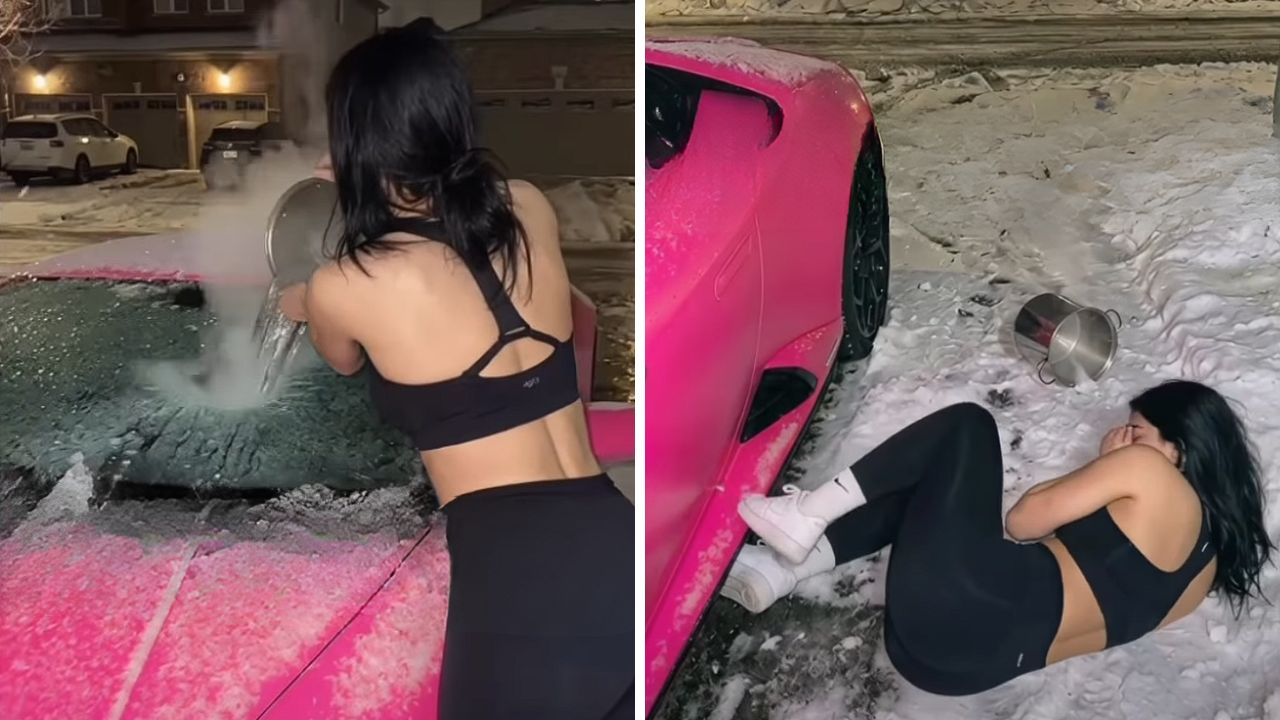
A bright pink Lamborghini Huracán just became the latest cautionary tale in a lesson that resurfaces every winter: hot water and frozen glass do not mix. A viral clip shows the exact moment a windshield fails, and the physics behind it explain why the damage happened almost instantly.
What the Video Actually Shows
Posted to the Instagram account itsmadisonclarkk, the clip shows a woman pouring hot water across the Huracán’s frozen windshield in an attempt to clear the ice quickly. Within moments, the glass fractures violently and collapses inward, sending water pouring directly into the cabin. It’s not a small crack along one edge — the failure spreads across a wide section of the windshield, letting the panel cave in rather than simply splitting.
The Physics: Thermal Shock, Explained
What happened is a textbook case of thermal shock. A frozen windshield sits at a uniformly cold temperature under its layer of ice. Pouring very hot water onto just one section causes that area to expand rapidly while the surrounding glass stays cold and contracted — creating intense, uneven internal stress that the material has to absorb all at once. Even glass with no visible damage can fail under a temperature swing that extreme, and the risk climbs sharply once the water is significantly hotter than the glass surface.
Minor imperfections make it worse. Small stone chips or stress marks that are completely harmless during normal driving can act as weak points once thermal stress is introduced, giving a fracture a place to start and spread rapidly across the surface.
Why This Matters More on a Supercar
Laminated safety glass is built to withstand impacts and protect occupants in a collision, but that engineering doesn’t make it immune to rapid heating or cooling stress. On a car like the Huracán, a shattered windshield isn’t just an inconvenience — specialized parts and installation requirements make the replacement itself considerably more expensive than on a mainstream vehicle. And once the glass fails, water intrusion can reach the dashboard, upholstery, and the kind of complex digital systems and sensors packed into a modern high-performance interior, turning one broken windshield into a much larger repair.
What Actually Works to Clear Ice Safely
The methods that avoid this outcome all share one thing: gradual temperature change. A windshield scraper removes ice mechanically without introducing heat at all. Running the defroster lets warm air raise the glass temperature slowly and evenly. Chemical de-icing sprays work by lowering the ice’s freezing point rather than shocking the glass with a sudden temperature swing. All three take longer than a splash of hot water — which, as this video makes clear, is exactly the point.