
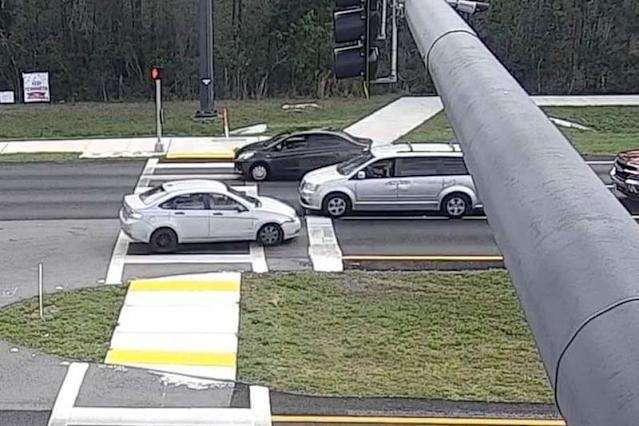
It’s not every day a driver tells law enforcement their car is stuck in reverse, and then decides the fix is to just keep driving anyway. That’s essentially what deputies say happened in Flagler County, Florida, where a routine traffic encounter turned into a legal mess with more layers than it first appears to have.
William Murphy III, 47, was taken into custody after deputies say they encountered him operating a vehicle under unusual circumstances. According to footage shared by the Flagler County Sheriff’s Office, Murphy told deputies his vehicle had malfunctioned and gotten stuck in reverse. Rather than stopping or calling for help, he says he chose to keep driving backward in an attempt to reach a mechanic.
10 Best Safety Items for Your Car
The decision didn’t just raise eyebrows. It resulted in criminal charges and another example of how unusual circumstances behind the wheel don’t erase legal responsibility.
What Deputies Documented
The case centers on Murphy’s own explanation and the footage captured during the encounter, which deputies say showed a vehicle being driven in reverse under conditions that were clearly unsafe.
Murphy’s reasoning, at least by his own account, was straightforward: if the car couldn’t go forward, the only option left was to keep it moving backward until he could get it to a shop. That logic doesn’t hold up against traffic law or basic road safety, and for good reason. Driving in reverse over any real distance on public roads limits visibility, slows reaction time, and puts other drivers in a spot where they have no expectation of encountering a car moving that way. A perceived workaround turned into a genuinely dangerous situation fast.
The Charge That Actually Matters Here
Murphy now faces a charge of driving with a suspended or revoked license, which complicates the situation well beyond the reverse-driving incident itself. This case isn’t only about how the car was being operated, it’s about whether Murphy should have been behind the wheel in the first place.
Driving on a suspended or revoked license is already a serious offense on its own, and stacking an unusual, hazardous driving maneuver on top of it only adds to the scrutiny. Law enforcement doesn’t carve out exceptions for mechanical problems when the person driving isn’t legally permitted to be behind the wheel at all. Murphy was released after posting a $1,000 bond, though the underlying license-related charge could carry consequences well beyond this single stop.
Why an Odd Story Still Matters for Everyday Drivers
It’s tempting to file this away as a one-off, viral-video-worthy incident. But it points to something every driver deals with eventually: responsibility doesn’t evaporate the moment something goes wrong with the vehicle.
Mechanical failures happen to everyone who spends real time behind the wheel. What separates a bad day from a legal problem is how the driver responds. Continuing to operate a compromised vehicle in a way that endangers other people crosses the line from inconvenience into liability, and that’s the line at the center of this case. Car culture is built on wrenching, improvising, and problem-solving, but there’s a clear difference between fixing a car and driving through a hazard it created.
When Improvised Fixes Meet Public Roads
This incident fits a broader pattern of drivers trying to improvise their way out of a mechanical jam on public roads, whether that’s limping a damaged car home, pushing obvious mechanical limits, or in this case, driving in reverse to a shop. Public roads aren’t a controlled environment, they’re shared space where unpredictability creates risk for everyone nearby, and once a driver introduces an unusual hazard, every other driver on the road is forced to react to it.
Law enforcement’s response in situations like this isn’t about penalizing creativity. It’s about holding a baseline of predictability that keeps traffic moving safely. Once that predictability disappears, the odds of a crash climb fast.
Who Actually Bears the Risk
Incidents like this rarely stay contained to the driver involved. Other motorists, pedestrians, and even first responders get pulled into the risk equation the moment a vehicle starts moving somewhere it shouldn’t be. Legally, the driver faces the most direct consequences, but the ripple effects, insurance impacts, license restrictions, and future encounters with law enforcement, can extend well past a single traffic stop. There’s also a broader perception cost: stories like this feed narratives about reckless drivers even though most people behind the wheel, enthusiasts included, take safety seriously.
A Simple Problem, a Complicated Outcome
This case started with a claimed mechanical failure and ended in criminal charges, and the gap between those two points comes down entirely to decision-making. Murphy’s choice to keep driving despite the circumstances is what defined the outcome, and the legal system tends to weigh actions far more heavily than intentions once public safety is on the line.
Modern driving comes with more variables than ever, from advanced vehicle systems to increasingly strict traffic enforcement, but one thing hasn’t changed: drivers remain responsible for how they handle the unexpected. This case stands out because of how unusual it sounds, but the underlying question is a familiar one. When a car genuinely fails in a way that limits control, is getting it off the road the priority, or just getting it somewhere else?