
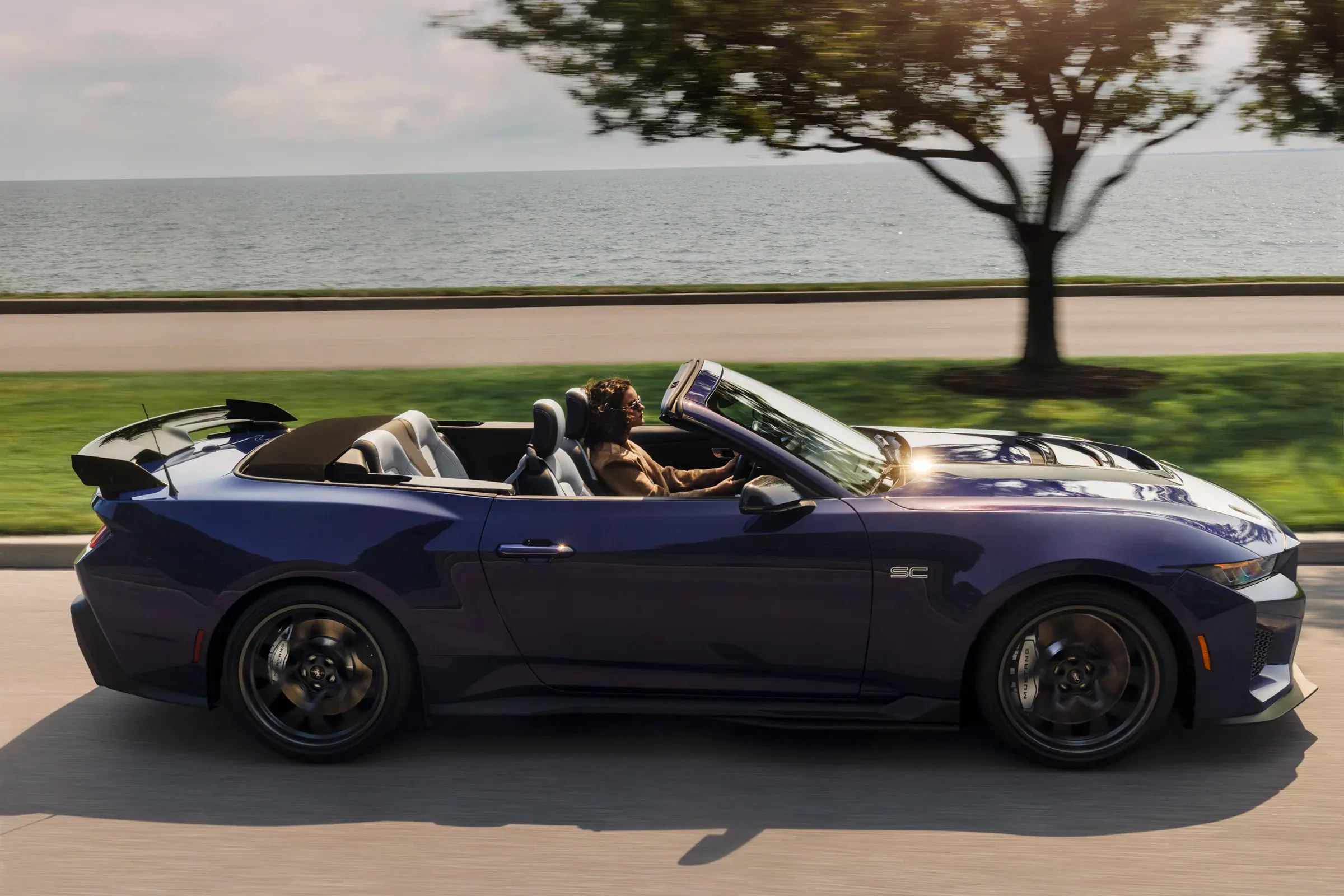
Ford wants you to notice the horsepower number on its new Mustang Dark Horse SC Convertible. Look at what’s missing from the fender instead.
On August 14, at the Woodward Dream Cruise outside Detroit, Ford Racing pulled the cover off the 2027 Mustang Dark Horse SC Convertible. A supercharged 5.2-liter V8 makes 795 horsepower and 660 lb-ft of torque, routed through a seven-speed dual-clutch transmission to a fully independent rear suspension. Ford calls it the most powerful Mustang convertible it has ever built. Orders open this fall, with cars reaching dealers next spring in a new shade called Precision Purple.
That’s the press release. It’s not the story.
The Badge That Isn’t There
The last time Ford sold a hot-rodded, drop-top Mustang this serious, it wore a Shelby badge. The 2014 Shelby GT500 convertible packed a supercharged 5.8-liter V8 good for 662 horsepower, ran it through a six-speed manual, and put the power down through a solid rear axle, with Carroll Shelby’s name stamped on the fenders the way it had been for half a century. That car is now twelve years and an entire Mustang generation removed from the showroom floor. Its replacement, arriving next spring, is faster in every measurable way. It also isn’t a Shelby anything. It’s a Dark Horse SC, Ford Racing’s own name, on Ford Racing’s own car, engineered entirely by Ford Racing’s own engineers.
We reported in 2023 that Ford was quietly dropping the Shelby name from its next Mustang, and the likely reason came down to money: royalties. Every Shelby-badged Mustang Ford built sent a licensing fee back to Carroll Shelby’s company for the use of his name and his signature snake logo. Build the flagship under a name Ford already owns outright, and that fee disappears. Multiply it across every unit sold over an entire model run, and the millions add up fast.
An Old Playbook, Run In-House
Ford Racing, the division once branded Ford Performance, is marking its 125th anniversary this year, and Dark Horse SC chief program engineer Arie Groeneveld leaned on that history when describing the new car. He pointed back to 1966, when Ford beat Ferrari at Le Mans with the GT40, then built a street-legal version of that same race car for customers who never planned to see a track. That’s the same instinct behind the Dark Horse SC lineup: one shared foundation, two very different missions. The coupe chases lap times. The convertible, in Groeneveld’s words, is tuned to be “the ultimate top-down grand touring machine,” riding on a MagneRide suspension retuned for comfort rather than cornering limits.
What’s notable is that Ford didn’t need an outside partner to pull any of this off. For decades, Ford’s most extreme Mustangs existed because Shelby American or Ford’s own SVT skunkworks built something the mainstream engineering organization wasn’t structured to do. That arrangement is gone. The Dark Horse SC coupe and convertible were both developed in-house by Ford Racing, which says as much about the current strength of Ford’s performance engineering bench as it does about the car itself.
What Actually Disappeared From the Mustang Dark Horse SC Convertible
Two things vanished along with the Shelby name, and both matter more to owners than a badge ever will.
The first is the solid rear axle. Every hot Mustang from the original Shelby GT350 through the 2014 GT500 relied on a live axle out back: heavier and cruder than the alternative, but nearly indestructible through repeated hard launches. Ford didn’t give the Mustang a fully independent rear suspension until the S550 generation arrived for 2015, and that architecture now runs through the entire lineup, including this convertible. It rides better and handles better. It’s also more complex to service and pricier to repair after a hard hit, a tradeoff that shows up on insurance estimates more than on window stickers.
The second is the manual transmission. The 2014 GT500 convertible still offered three pedals. The Dark Horse SC doesn’t, coupe or convertible; it’s a seven-speed dual-clutch automatic only. That mirrors where Ford’s most track-focused Mustangs have been heading for years. Manuals are still available on tamer trims, but the moment Ford builds something meant to survive repeated triple-digit abuse, the clutch pedal quietly disappears from the order sheet. It’s an engineering call, not a nostalgic one. A dual-clutch gearbox shifts faster than any driver can, and at this power level, that matters more to Ford’s performance claims than three pedals do.
Why This Car Will Stay Rare
There’s a reason cars like this never sell in big numbers, and it isn’t only enthusiasm. It’s the tax code. The federal gas guzzler tax, on the books since 1978, applies only to passenger cars that fall below an EPA combined fuel economy threshold. Trucks and SUVs are exempt entirely, which is exactly why a supercharged Dodge Durango can sell out in six hours without anyone blinking at the price, while a supercharged Mustang convertible carries a built-in tax penalty before Ford even sets a final MSRP. The standard 2026 Dark Horse coupe already starts north of $69,000; expect the SC convertible’s sticker, once announced, to land well into six figures once that tax and the extra hardware are baked in.
That’s the quiet logic behind why serious performance keeps migrating toward trucks and SUVs across the industry, even as Ford is already previewing a next-generation Mustang redesign that could reshape this entire lineup again. A car like the Dark Horse SC Convertible increasingly functions less like a mainstream product and more like a low-volume flex: proof of engineering capability sold to collectors, not a car built to move the sales needle.
None of that makes the car uninteresting. It makes it honest about what it actually is. Shelby’s name taught Ford how to build a legendary performance Mustang. The Dark Horse SC Convertible is Ford proving, in 795 horsepower and one dropped top, that it no longer needs the lesson.