
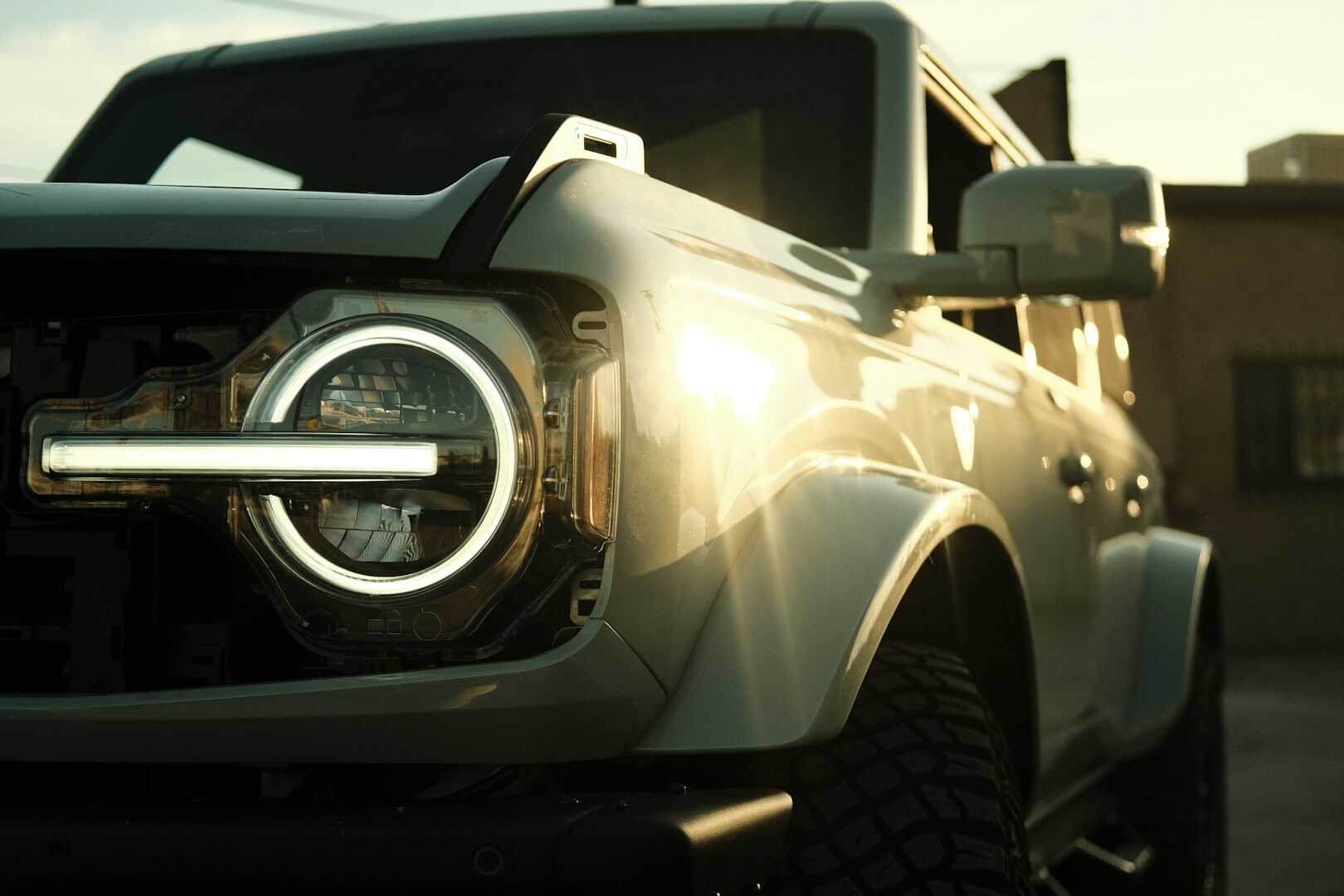
Jim Farley has a favorite prop when he explains why Ford doesn’t want you popping the hood on your own Bronco: his own garage. In a June 10 interview with the Detroit Free Press, Ford’s CEO said he’s perfectly comfortable wrenching on a 1973 Bronco but wouldn’t dare touch a new one himself. “I have no problem working on a 1973 Bronco,” he said, before laying out why the modern version needs specialty tools, dealer-level diagnostics, and, in his view, professional hands only.
The comment landed at an odd moment, because Farley wasn’t just fielding grief from disgruntled owners or repair advocates. He was responding to the President of the United States. On June 4, Trump told reporters in the Oval Office, during an appearance about an unrelated topic, that he’d had a great meeting with the heads of Ford and General Motors, along with Roger Penske, and that the automakers wanted a bill that would prohibit people from fixing their own cars. It wasn’t clear which bill he meant, and neither company rushed to clarify. But the remark yanked a wonky Washington fight over vehicle data into a presidential news cycle, and it put Farley on the record days later.
Farley’s actual position, laid out in that Free Press interview, is more nuanced than the stay-out-of-your-own-engine-bay headline suggests. He said Ford supports the ability to repair a vehicle, provided it happens at a reasonable cost, but drew a hard line at warranty work and safety-related repairs on newer vehicles, arguing that today’s Broncos, like most of Ford’s current lineup, are complicated enough that DIY work risks real harm. It’s the argument automakers have leaned on for years: that layers of driver-assistance sensors, computer-controlled subsystems, and structural repair procedures have turned what used to be a Saturday brake job into something that requires factory-level equipment to do safely.
There’s a kernel of truth in that, worth taking seriously even if you don’t buy the rest of it. A new Bronco isn’t a 1973 Bronco. It carries radar- and camera-based driver assistance that needs precise recalibration any time you touch the suspension, alignment, or windshield. Structural repairs on high-strength steel and aluminum panels have to follow bonding and welding procedures specified by the automaker, not eyeballed with a driveway MIG welder. Software-controlled systems, from throttle mapping to stability control, can behave unpredictably if a module gets disturbed without the right calibration step afterward. None of that is unique to Ford, and none of it is news to anyone who’s worked in a shop over the last decade.
What Farley’s answer conveniently sidesteps is the actual fight happening in Washington, which isn’t really about whether an amateur should replace a strut mount at home. It’s about who controls the diagnostic data, software access, and repair procedures that even professional independent mechanics need just to work on a modern vehicle at all. Right-to-repair advocates argue automakers have leaned on safety and cybersecurity concerns as convenient cover for steering higher-margin repair work back toward dealership service bays, at a time when service and parts revenue matters more to automakers as new-vehicle margins get squeezed.
That fight has a name and a bill number: the REPAIR Act, H.R. 1566, introduced in the House by Florida Republican Neal Dunn. It would require automakers to give vehicle owners and the independent shops they choose direct access to the same repair data, diagnostic tools, and software that dealers already have. The bill has genuinely rare bipartisan backing, 44 cosponsors split evenly between the two parties, but it has been sitting in committee since it was introduced in February 2025, and legislative tracker GovTrack currently gives it just a 15 percent chance of becoming law. That gridlock is a big part of why this fight has spilled over into the executive branch instead.
On June 29, Trump signed a presidential memorandum titled “Lowering the Cost of Living by Promoting the Freedom to Fix,” directing the EPA to help clear the way for cheaper aftermarket repairs. It’s worth being precise about what that document actually does, because the headline framing overstates it. It’s a memorandum, not an executive order, and it carries no force of law. Its substance is narrow: it tells the EPA to issue guidance within 30 days clarifying what individual owners can do to their own emissions systems without running afoul of Clean Air Act tampering rules, and it directs the agency to consider easing enforcement against people who, in good faith, try to restore their own vehicle to its original configuration. The memo also targets the California Air Resources Board’s process for certifying aftermarket parts, which the administration calls slow and costly, noting it can take more than a year to get a part approved even with complete paperwork.
Notice what’s missing from that list: anything about vehicle data, telematics, or diagnostic software access, which is the actual crux of the dispute between Ford and independent mechanics. The memo is aimed almost entirely at the emissions side of right-to-repair, not the data-access side. That distinction matters practically, too, since the EPA has jurisdiction over tailpipe emissions, not the encrypted gateway modules and subscription-based diagnostic tools that determine whether an independent shop can even talk to a modern Bronco’s computer in the first place.
Reaction to the memo split along predictable lines. Nathan Proctor, who runs the right-to-repair campaign for the U.S. Public Interest Research Group, welcomed the administration’s general direction but was blunt that it doesn’t touch the cost and access problems his coalition has pushed Congress to fix. The aftermarket-parts industry, represented by SEMA, cheered the move as a step toward certainty for suppliers stuck in CARB’s backlog. And the Alliance for Automotive Innovation, the trade group that speaks for most major automakers including Ford, put out a statement broadly endorsing the memo’s goals of vehicle affordability and choice, while pointedly noting it wants automakers’ intellectual property and confidential business information protected along the way, a reminder of exactly what’s still being negotiated behind the scenes.
None of that policy nuance made much of a dent in the reaction Farley got once his Bronco comment started circulating online. A thread on Reddit’s r/Futurology board pulled in more than 1,500 upvotes and over 200 comments in under two days, with top-voted takes accusing Ford of dressing up a data and revenue play in safety language, and drawing direct comparisons to John Deere’s long-running fight with farmers over tractor repairability. Plenty of commenters swapped their own dealer-versus-DIY cost stories, the kind of anecdote that’s become a rite of passage for anyone who has ever priced out a repair at a franchised dealership.
For anyone actually shopping for or already owning a new Bronco, here’s what hasn’t changed: nothing, yet. Warranty repairs still have to go through Ford’s dealer network no matter what Congress or the White House does next, and that’s true of every new vehicle sold in the U.S., not just Fords. Independent shops can already buy subscription access to Ford’s own diagnostic software for non-warranty work, though critics argue the pricing and scope of that access is exactly what federal legislation like the REPAIR Act is meant to standardize. If you’re weighing whether to have suspension, ADAS-related, or structural work done outside a dealer, the practical question isn’t whether it’s legal, since it generally is, but whether the shop has the calibration equipment and factory repair procedures to do it correctly. A botched ADAS recalibration can absolutely affect an insurance claim down the road if an adjuster determines the repair wasn’t done to specification.
This isn’t the first time an automaker has tried to draw a line between what a shade-tree mechanic can safely handle and what belongs behind a dealer’s service counter, and it won’t be the last. What’s different this time is that the argument is playing out in the Oval Office and on Capitol Hill instead of in a service bay, with a bipartisan bill stalled in committee for over a year and a presidential memo that addresses maybe a third of the actual complaint. Farley picked the Bronco to make his point because it’s a vehicle whose entire identity is built around being taken apart, doors off, roof off, mud everywhere. That’s probably why the comment stuck.