
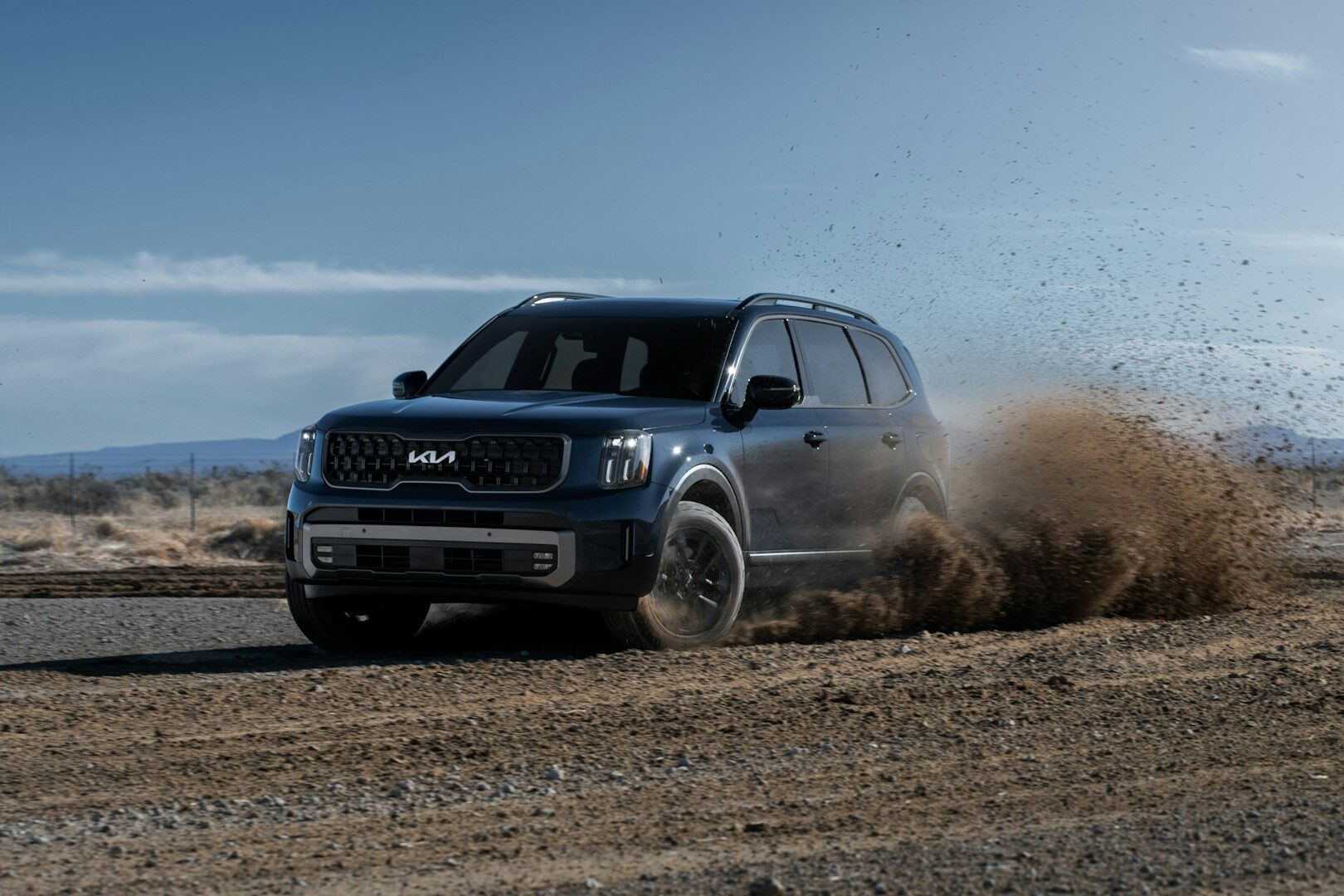
Kia just told the owners of nearly half a million Tellurides to park outside, away from their homes and other vehicles, because the front seats might catch fire. Park-outside recalls aren’t shocking anymore. What’s easy to miss in Kia’s announcement is this: these are the same 462,869 vehicles the company already recalled for this exact problem two years ago.
This isn’t really a story about a seat catching fire. It’s a story about a repair that didn’t hold, and possibly one that made the problem worse.
According to NHTSA’s July 9 notice, if the power seat’s slide cover or control knob gets bumped hard enough, the switch underneath can be knocked loose or misaligned. Once that happens, the seat motor keeps running when it shouldn’t. Motors that run continuously get hot, and in a handful of cases, hot enough to melt the switch housing or ignite. Kia says it is aware of seven seat fires and eleven melted seat motors so far.
Kia first recalled 2020-2024 Tellurides for this exact failure mode back in June 2024, under campaign SC316, sending dealers to repair or replace the front seat control switches. Two years later, Kia is recalling the identical population of vehicles, all 462,869 of them, because the fix apparently didn’t stick. Buried in the new notice is a sentence that deserves more attention than it’s getting: an improper repair under the previous recall could also lead to the motor overheating and catching fire. Read that again. The remedy that was supposed to eliminate the fire risk is now a documented cause of it.
That’s the part worth sitting with. Automakers issue follow-up recalls all the time when a fix proves incomplete. It’s much rarer to see, in an official government filing, an admission that the repair itself introduced a new path to the same failure. That points to a quality-control gap that isn’t just about a defective part. It’s about how thousands of dealership technicians executed a nationwide repair, or how the replacement switch was engineered in the first place.
There’s a second detail worth noticing. The original 2024 recall excluded the base Telluride LX trim, because entry-level cars use manual seat sliders with no motor to overheat. Only vehicles with power seats were ever at risk. Load up a Telluride with the features Kia wants buyers to pay extra for, and you also load it up with the wiring harness and switch assembly this fire risk comes from. It’s an uncomfortable irony of modern car buying: the convenience upgrade is also the added electrical complexity sitting a few inches from your legs. That trade-off isn’t unique to Kia, but it’s worth remembering every time a comfort feature turns into a recall headline.
Then there’s the timeline, which says something about how these recalls actually function. NHTSA and Kia issued the urgent park-outside warning on July 9. Yet affected VINs won’t be searchable on NHTSA’s recall lookup until July 17, and Kia isn’t set to start mailing owner notifications until August 13. For more than a month, owners are being told a seat motor could start a fire, without a firm way to confirm their specific vehicle is affected and without an appointment to get it fixed. That gap isn’t unique to Kia. It’s how the remedy pipeline works across the industry: a regulator can announce a warning the same day a decision is made, while parts, dealer training, and technician bandwidth take months to catch up. The urgency of the warning and the pace of the fix run on two different clocks.
It’s also worth putting the numbers in perspective. Out of 462,869 vehicles, Kia has documented seven fires and eleven melted motors, a defect rate the company’s own 2024 paperwork estimated at roughly one percent, which is generous relative to the handful of confirmed incidents. Regulators don’t wait for the odds to worsen before acting, and they shouldn’t. But the gap between statistically rare and recall every single one of them, twice, says something about how national recalls actually work. They’re built around the worst plausible outcome, not the average one. A seat fire is exactly the kind of low-probability, high-consequence event NHTSA is designed to overreact to. That’s not a flaw in the system. It’s the point of it.
The Telluride isn’t a niche product Kia can afford to fumble twice. It has been the brand’s flagship three-row family SUV since 2020, the vehicle most responsible for convincing American buyers that Kia belongs in the same conversation as Toyota and Honda on quality and safety. A recall that reopens a problem the company already told owners was solved does more damage to that reputation than the raw fire count suggests, especially for shoppers cross-shopping the segment right now.
None of this means Telluride owners should panic. It means they should actually read the notice Kia mails out in August, confirm the new electronic fuse assembly gets installed, and stop assuming a repair order from 2024 means the job is done. Owners without a garage or driveway, and there are plenty in this segment, are effectively being asked to solve a parking problem the automaker created. That’s a real inconvenience NHTSA’s press release doesn’t spend much time on.
The bigger lesson extends past one SUV. A recall notice isn’t a guarantee. It’s a promise that’s only as good as the technician who carried it out, and the engineering behind the part they installed. The first fix on your car is not automatically the last word on whether it’s safe.