
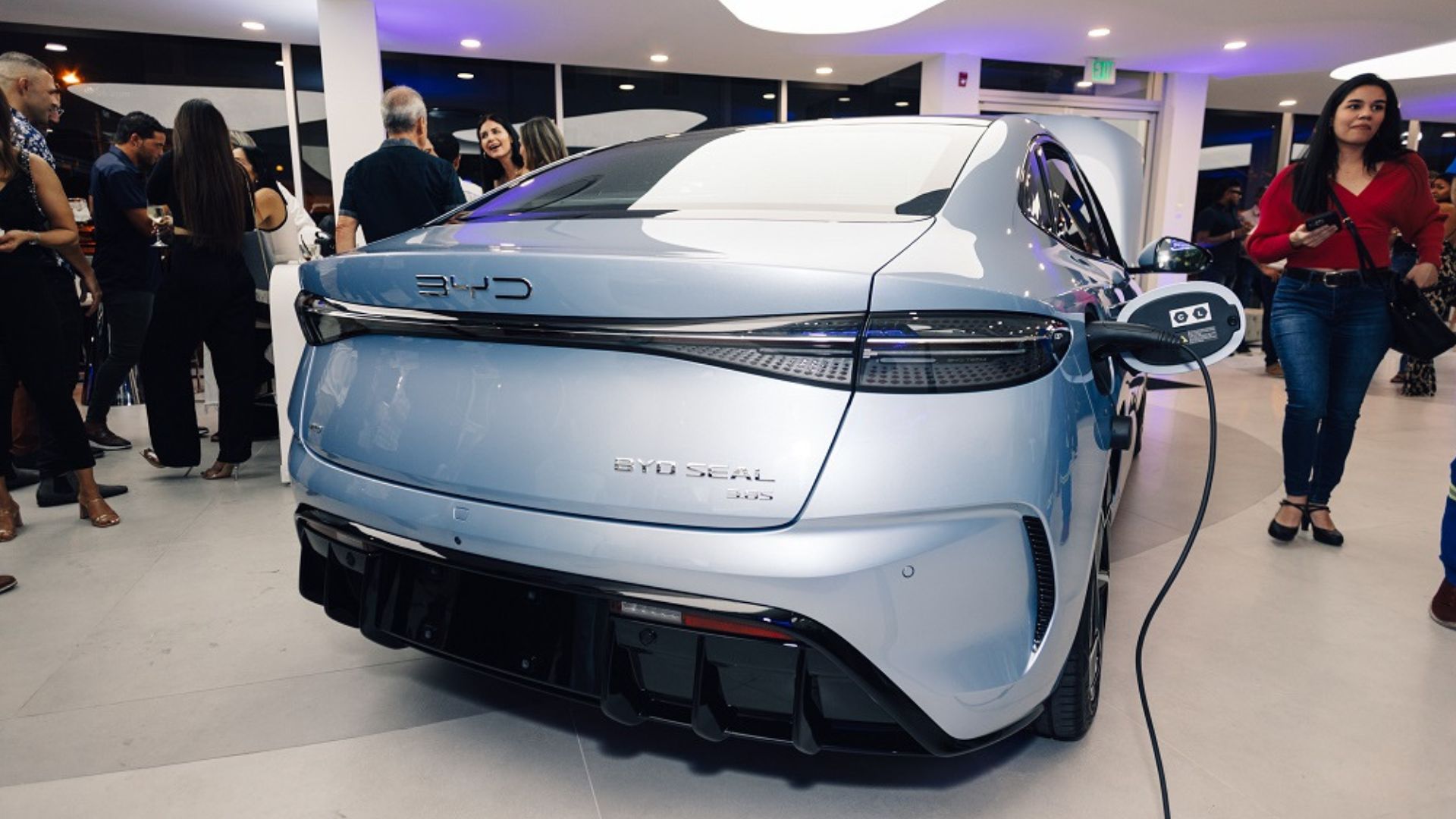
BYD wants to sell you a car with a karaoke machine wired into the dashboard. Somewhere in Shenzhen, a set of headlights can already project a movie onto your garage door. Neither of those is the story. The real story is why an industry stacked with battery chemists and manufacturing engineers is suddenly fighting China’s EV price war with singalongs and light shows instead of sticker prices.
Earlier this month, BYD, the world’s largest EV maker, began fitting a factory-installed karaoke system into its vehicles through a partnership with Stingray, the Canadian company that normally supplies digital jukeboxes to bars and gyms. It isn’t a dealer-installed novelty. It ships as a built-in feature. Elsewhere in China, other automakers are rolling out headlights built around micro-LED arrays that can project films, video games and navigation arrows directly onto the road, along with digital cockpits dressed up in virtual reality displays. Every bit of it is aimed at a young buyer who treats a car less like transportation and more like a phone that happens to have wheels.
Here’s the part nobody selling these cars wants to say plainly: this is happening because China’s domestic EV market can’t absorb another round of price cuts. State incentives that propped up demand are fading, and dozens of Chinese EV brands have already been thinned out in the scramble that followed. Add in a domestic market where sales at home keep sinking even as exports climb, and you have an industry with almost no room left to compete on sticker price without bleeding out. Cutting the price of a car further, in that environment, is close to financial suicide. Bundling in a karaoke machine is not.
The first thing that should surprise you is how cheap this stuff actually is to build. The micro-LED modules going into those projector headlights come from suppliers like Shenzhen-based Sitan Technology, which already manufactures ten million units a year for a customer base that spans automakers, phone makers and AR-glasses brands. That shared manufacturing base is the whole trick. A display or lighting chip that’s also being stamped out for a smartphone or a pair of smart glasses gets cheap fast, because the tooling and yield costs are spread across a much bigger market than cars alone. These “premium” features aren’t expensive engineering flexes. They’re closer to a rounding error bolted onto a car that still needs to look and feel more expensive than it is.
The second thing that should surprise you is that most of this will never be legal to sell, as-is, in the United States, and not because Detroit lacks imagination. Federal Motor Vehicle Safety Standard 108 governs precisely how a headlamp is allowed to behave on American roads, and it moves at a glacial pace. It took NHTSA until February 2022 just to clear adaptive driving beam headlights, a far more modest technology that simply dims itself around oncoming traffic and had already been standard equipment in Europe and Japan for the better part of a decade. A headlamp that can project a video game onto the pavement is a different animal, and it’s hard to picture the same regulators who spent ten years evaluating a beam-dimming feature moving quickly to approve a headlight that doubles as a projector screen for the car behind it.
None of this is actually new, either. Detroit ran its own version of this experiment decades ago, and it mostly flopped. Buick put a CRT touchscreen in the 1986 Riviera. Chrysler built cars in the early 1980s that talked to their drivers. Both were expensive, buggy, and largely forgotten within a few model years, because the electronics behind them were bespoke, low-volume, and built for nothing but a car. What’s different this time is scale. China’s suppliers aren’t designing a lighting module for one automaker. They’re adapting a chip that also ships in a phone, a speaker or a pair of glasses. That’s the difference between a gimmick and a standard feature.
Detroit tried to turn the car into a jukebox forty years ago and gave up when the buttons kept breaking. China isn’t reinventing the jukebox. It just found a factory that can build ten million of them for pennies apiece.
That factory advantage is the part worth watching longest. Sitan says it wants to take on Texas Instruments’ DLP chips in the global lighting and display market, and it’s already earning roughly double the margin on parts it exports compared with what it sells at home. That’s the same playbook Chinese suppliers already ran on batteries, and it’s the same one that’s put Chinese-built software and hardware underneath two dozen car brands most American buyers have never heard of. The karaoke machine is the bait. The real shift is Chinese component makers climbing into higher-margin automotive electronics that used to belong almost exclusively to American, Japanese and German suppliers.
It’s also worth remembering what this eventually costs the person who owns the car. A headlamp built around a micro-LED matrix and its own driver electronics is not a forty-dollar sealed-beam unit off a parts-store shelf. It’s closer in cost and complexity to the adaptive matrix LED headlamps that already turn a minor fender-bender on a loaded German luxury sedan into a four-figure repair bill. Insurers eventually price that complexity in, through higher parts reserves and, in some cases, faster total-loss decisions on cars that would once have been an easy fix. A karaoke amplifier or a video projector wired into the front end doesn’t make that math any better.
Five years from now, nobody will remember that a BYD could play karaoke. What they’ll remember, if they’re paying attention, is that Chinese suppliers proved they could manufacture premium-feeling cockpit technology at commodity prices, the same trick they already pulled with EV battery cells. Once that manufacturing advantage clears the trade and safety hurdles still standing between it and markets like the United States, it stops being a novelty story about singing dashboards. It becomes a direct threat to the supplier relationships every legacy automaker currently depends on for lighting, infotainment and cockpit electronics. BYD’s own chairman has already promised to be the world’s largest automaker within five years. The karaoke machine won’t get them there. The factory behind it might.