
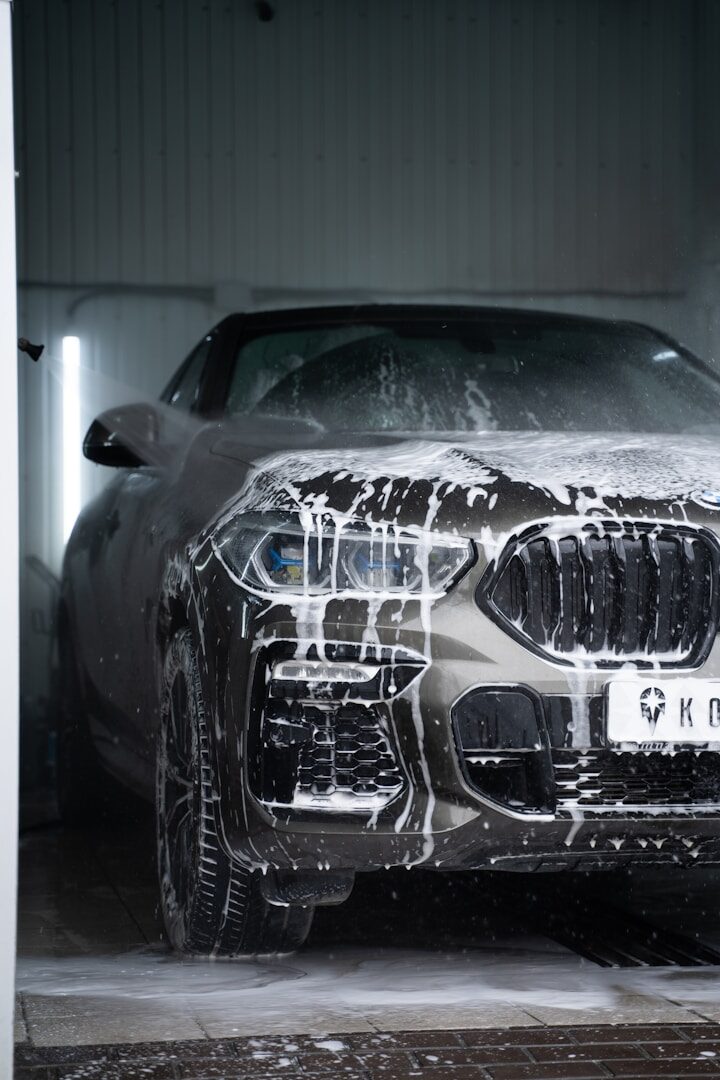
You trust it every week or two. Pull in, pick a package, stare at your phone for four minutes while foam and rinse arms do their thing. Nobody thinks twice about the equipment inside that tunnel, or the brush hanging on the wall at the self-serve bay down the street. But operators build the physical media and chemistry doing the actual cleaning to a price point. Not every price point is gentle on a clear coat.
The Brush That Touches Your Paint
Start with the part customers touch directly: the self-serve wand brush. According to Dan Pecora, an industry veteran who runs a car wash supply company in Chicago, the bristle material loaded into that brush determines almost everything about whether it scratches your paint. Nylon bristles are stiff, inexpensive, and good at scrubbing built-up dirt off a neglected car. But their larger-diameter filaments hold onto sand and grit picked up from the last several vehicles that used them, and that trapped grit is what actually does the scratching.
Pecora specifically warns against nylon on dark-colored cars, since any marks left behind show up far more easily. Synthetic fill behaves almost identically. Cloth fill is gentler but still accumulates grit over repeated use. Hog’s hair bristles, by contrast, are finer, taper at the tips, and flex around dirt rather than dragging it. That’s why the industry treats it as the safer standard, even though it costs operators more to install.
Here’s the part that never makes it onto the sign at the wash bay. The fix suppliers actually recommend is to rinse your car with a pre-soak before touching it with the brush, and to rinse the brush itself before you start. That’s what clears out the grit sitting in the bristles from the car before you. Almost nobody does either step, which means the same brush is quietly transferring the previous customer’s road grit onto your paint, one pass at a time.
Automatic Tunnels Have the Same Problem
Automatic tunnels carry the same risk with a longer word for it: media wear. A tunnel running fresh hog’s hair or well-maintained foam is a different experience than one running matted, discolored cloth strips that haven’t been swapped out since the wash first opened. Operators replace this equipment on a cost basis, not a “your paint will thank us” basis. A bargain unlimited-membership wash advertising rock-bottom monthly pricing is exactly the kind of place where media replacement is the first budget line to get stretched.
Then there’s the chemistry, which is the part almost nobody thinks to be suspicious of. Touchless washes skip physical media entirely, which sounds like the safe choice. But it means the entire cleaning job has to come from the detergent instead of friction. So touchless formulas lean on stronger concentrations to break down grime with no brush helping out. That’s a reasonable tradeoff when you rinse the soap promptly and thoroughly. It’s a worse one when you let it sit, or when it’s paired with an aggressive wheel or undercarriage add-on.
The car wash industry has its own history here. Claudia Moldovan Crea, CEO of car wash chemical supplier Qual Chem, has spoken publicly about her father’s early career at a chemical manufacturer. There, hydrofluoric acid, a highly corrosive compound, was in widespread industry use. That’s precisely why he later built a company around reformulating car wash chemistry into something safer. The industry has moved a long way from that era. But it moved because the old chemistry was a real problem, not a hypothetical one, and cut-rate operators are the ones least likely to have upgraded away from it.
What to Avoid and What’s Actually Fine
So the actual list of what to avoid is narrower and more useful than “don’t go to automatic car washes.” Skip self-serve bays where you can’t rinse the wand first and the brush looks packed with old, dark grit. Skip bargain tunnel washes where the cloth or brush media visibly looks matted, frayed, or discolored. And be wary of any wheel or undercarriage “acid” or “ultra-strength” add-on at a wash that can’t tell you what’s in it. That caution matters most on aluminum wheels or painted trim.
What’s actually fine? A touchless wash used occasionally and rinsed well. A tunnel or self-serve bay that visibly uses hog’s hair or foam media in good condition. And if you want to remove the guesswork completely, doing it yourself. We’ve already laid out the two-bucket method that actually protects your clear coat. Pairing that technique with the products detailers actually reach for gets you a cleaner result than most commercial equipment can promise. And you’ll never have to wonder what’s loaded into somebody else’s brush.