
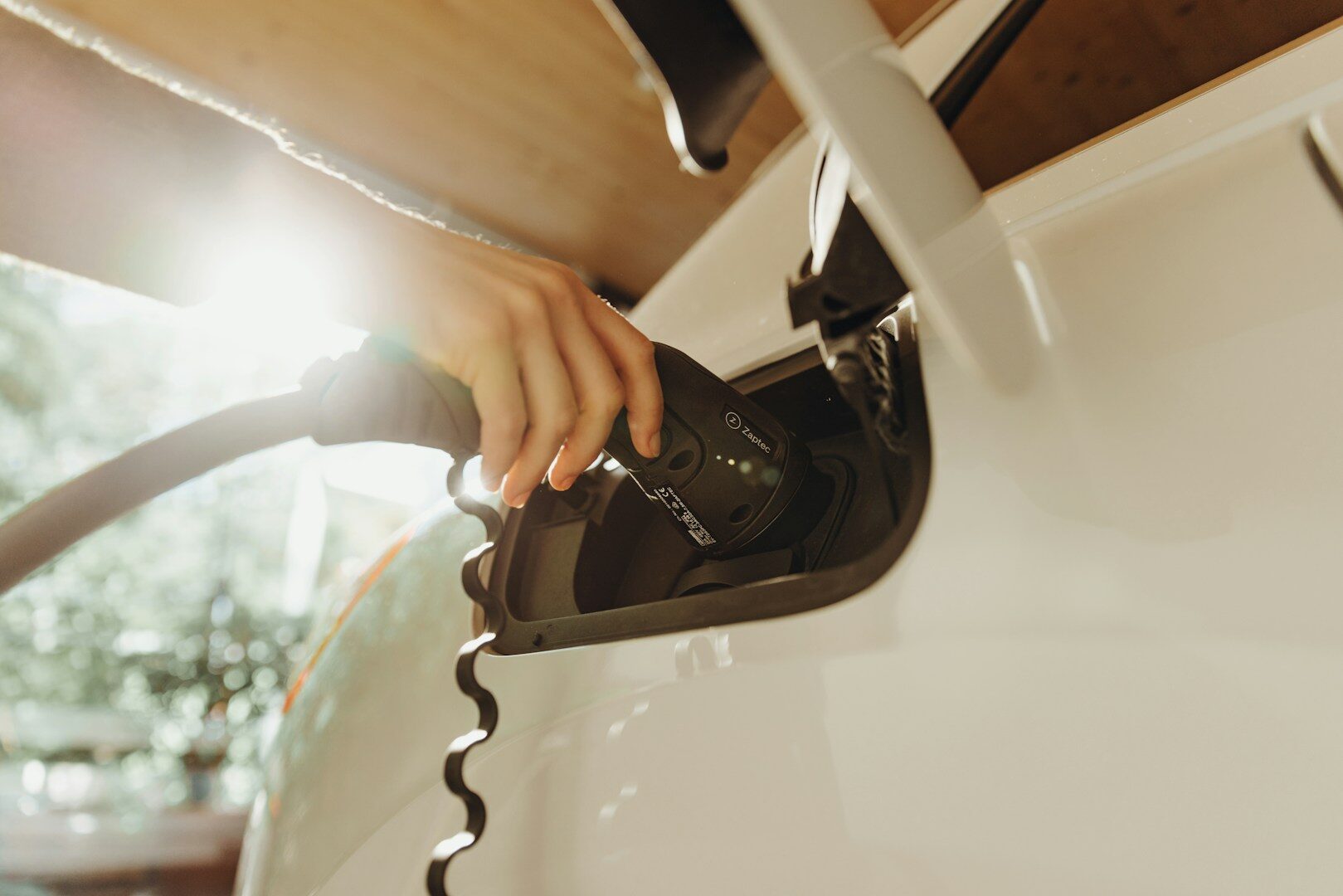
Rhode Island’s DMV is about to start mailing your local fire station a list of everybody in town who drives something with a big battery in it. Not a database firefighters can query. A list. Twice a year. On paper or in a spreadsheet — the law doesn’t say.
Governor Dan McKee put his signature on H 7135 Substitute A on June 19, then did the photo-op version last week at the West Warwick Fire Department, flanked by the bill’s sponsors. The law adds a new section to Rhode Island’s fire marshal statute, § 23-28.2-31, and it is genuinely short — one page of operative text. Read it closely, though, and there’s more engineering and politics packed into those four subsections than the ceremony suggested.
What the law actually does
The Office of the State Fire Marshal has to build and maintain a vehicle identification database covering electric or hybrid vehicles powered in whole or in part by a high-voltage lithium-ion storage battery. The Fire Marshal compiles a contact list of every department and district that provides firefighting services and hands it to the Division of Motor Vehicles. The DMV then pushes vehicle data straight to whichever municipal or volunteer outfit covers the address where the car lives — by January 1 and July 1 of each year.
The act takes effect six months after passage, which puts the switch-flip around December 19. The first actual data transfer lands January 1, 2027.
Related Articles
- Ford Wanted to Patent a Car That Locks You Out and Drives Itself to the Junkyard. The Government Said No.
- The Auto Wire Readers Get More Entries to Win a 1969 Camaro Z/28 and 1970 Chevelle SS454 — Super Chevy Dream Giveaway Ends 8/4
Here’s the part nobody mentioned at the podium. The bill as introduced in January listed three data elements: vehicle registration information, a description including make/model/year, and the address. The committee substitute that became law deleted the first one. Fire departments get make, model, year, and a street address. No plate. No VIN.
That’s a meaningful edit. A VIN would let a company officer decode the exact build — which is how you determine whether a given hybrid actually contains the lithium-ion chemistry the statute is aimed at. Make/model/year gets you close, and it’s enough to pull a manufacturer’s emergency response guide, but it doesn’t resolve trim-level differences. That matters more than it sounds.
The “high-voltage lithium-ion” trapdoor
The statute’s scope is narrower than the phrase “electric and hybrid vehicles” implies, and the seams are worth understanding if you own one.
“High voltage” has a federal definition. Under FMVSS 305, a high voltage source is one with a working voltage greater than 30 VAC or 60 VDC. A 48-volt mild hybrid — belt-driven starter-generator, no EV-only propulsion — sits under that ceiling. Lithium chemistry, yes. High voltage, no. Meanwhile a conventional hybrid running a nickel-metal hydride pack at 245 volts is unambiguously high voltage but isn’t lithium-ion, and Toyota shipped NiMH packs in high-volume models long after most people assumed the industry had moved on. eCFR
Now look at how Rhode Island’s own DMV sorts powertrains for its new registration surcharges. The fee schedule charges $200 a year for battery electrics, $100 for plug-in hybrids, and $50 for non-plug-in hybrids — and explicitly folds mild hybrids into that last bucket. The department’s guidance on identifying one? If you’re unsure whether a vehicle is a mild hybrid, a quick Google search can usually provide the answer.
So the agency being asked to populate a lithium-specific safety database currently classifies vehicles using a taxonomy that doesn’t track battery chemistry at all. The raw material exists — NHTSA’s vPIC catalog carries both an electrification level field and a battery chemistry field, populated from manufacturer Part 565 submissions — but chemistry reporting is inconsistent enough that decoding a fleet cleanly is a project, not a query. Somebody at the DMV is going to spend a while on this before January.
Why a street address is worth anything to a fire crew
Skeptics will point out that cars burn where they burn, not where they’re registered. Fair. But residential is exactly where the tactical problem gets ugly.
Washington’s State Patrol published a full study of EV fires in January 2025, and it’s the most useful public document on this subject right now. Its findings: cells burn hotter than an ICE fire, thermal runaway releases carbon monoxide, hydrogen fluoride, hydrogen chloride, cyanide compounds, nitrogen and sulfur oxides, and gases generated during thermal runaway may build up in enclosed spaces such as garages, vehicle compartments, and shipping containers which can result in an explosion. Suppression takes water volumes that exceed anything a normal vehicle fire demands. Damaged packs reignite hours, days, sometimes weeks later.
Knowing there’s a lithium pack in the attached garage before you arrive changes your first-in assignment, your ventilation plan, and where you stage the second engine. That’s the actual value proposition.
The NTSB reached similar conclusions in Safety Report 20/01, where three of four investigated EV fires involved batteries that reignited after firefighters extinguished the vehicle fires. Its recommendation to 22 manufacturers was to build emergency response guides on ISO 17840 as incorporated in SAE J2990. Those guides are free and public. If you own an electrified vehicle, downloading yours and taping it inside the garage door costs nothing and is more useful than anything this database will produce. ntsb
The parts that hit owners in the wallet
Two downstream realities that don’t make press releases.
Towing and storage. NHTSA’s interim guidance tells operators not to store a severely damaged lithium-ion vehicle inside a structure or within 50 feet of any structure, vehicle, or combustibles. Regenerative braking means all four wheels come off the ground — flatbed or dollies, never a hook. In Washington’s survey, 46% of tow yards said they don’t meet the 50-foot storage recommendation, and 54% said they’d opt out of towing EVs entirely if there were no penalty. Fewer willing operators plus longer storage holds equals a bigger bill, and Washington’s workgroup flagged that vehicle insurance policies may not have adequate coverage for clean-up or storage costs. Read your comprehensive coverage before you need it.
Related Articles
- Honda And Nissan Shared Car Software: What A Joint OS Would Really Change
- Hertz Fleet Depreciation Lawsuit: What The DPU Collapse Really Means
Environmental liability. Soil sampling after a single EV fire in Mason County, Washington, returned cobalt at 4,380 mg/kg against a 24 mg/kg cleanup threshold and nickel at 23,900 against 1,600. If that happens on your driveway, somebody is paying for remediation.
The privacy question the Senate mostly waved through
Federal law governs this. The Driver’s Privacy Protection Act bars DMVs from releasing personal information from motor vehicle records except under enumerated exceptions — the first of which covers use by any government agency in carrying out its functions. A fire district responding to fires qualifies comfortably. Stripping the registration data from the substitute narrowed the exposure further. U.S. House of Representatives
What the statute doesn’t include: any retention limit, any handling or storage requirement, any restriction on secondary use, any penalty for misuse, any opt-out, and any appropriation. It also doesn’t require the DMV to purge you from a department’s list when you sell the car or move. Rhode Island’s House passed it 69-0; the Senate went 33-4.
For context on scale, the Energy Department’s registration data put Rhode Island at 6,396 all-electric vehicles at the end of 2023 — before you add plug-in and conventional hybrids, and before the state layered on its new annual surcharges. Rhode Island has also offered a voluntary electric-drive license plate for years, one the DMV encourages specifically for first-responder safety. Enough people ignored it that the legislature decided to make the notification mandatory and route it around the owner entirely.
Practical takeaway for Ocean State owners: your address is going to a fire station in January whether you like it or not, the data will be six months stale at worst, and it won’t tell the crew what chemistry is under your floor. Fix that yourself. Print the manufacturer’s emergency response guide, know where your service disconnect is, and don’t assume your policy covers a week in a tow yard fifty feet from anything flammable.