
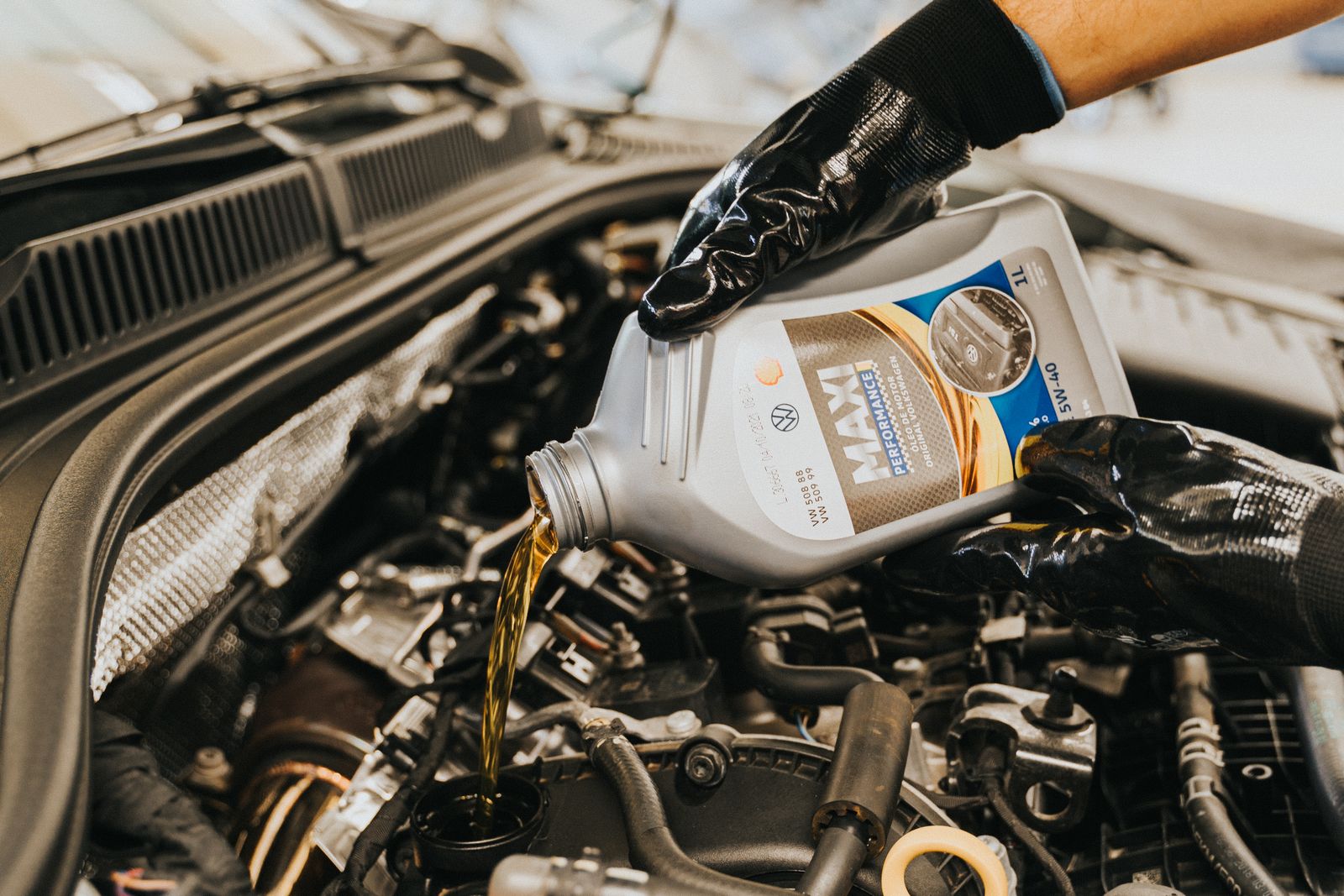
Costco is selling a two-pack of five-quart jugs of Kirkland Signature full synthetic for $57.99. That works out to $5.80 a quart. Printed on the product page, directly beneath a Proposition 65 benzene warning, is a line warehouse clubs almost never run: “Limit of 1 Transaction Per Membership, with a Maximum of 2 units every 7 Days.”
We covered the price jump last week. The limit is the more revealing artifact. A retailer rations a product when it stops trusting the next truckload.
What has gone largely unsaid is why. Crude is expensive, and that story has been running since March. But crude prices did not empty this aisle. A single ingredient did, one that never appears on a bottle, that most drivers have never heard of, and that the United States, for all its refining muscle, barely produces.
The ingredient that is not on the label
Somewhere between 75 and 98 percent of what sits in a jug of motor oil is base oil. The additive package gets the marketing budget. The base oil does the job.
The American Petroleum Institute sorts base oils into five groups, and the dividing lines are chemistry, not branding. Per API 1509, Annex E, Group II base stocks run at least 90 percent saturates, no more than 0.03 percent sulfur, and a viscosity index between 80 and 119. Group III clears the same purity thresholds with one change that reorganized the entire industry: a viscosity index of 120 or higher. Group IV is polyalphaolefin, hydrocarbon genuinely assembled in a reactor.
Here is the part that catches people off guard. The overwhelming majority of American bottles marked “full synthetic” are Group III. That is petroleum, hydroprocessed so aggressively that it behaves like something built in a lab. Actual synthetic, Group IV PAO, is the expensive minority.
Viscosity index is why Group III became the backbone of the modern oil aisle. It measures how little an oil thins as temperature climbs. An engine specified for 0W-20 needs a fluid that moves like water at a cold start and still holds a load-bearing film at 250 degrees, and it has to do that for 7,500 or 10,000 miles. Group II cannot carry that assignment. Group III can.
So a Group III interruption is not a premium-product inconvenience. It is a problem with the default oil in most vehicles built in the last fifteen years.

Three-quarters of the supply sits in one neighborhood
In April, the Independent Lubricant Manufacturers Association brought the problem to the Department of Energy with a set of numbers that ought to bother anyone who owns a car.
Roughly 44 percent of U.S. Group III demand is met out of the Persian Gulf. Another 30 percent arrives from South Korea, whose refiners run on Persian Gulf crude. That is about three-quarters of American supply resting on one stretch of water the U.S. Energy Information Administration calls the world’s most important oil transit chokepoint, with roughly 21 million barrels a day moving through it.
Then there is Pearl GTL.
Shell’s plant at Ras Laffan, Qatar, is the largest gas-to-liquids facility on earth. It handles 260,000 barrels per day of GTL products and natural gas liquids, and Shell’s own figure for its lubricant output is enough base oil each year to serve more than 225 million vehicles.
Read that again. A meaningful share of the oil in American crankcases begins as Qatari natural gas. Not crude. Gas.
ILMA told DOE that Pearl sustained rocket damage in March, knocking out roughly 30,000 barrels per day, with repairs expected to take at least a year. Producers in Bahrain and the UAE declared force majeure. Spot availability, in ILMA’s phrasing, largely disappeared. About 60 percent of Group III output goes into automotive applications, which means the shortfall lands squarely on drivers rather than on industry.
What that API donut is certifying right now
On March 13, ILMA asked API to invoke force majeure under its Engine Oil Licensing and Certification System. On March 25, API agreed.
The mechanism is Emergency Provisional Licensing, API 1509 Section 6.9. It exists for explosions, fires, legal action, natural disasters, epidemiological events and acts of terrorism. API’s own standard for granting it, in the document’s own words: relief “will rarely be granted.”
It was granted.
An EPL lets a licensee substitute base oils or other components that force majeure has made unavailable and keep selling the product under the API mark. The term runs 90 days, extendable at API’s discretion. The required testing must be completed within 180 days of signing, which is to say after the oil has already been sold, poured and driven.
That is not a scandal, and it should not be read as one. It is a documented, supervised trade: keep certified oil moving, verify on a delay, then revert or relicense. But it is worth knowing that the little donut on the back of the bottle may currently be vouching for a formulation whose engine tests are still running.
One line API did not cross. ILMA did not request permission to drop Group II into products sold as “synthetic,” and API did not grant it. Whatever else moved, the word on the front of the bottle still means what it meant.
GM was asked to bend. It said no.
API is a standards body. dexos is a trademark.
GM’s dexos program is a private license: GM’s tests, GM’s audits, an 11-digit license number on the back label, and GM’s authority to revoke it. GM’s position on oils without it is blunt. Unlicensed products, it says, “have not gone through GM’s rigorous testing process, are not monitored for quality, and are not approved or recommended for use in GM vehicles,” and damage traced to them may not be covered.
In April, ILMA asked GM for temporary enforcement flexibility while the base oil its licensees needed sat stranded behind a closed strait. GM declined. It said it did not intend to suspend license terminations or other enforcement actions. It offered faster case-by-case review of alternative base oils, and nothing more. ILMA’s chief executive said the association remained “concerned by the OEM’s decision not to provide temporary enforcement flexibility under these extraordinary circumstances.”
There is a defensible argument on GM’s side. A specification that bends under pressure is not really a specification, and GM has spent this year explaining why an oil-change remedy did not save thousands of L87 V-8s. This is not the moment the company wants to be caught loosening oil rules.
But look at what the refusal exposes. The choke point in your oil change is not the barrel. It is the license attached to the barrel. A blender can have perfectly serviceable base oil sitting in a tank and still be unable to put it in a bottle wearing the right logo.
Why your engine needs this stuff at all
None of this would matter if engines still drank 10W-30 every 3,000 miles.
They do not, because thin oil became a compliance strategy. Cutting viscous drag inside an engine is one of the cheapest slices of a mile per gallon an automaker can buy. No new hardware, no retooling, just a different number on the filler cap. EPA has promoted low-viscosity lubricants as a fuel-saving technology for years. The industry marched from 5W-30 to 5W-20 to 0W-20 to 0W-16, and in Japan to 0W-8.
Thin oil and long drain intervals pull against each other. Group III is the compromise that lets both live in the same crankcase.
Then automakers went further and began treating oil as a structural fluid instead of a consumable. Ford routed a timing belt through the crankcase to shave friction, a design federal safety regulators are now examining across 135,000 vehicles. Ford also walked back a fix for the F-150’s oil consumption rather than surrender mileage numbers. Toyota warned about oil supply years before this crisis, and the industry filed the warning away.
Engine oil quietly stopped being something you buy and became something your engine is designed around. Parts have supply chains. Consumables you can substitute.
What to actually do about your next oil change
Match the specification, not the brand. Federal law is friendlier here than most owners believe. Under the Magnuson-Moss Warranty Act, a manufacturer cannot void your warranty merely because you used someone else’s oil, and FTC staff have written that when a warrantor wants to deny a claim over an unauthorized part, “the burden will be on the warrantor to demonstrate that it was the unauthorized part that caused that damage or defect.” What a manufacturer can do is refuse to pay for damage a wrong-spec oil actually caused. The brand is your call. The specification is not.
Do not answer a price problem by moving up in viscosity. Bearing clearances, oil pump sizing, variable valve timing actuators and chain tensioners in a modern engine were dimensioned around the grade printed on the cap. A 5W-30 in a 0W-20 engine is not thrift. It is a slow bet against your own hydraulic components.
Do not stockpile. You would be buying at the top of a market, warehousing a product with a finite shelf life, and pulling inventory away from the next person in line. That behavior is precisely what a two-case limit exists to stop.
Do revisit the interval you actually run. If you have been changing oil at 4,000 miles in a car engineered for 10,000, that habit just got considerably more expensive, and the number that actually matters deserves another look.
The number to remember is 2027
ILMA laid out the repair timeline for DOE. New North American Group III capacity from Chevron and ExxonMobil does not come online until 2027. Damaged Gulf capacity needs at least a year. Depleted inventories throughout the chain have to be rebuilt after that. The association’s own outlook is that the market does not normalize until the end of next year at the earliest.
So Costco’s purchase limit is not panic. It is a forecast, printed in small type under a benzene warning.
And the lesson that outlives this particular war is the uncomfortable one. In chasing fractions of a mile per gallon, the industry engineered American engines around a fluid America does not make. Nobody voted on that. It accumulated one viscosity grade at a time, in a line of text on an oil filler cap, until a rocket landed in Qatar and a warehouse club started counting jugs.
The shortage is not in the crude. It is in the specification.
Your turn: should automakers be required to certify a documented backup oil specification for every engine they sell, a second-best grade that still protects the warranty when the first choice is unavailable? Or is the real fix building engines that do not depend on an imported base stock at all?