
What Jaguar Land Rover’s suppliers asked for in their open letter matters less than what they had to believe before asking.
You don’t write to the prime minister asking for help getting into aerospace and defence because you expect the car business to come roaring back. You write that letter because you’ve looked at your order book, looked at your customer’s order book, and decided the volume isn’t coming home.
So the letter reads less like a pivot than a forecast.
What the suppliers actually said
The letter went to the prime minister, the chancellor and West Midlands Mayor Richard Parker, according to the BBC. Its signatories include Coventry-based Evtec, Solihull-based Artifex and the Confederation of British Metal Forming. Their argument, in short: the Midlands supply chain is “not in decline” but “in the wrong market.”
They want three things. Cheaper industrial energy. Help qualifying for aerospace and defence contracts. And a West Midlands programme to speed the move into those sectors. Evtec chairman David Roberts put the underlying premise bluntly, telling the BBC that manufacturers see high-volume UK car production heading into a decade of decline.
The timing is not subtle. The letter landed roughly two weeks after JLR confirmed it would cut 4,000 jobs over two years, mostly in non-production roles and through a voluntary redundancy programme, ITV News reported. The suppliers called those cuts the first visible crack.
Two very different forecasts
The suppliers’ outlook runs directly against the official line from the car industry’s own trade body.
The Society of Motor Manufacturers and Traders said as recently as July that “decline is not inevitable”, and the government’s Industrial Strategy has talked about restoring UK output to 1.3 million vehicles a year, a goal SMMT itself referenced last October.
The country is a long way from that. SMMT figures show the UK built 717,371 cars and 47,344 commercial vehicles in 2025. That’s about 765,000 vehicles in total, a little more than half the 1.3 million ambition. The first half of 2026 was down another 7.5%, to 385,979 units.
The trade body and the government are selling a recovery. The companies that bend the metal are buying insurance. When parts makers start shopping for new customers, that’s worth noticing.
The scale problem
On paper, the logic is sound. Precision casting, machining, forming, welding and tight-tolerance quality control are exactly the skills an aircraft or armoured-vehicle programme needs. The letter’s version: the capacity exists, the people exist, and what’s missing is “the bridge.”
But consider the size of the river.
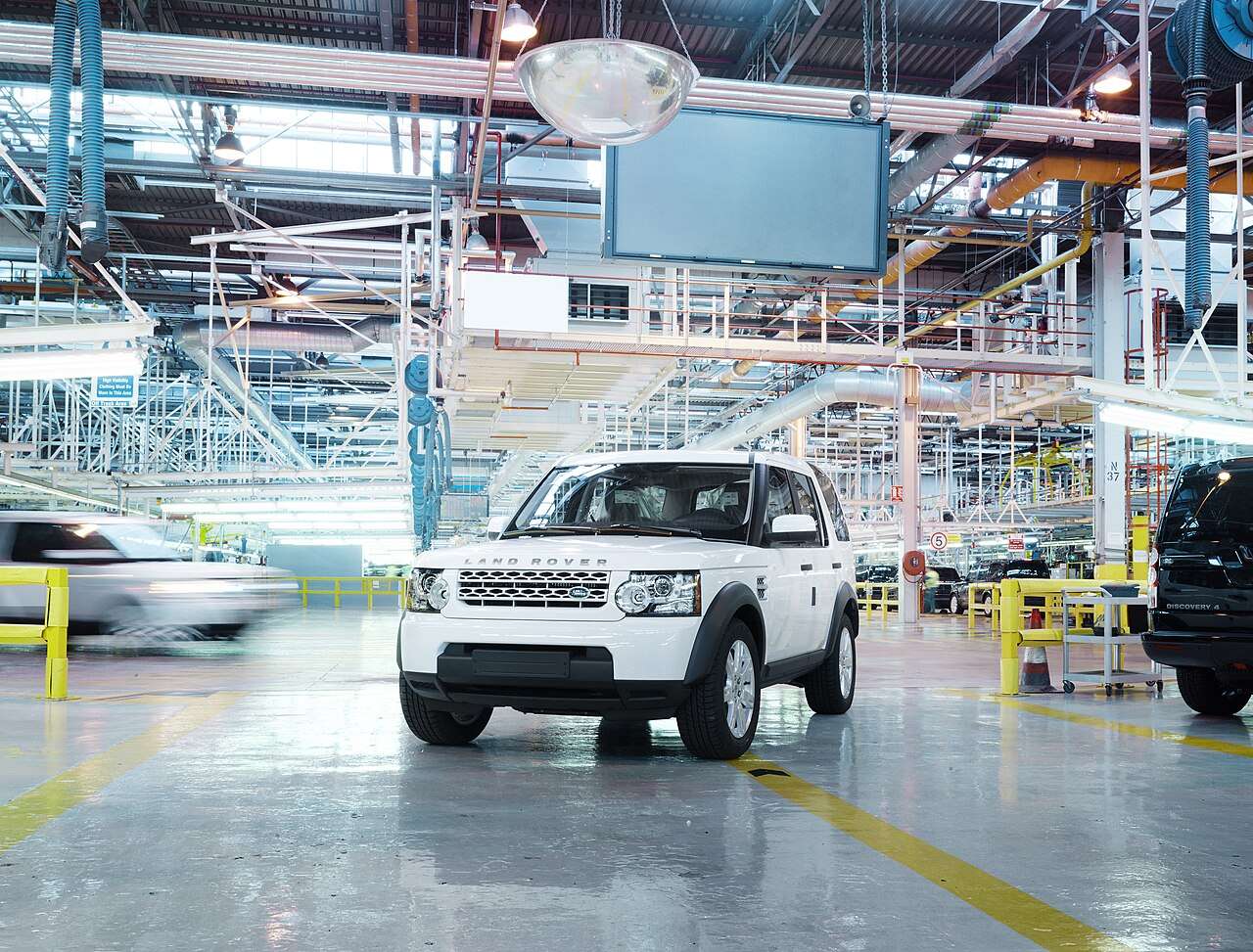
Airbus delivered 793 aircraft in all of 2025, across every model it sells. JLR, in its own UK economic impact report, says its Solihull plant turns out a Range Rover every 90 seconds. At that pace, a single English car factory builds as many vehicles as Airbus delivers worldwide in a year in roughly 20 hours.
That comparison is unfair in one direction, and it matters which one. An airliner contains vastly more parts and far more value than any SUV, so a supplier who wins aerospace work can earn serious money per component. What aerospace can’t do is replace the rhythm of a car plant. The presses, casting cells and staffing models across the Midlands were built for thousands of identical parts a day, at automotive margins, on a just-in-time schedule. Aerospace wants fewer parts, made slower, with far more documentation behind each one.
Aerospace can absorb the skills. It cannot absorb the scale.
That doesn’t make the idea wrong. It makes it a diversification strategy rather than a replacement for car work. Some firms will make the jump and be stronger for it. The industry as a whole cannot move 183,000 manufacturing jobs, the figure SMMT uses for the sector, into a market that counts output by the month instead of by the minute.
The bridge is made of paperwork
A car-parts supplier and an aerospace supplier can use the same machine tools and still live in different regulatory worlds.
Automotive suppliers generally work to the IATF 16949 quality standard. Aerospace and defence run on a separate family, the 9100 series maintained by the International Aerospace Quality Group. The Performance Review Institute, which certifies suppliers, describes AS9100 as ISO 9001 plus additional requirements set by the aerospace industry to satisfy defence, NASA and FAA expectations. Heat treating, welding, non-destructive testing and similar “special processes” often need their own separate accreditation on top of that.
None of it is impossible. All of it takes time and money, and it has to be spent before the first purchase order arrives. For a mid-sized supplier already squeezed by energy bills and losing work to overseas sourcing, that’s the gap the letter calls a bridge. In practice, it’s a cash-flow problem.
Follow the defence money, and look where it isn’t
The suppliers are not chasing a fantasy market. The government’s Defence Investment Plan, published in June, commits to 2.7% of GDP on core NATO defence spending from 2027-28, rising toward 3% next Parliament and 3.5% by 2035, with £298 billion budgeted over four years. The Defence Industrial Strategy also pledges to raise Ministry of Defence spending with small and medium-sized firms by £2.5 billion by May 2028.
That helps explain why the letter also went to a regional mayor. The same strategy’s first £250 million round of Defence Growth Deals named Plymouth, South Yorkshire, Scotland, Wales and Northern Ireland. The West Midlands, home to JLR and much of its supply chain, was not on the initial list.
So the ask for a West Midlands programme isn’t parochial grumbling. It’s a request to be pointed at a pipe of money that currently runs elsewhere.
The energy complaint travels with you
One point in the letter deserves a harder look. Moving into aerospace doesn’t escape the energy problem. The government’s British Industrial Competitiveness Scheme promises eligible manufacturers up to 25% off electricity bills, and it names automotive and aerospace together as the frontier industries it wants to help. A foundry pays the same for a kilowatt-hour whether the casting ends up in a Defender or a drone.
The catch is timing. That relief doesn’t start until April 2027. The suppliers are paying today’s prices while their largest customer trims costs today.
Britain has done this before, under very different terms
Between 1934 and 1942, the government’s shadow factory scheme drew motor manufacturers in Coventry and elsewhere into aircraft production, a chapter the Imperial War Museums catalogue documents in its own research holdings. The West Midlands has converted car know-how into aviation work before.
The difference is who carried the risk. Back then, the state was the customer and the deadline was existential. Today the suppliers are asking to compete for contracts that may or may not come, in a certification system that doesn’t care how good their car parts were.
Why this matters if you just drive the car
This isn’t only a British industrial policy story.
JLR itself says its Solihull production depends on supplier partners within a 15-mile radius of the plant. That tight local web is what lets a luxury SUV roll off the line every minute and a half. It is also why the 2025 cyberattack hit so hard: a local web works beautifully until the hub stops, and SMMT data show UK car output fell 27.1% that September.
If the most capable local suppliers shift their best people and machines toward aerospace, carmakers lean further on imported components. That can mean longer supply lines, more exposure to shipping and tariffs, and less flexibility when a recall or a redesign demands new parts in a hurry. We’ve already seen how thin the margins are on the models Land Rover can afford to build in Britain.
And it’s not only aerospace pulling at car suppliers. Robotics is doing the same thing on the other side of the Atlantic, as the plan for Tesla’s Optimus robot factory shows. Car-parts makers are becoming the most sought-after talent pool in manufacturing just as the car business stops guaranteeing them work.
The government is funding one future. Its suppliers are hedging for another
The government’s response pointed to its £2.5 billion DRIVE35 programme, which is built around zero-emission vehicle manufacturing through 2035. That’s a bet that the UK will keep building cars in volume, just electric ones.
The suppliers’ letter is a polite vote of no confidence in that bet, not on EVs but on volume.
Both sides may be partly right. The smartest outcome isn’t for suppliers to abandon cars, or for the government to pretend nothing is shifting. It’s a supply base certified to serve both industries, so a bad year for one customer isn’t a death sentence. That’s a boring answer. Boring answers keep factories open.
For years the question was whether Britain could keep building cars. The people closest to the metal have started answering a different question: what else can we build if it can’t?
Should Britain’s car-parts makers be steered toward aerospace and defence, or should the effort go into winning back car production? Share your view in the comments.