
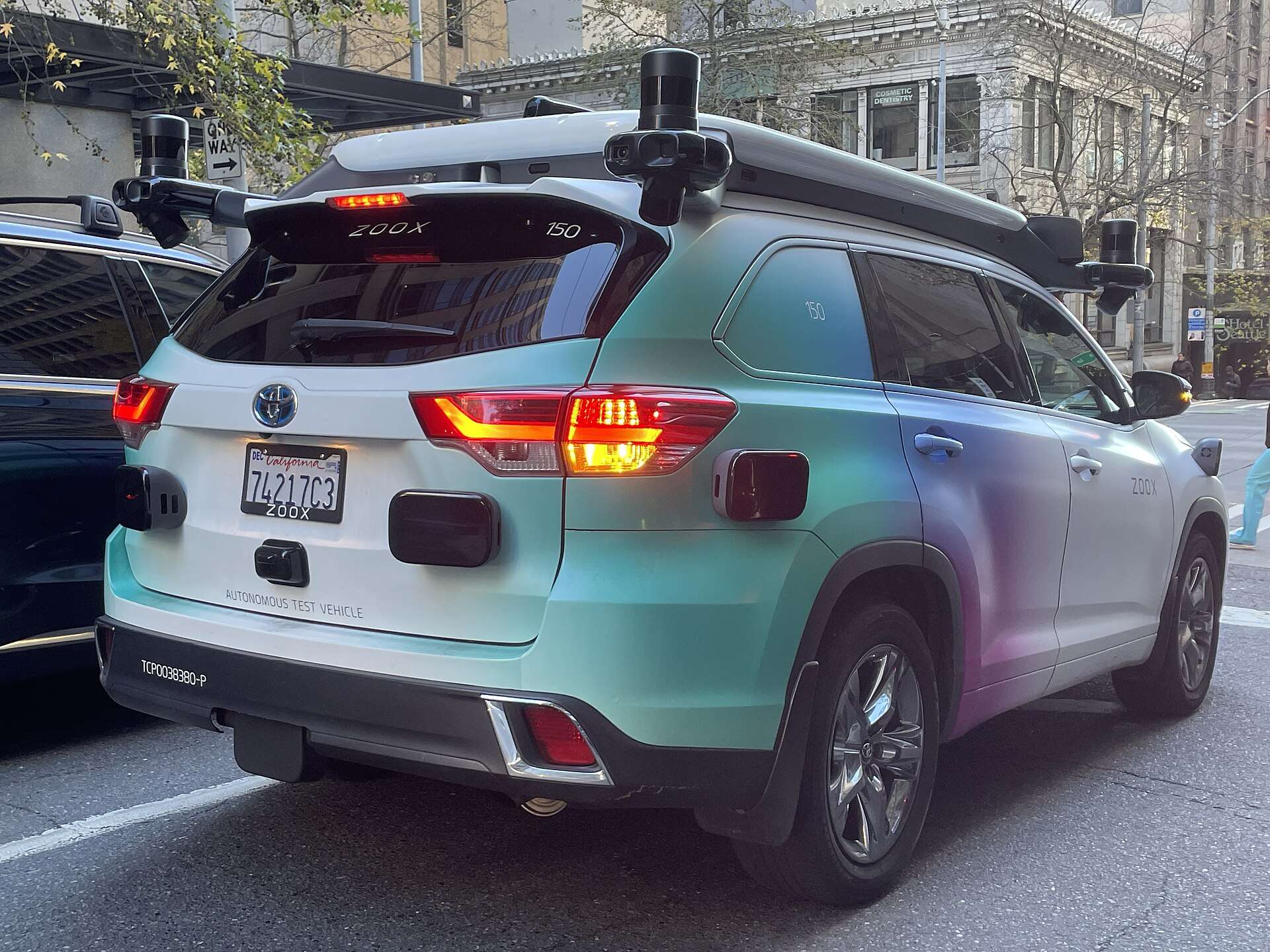
The vehicle that matters most to Zoox right now isn’t the boxy, bidirectional robotaxi you’ve seen in the company’s promotional videos. It’s a Toyota Highlander with a crown of sensors on the roof, a gasoline engine under the hood, and a person in the driver’s seat.
In Atlanta, that vehicle is parked.
Zoox has pulled its test fleet off Atlanta streets after contract safety drivers reported feeling sick inside the SUVs during August and linked it to possible gas exposure, TechCrunch reported on September 23. The Amazon-owned company hasn’t said anything about it on its own newsroom. In a statement given to that outlet, Zoox said it has “ceased operations of our test vehicles in this market” while it investigates.
It would be easy to file this under “robotaxi trouble.” But the driverless vehicle wasn’t involved at all. The problem turned up in the least futuristic part of the operation: a combustion-engine SUV that has been modified, packed with electronics, and kept running for long shifts with people inside.
It’s a fleet-upfitting problem, and the auto industry has dealt with it before.
What’s been reported, and what hasn’t
Because Zoox hasn’t published anything, most of the details come from Zoox’s correspondence with the Occupational Safety and Health Administration, which TechCrunch reviewed, and from interviews with workers. The Auto Wire has not seen those letters. According to the report:
- An OSHA letter to Zoox put the number of workers who may have been exposed as high as 40. Zoox says it’s lower.
- In a September 10 letter to OSHA, Zoox said 28 employees had ridden in six test vehicles where an odor was reported that the company couldn’t explain. Ten of them sought medical evaluations, and Zoox said it received one medical report identifying carbon dioxide exposure.
- Zoox said it checked exhaust systems for leaks, ran a smoke test for cabin intrusion, and pulled, inspected, and replaced the vehicles’ 12-volt batteries. It has since said it found no battery damage, no hydrogen sulfide, and no carbon monoxide. The only gas it detected was CO2.
- The company plans to install in-cabin gas monitors. OSHA has closed its inquiry.
- The Atlanta drivers are employed through a staffing contractor, not Zoox directly, and the purpose-built robotaxis aren’t affected.
Some workers’ accounts differ sharply from the company’s. One contractor said a crew that reported feeling ill was put into a different test vehicle and sent back out the same day. Those accounts haven’t been independently confirmed. Zoox’s version and the workers’ versions don’t have to be fully reconciled for the central lesson to hold, though.
The gas that doesn’t smell
The National Institute for Occupational Safety and Health lists both carbon monoxide and carbon dioxide as colorless, odorless gases. Yet by Zoox’s own account, what tied the six vehicles together was a smell.
So the one gas the company says it found can’t, by itself, explain what people say they noticed.
That isn’t proof of anything else. Zoox says it found no hydrogen sulfide, the gas OSHA describes as smelling like rotten eggs. But it does show why the nose is a lousy safety system. The gas most associated with engines, carbon monoxide, gives no warning at all. And OSHA notes that at higher concentrations, hydrogen sulfide can knock out the sense of smell entirely, so a smell that fades doesn’t mean the air got better.
Carbon dioxide deserves a closer look too. NIOSH lists normal outdoor air at roughly 300 parts per million. OSHA’s workplace limit is 5,000 ppm averaged over an eight-hour shift. Every person in a closed cabin adds to the total with every breath, and peer-reviewed research has looked at how ventilation settings and driving conditions affect how fast CO2 builds up inside cars. According to the reporting, Zoox puts four people in a vehicle while it trains new staff. Four people breathing for hours in an SUV is a cabin-air problem worth measuring, even before an engine is part of the picture.
That makes the least glamorous item on Zoox’s to-do list, cabin gas monitors, the most important. They arguably should have been there from day one.
Detroit already ran this experiment
For years, federal safety regulators investigated exhaust odors in the 2011–2017 Ford Explorer. The case drew thousands of complaints and got so serious that the City of Austin temporarily pulled more than 400 Explorer Police Interceptors from service.
The answer surprised a lot of people. In its closing report, NHTSA said it found no Explorer unaffected by upfitting problems or earlier crash damage with carbon monoxide above OSHA’s occupational limits. The highest readings were in police vehicles, and the agency tied them to “sealing issues caused by upfitting.” That meant the sirens, lights, cages, and auxiliary power that government fleet shops installed after the vehicles left Ford.
The SUV wasn’t the problem. The holes people drilled into it were.
Now picture an autonomous-vehicle test car. Like a police cruiser, it carries a load of aftermarket electronics, with wiring routed through a body that was never designed for it and extra demand on the electrical system. It also has a police-style duty cycle. According to the same reporting, Zoox keeps its test vehicles running for much of the day to hold sensor calibration and avoid long reboots of the self-driving computer. The company also uses exhaust-capture equipment at its indoor depots, the kind firehouses use.
Your commuter car spends most of its life parked. A self-driving test car can spend its shift idling like a patrol car on a stakeout. Maintenance intervals, battery life, and exhaust-system wear all follow the duty cycle, not the badge on the hood.
Zoox says it doesn’t modify the ventilation systems in these SUVs. That may be true. The Ford case shows that you don’t have to touch the HVAC for exhaust to find a way in.
The fleet nobody puts in the press release
This is where it stops being an Atlanta story. Zoox calls its robotaxi all-electric, and it has spent the year collecting milestones for it, including federal exemptions and California permits. But the vehicle that actually opens each new city is the retrofitted SUV.
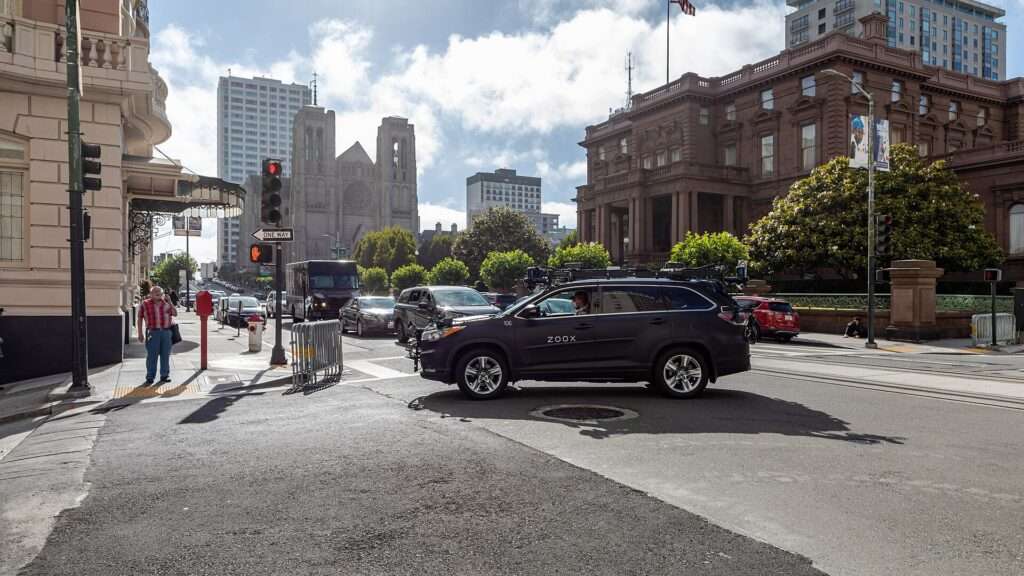
When Zoox announced Atlanta in May 2025, it described the plan in the same order it always does: retrofitted SUVs with human safety operators drive the streets by hand, gather map data, and then test autonomy. On September 1, it added Houston and San Diego, bringing it to 12 U.S. locations, and said both would start with its retrofitted test fleet. A 2024 NHTSA investigation document put the population of Toyota Highlanders running Zoox’s automated driving system at roughly 500 vehicles, and the company has expanded considerably since then.
Every press release about a new city is also an order for more modified gas SUVs and more people to sit in them. It’s the same pattern we saw when Spain issued its first robotaxi permit with a human still behind the wheel. The driverless future has a lot of drivers in it.
Every robotaxi is taught to drive by a car that isn’t one.
“Inquiry closed” is not the same as “all clear”
OSHA closing its inquiry sounds like a clean bill of health. It may not be.
For many complaints, OSHA uses a phone/fax investigation. The agency contacts the employer about the alleged hazard, and the employer has five days to reply in writing with what it found and what it fixed. If OSHA considers that reply adequate, it generally won’t send an inspector. The worker who complained gets a copy and can still request an on-site inspection.
Based on what’s been reported, OSHA told Zoox to investigate, Zoox sent a letter, and the inquiry closed. That fits the process working as designed. It also means “closed” tells you the regulator accepted the company’s account. It doesn’t tell you a federal inspector sampled the air in those Highlanders. Add a staffing-agency layer between the drivers and the company that controls the vehicles, and it becomes clearer why workers and management can come away describing the same month in very different ways.
Beyond robotaxis
You don’t need to work for a robotaxi company for this to matter. Plenty of vehicles on the road carry holes, wiring, and extra equipment their manufacturer never planned for: police cars, ambulances, work trucks, rideshare cars with add-on gear, and the family SUV with a DIY install. The same physics applies to a car idling with a blocked tailpipe, which is why carbon monoxide shows up in our winter driving guide. Exhaust doesn’t care whose logo is on the door.
For the autonomous-vehicle industry, the lesson is harder to ignore. These companies publish detailed safety frameworks for the robot. The people training that robot sit in ordinary combustion vehicles that have been modified in ways the Explorer case showed can matter. They deserve the same level of engineering discipline, starting with a sensor that can detect what a human nose can’t.
Zoox may well trace the Atlanta complaints to a single explainable cause and get the fleet running again quickly. Even so, the most important vehicle in its expansion plans will still be the one with a tailpipe.
Should companies testing self-driving cars be required to put gas monitors in any test vehicle with people aboard, or should that standard apply to every heavily modified fleet vehicle, from police cruisers to delivery vans? Share where you’d draw the line.