
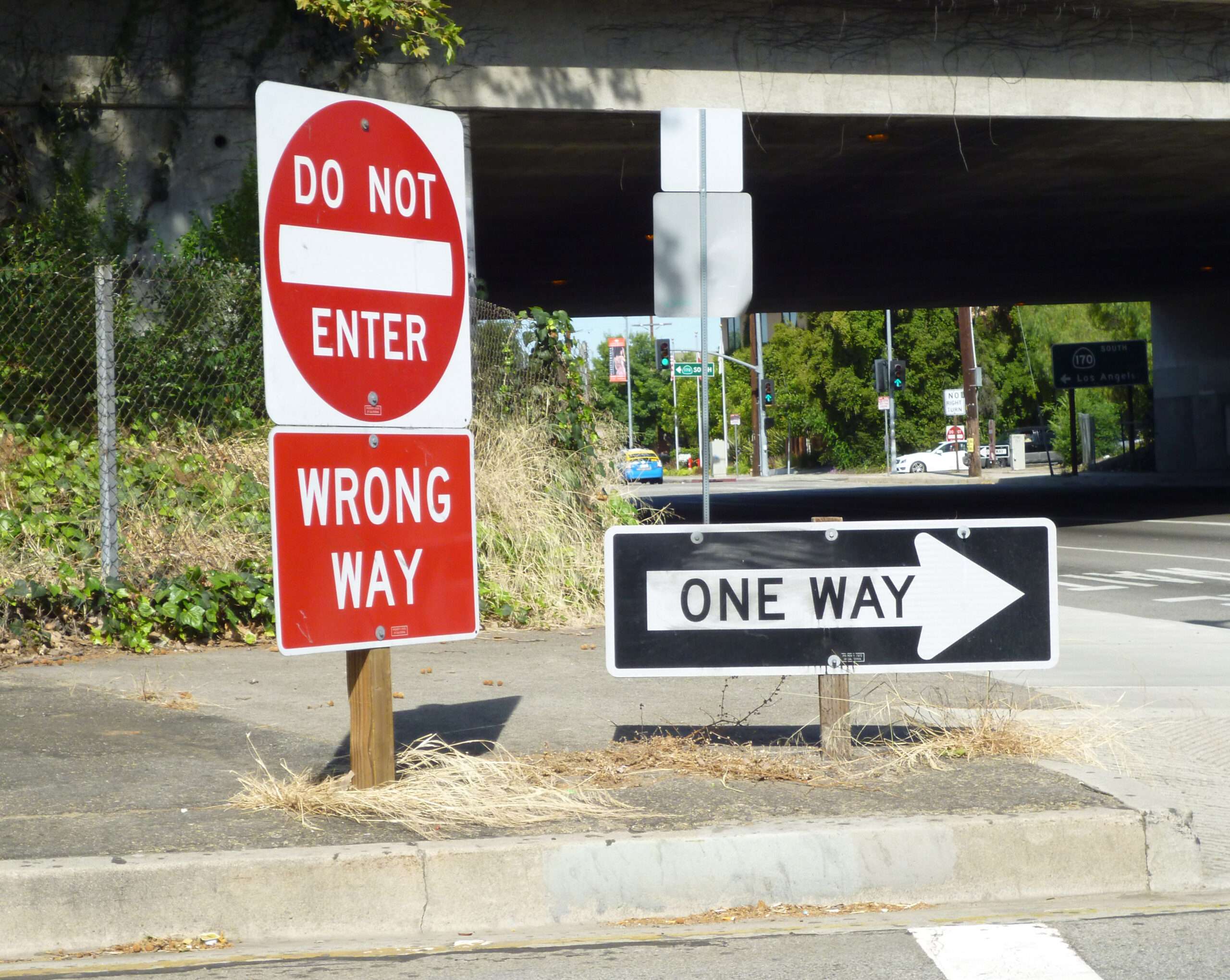
A man driving an SUV west in the eastbound lanes of Interstate 40 outside Winslow, Arizona, on Sept. 20 told state troopers he was doing it on purpose. According to the Arizona Department of Public Safety, he said he was playing a game called “Lunatic,” in which participants intentionally drive the wrong way on highways or interstates, and that he was acting as its “supervisor” because he was older than the two other players.
Multiple callers reported the SUV near the AZ-99 interchange, DPS said in its Facebook post on the stop. Highway Patrol troopers found it and intercepted it before anyone was hurt, took the driver into custody, and arrested him for endangerment and reckless driving. The agency has not released his name or age and described the other two people only as “unidentified individuals.” The post does not say whether they were riding in the SUV or driving other vehicles, and it does not mention alcohol or drugs.
DPS did not publish the name, and without it I could not locate a court filing, so two things are not yet public: whether prosecutors have filed the endangerment count as a felony or a misdemeanor, and whether the man has a lawyer speaking for him. What is on the record is his own explanation, as troopers relayed it. Under Arizona law, that explanation may matter more than anything the SUV did on the pavement.
Why the driver’s own words matter under Arizona’s endangerment law
The typical wrong-way driver doesn’t know he’s wrong. The Arizona Department of Transportation says two of every three wrong-way crashes involve impaired drivers, often with blood-alcohol levels more than twice the legal limit. A March 2026 study by the AAA Foundation for Traffic Safety found that nearly 70% of wrong-way drivers in fatal crashes on U.S. divided highways had a BAC above 0.08, while most of the right-way drivers they hit had none. Age is the other recurring factor: the National Transportation Safety Board’s 2012 special investigation put drivers over 70 at about 15% of wrong-way collisions.
Those cases turn on what the driver knew, and that is usually the hardest thing for a prosecutor to prove in a traffic case. Arizona’s endangerment statute, A.R.S. 13-1201, requires that a person “recklessly” endanger someone else with a substantial risk of imminent death or physical injury. The criminal code’s definitions section says reckless means the person is aware of a substantial and unjustifiable risk and consciously disregards it. A separate provision, A.R.S. 13-202(C), says that when recklessness is enough to establish an element of a crime, acting intentionally or knowingly establishes it too.
Usually the state has to build that awareness out of circumstantial evidence: how far the car went, whether the driver passed Wrong Way signs, whether he flashed his lights or swerved at oncoming traffic. According to DPS, this driver supplied it in words. He said the point of the game was to drive the wrong way on purpose, and he gave himself a title in it.
That is DPS’s account of a roadside statement, not a finding by any court. A defense lawyer can challenge how and when a statement was obtained, including whether Miranda warnings were required and given, and nothing DPS has released addresses that. But if the statement comes in as described, the usual fight over the driver’s state of mind is mostly settled before it starts.
Felony or misdemeanor depends on the risk of “imminent death”
Arizona splits endangerment in two. If the risk was of imminent death, it is a class 6 felony. In all other cases it is a class 1 misdemeanor. That line is where this case will be argued, and the evidence for it has not been released: how long the SUV was going the wrong way, how fast, how much traffic was on that stretch at that hour, and what the 911 callers saw.
The spread between the two is wide. For a first-time class 6 felony, A.R.S. 13-702 sets a presumptive prison term of one year, with a range from 0.33 years mitigated to two years aggravated if the court imposes prison rather than probation, and felony fines can reach $150,000. Judges can in some cases designate a class 6 felony as a class 1 misdemeanor if they find a felony sentence would be unduly harsh. A class 1 misdemeanor carries up to six months in jail and a $2,500 fine.
One reckless driving conviction hits Arizona’s 8-point limit by itself
The reckless driving charge is the smaller one, and the one with consequences most drivers will recognize. Under A.R.S. 28-693, driving “in reckless disregard for the safety of persons or property” is a class 2 misdemeanor: up to four months in jail, a fine of up to $750, and a possible license suspension of up to 90 days ordered by the judge.
The larger license consequence comes from the Motor Vehicle Division, not the courtroom. ADOT’s point schedule assigns 8 points to a reckless driving conviction, and 8 points in any 12-month period is the threshold at which MVD can require Traffic Survival School or suspend driving privileges for up to 12 months. A speeding ticket is worth 3 points. A single reckless conviction gets a driver to the limit with no other tickets on the record. A second reckless conviction within 24 months becomes a class 1 misdemeanor under the same statute, with at least 20 days in jail and a mandatory one-year suspension.
The same statute has a subsection that fits the “supervisor” claim. Section 28-693(F) makes it a class 2 misdemeanor to knowingly aid or abet another person’s reckless driving. DPS has not identified the two other people or said whether anyone else faces charges, but if other players were behind the wheel of their own cars, Arizona law has a charge written for the person who says he was running the game.
No thermal cameras on I-40 outside Winslow, so callers did the detecting
ADOT’s answer to wrong-way drivers in metro Phoenix is electronic. Its $4 million pilot on I-17 in Phoenix uses 90 thermal cameras between the I-10 Stack and Loop 101 to spot a wrong-way vehicle, light up warning signs, and alert DPS automatically. ADOT reported in July 2020 that it had detected more than 100 wrong-way vehicles since January 2018. The department’s wrong-way page describes that metro system; it does not list the rural stretch of I-40 near Winslow.
On Sept. 20, detection came from other drivers. DPS thanked the people who called 911. ADOT’s advice for anyone who meets a wrong-way car is to ease off the gas, make sure no one is alongside, steer away, get to a safe place, and then call 911. Those calls are how troopers knew where to look.
“New game alert” rests on one driver’s word
DPS headlined its post “Dangerous new game alert” and told the public not to fall for trends that put their safety at risk. The only public evidence that “Lunatic” exists is the arrested driver’s own statement as DPS relayed it. The agency did not cite other stops, other arrests, or any online source for the game, and I found no other law enforcement agency warning about it. Whether it is a trend or one man’s explanation for his drive is unconfirmed.
The danger it describes is not in question. The AAA Foundation counted 4,164 fatal wrong-way crashes on U.S. divided highways from 2014 to 2023, killing 5,730 people, and the annual number of those crashes rose from 278 in 2014 to 520 in 2023. The Auto Wire has covered deliberate wrong-way driving before, when the California Highway Patrol called a wrong-way crash a deliberate act in 2024, and Phoenix saw its own wrong-way scare that year when a tow truck driver halted a wrong-way motorist.
What to watch as the Winslow case reaches court
Three things will show how seriously Arizona treats the game he described: whether the endangerment count is filed as a class 6 felony, whether the two other people are identified and charged, and whether the case ends in a plea that drops endangerment and leaves reckless driving, which would still put 8 points on his MVD record. The man has not been convicted of anything, and DPS’s post is the only account of the stop released so far.
If a driver tells troopers he went the wrong way on an interstate on purpose, as part of a game, and nobody gets hurt, should prosecutors go for felony endangerment, or is a misdemeanor with a license suspension enough?