
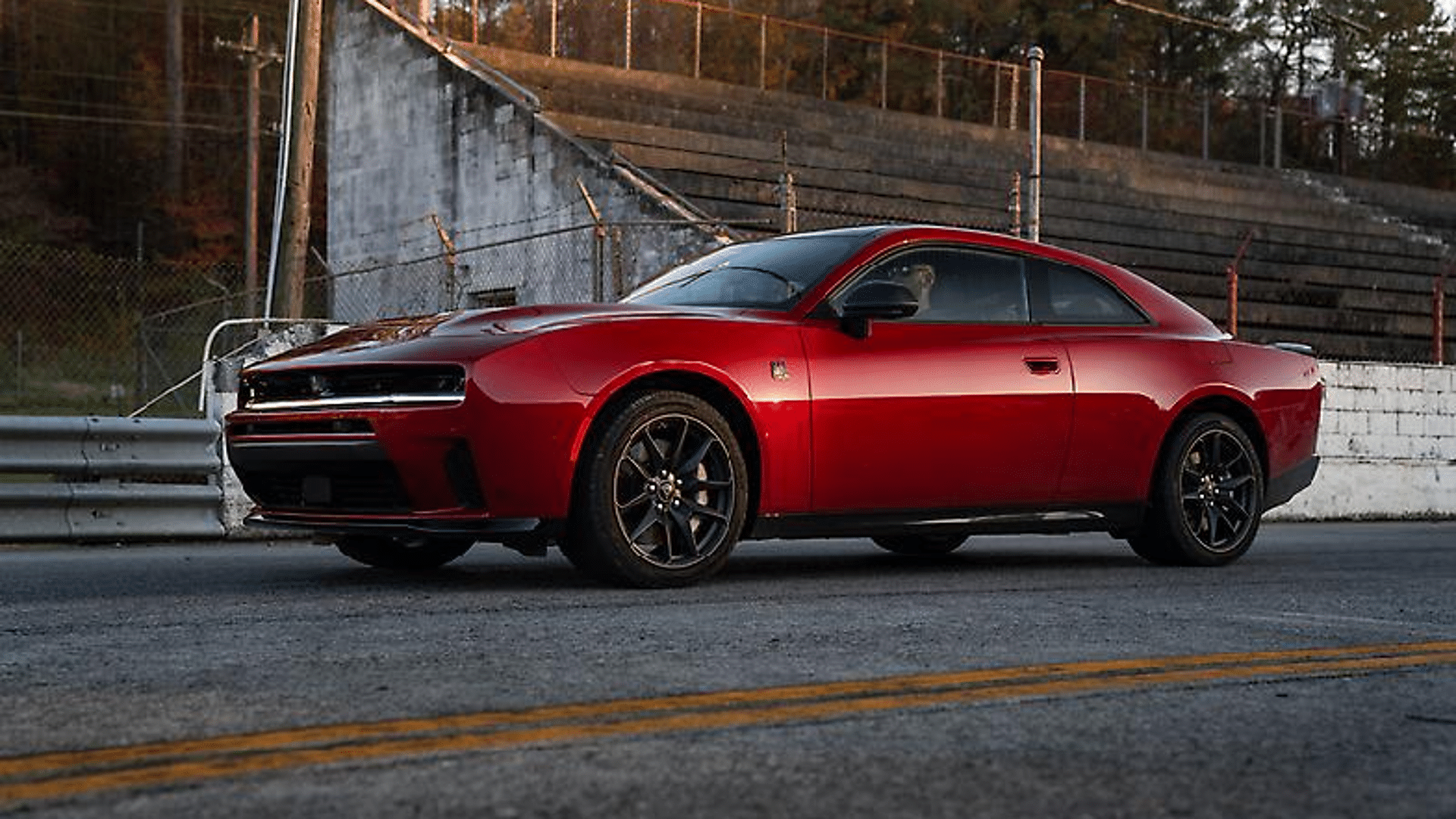
A slide in Stellantis’s May 21 Investor Day presentation lists a Charger SRT as a planned model, and Antonio Filosa told investors the company will deliver “the return of the legendary HEMI V8.” No Stellantis document I read connects those two statements, names the engine that would go into a Charger SRT, or gives a year for it.
What Stellantis has put on the record
The North America presentation carries a slide labeled “SRT Variant Planned” that lists the two-door Charger, the four-door Charger and the Durango GLH. The word Hellcat does not appear next to the Charger anywhere in the material I pulled. In the North America transcript, Tim Kuniskis says SRT had one model last year, “the Durango Hellcat,” and that Ram’s TRX and Rumble Bee join it this year.
Filosa’s line about the V-8 describes the product plan through 2030 and names no model. It says ICE vehicles will be more efficient and that the HEMI V8 will be among them. Whether the engine arrives in a Charger, a Ram, a Durango or all three is not specified in the transcript.
The multiplier
Kuniskis described SRT this way at the investor day: “It’s not a brand. It’s a multiplier.” He said SRT models “generate two to three times the net margin of the donor vehicle,” and that SRT sales of roughly 50,000 units by 2030 are worth the equivalent of 100,000 to 150,000 non-SRT units.
That upper figure is larger than all of Dodge’s 2025 volume, which Kuniskis put at 125,000 units. The 50,000 SRT units are spread across Dodge and Ram, so the comparison is loose, but the direction is plain: Stellantis expects performance trims to carry a disproportionate share of the profit. A Charger SRT is, in Stellantis’s own telling, a margin decision. Kuniskis also said Dodge intends to “recover the number one selling muscle car title” by the end of the plan.
The volume the Charger has to work with is modest. The Auto Wire reported that Stellantis sold 3,446 gasoline Chargers in the third quarter, from a base of 238 a year earlier. A trim that earns two to three times the margin of the car underneath it matters a great deal at that pace.
Where the Charger’s power sits now
Dodge’s 2027 Charger release lists the gas lineup as the 3.0-liter twin-turbo Hurricane inline-six, branded SIXPACK, in two states of tune: 420 horsepower in the R/T and 550 in the Scat Pack, which uses twin Garrett turbochargers that reach up to 30 psi. The all-electric Daytona Scat Pack makes 670 horsepower. The 600-horsepower Super Bee Launch Edition is the strongest Sixpack Charger Dodge has announced.
The same release calls the Durango SRT Hellcat “powered by the legendary supercharged HEMI V-8 engine,” and a Dodge release from September lists that Durango at 710 horsepower. If a Charger carried that engine at that output, it would sit 110 horsepower above the Super Bee and 160 above the Scat Pack. Dodge has not said the Charger SRT would be that car. A hotter Sixpack is as consistent with “SRT Variant Planned” as a V-8 is, and Dodge’s own comparison is telling: it says the 2027 R/T makes 50 more horsepower than the 5.7-liter HEMI R/T it replaced, and the Scat Pack 65 more than the 6.4-liter HEMI Scat Pack. Dodge is selling the six-cylinder as the stronger engine.
Every 2027 Charger also comes with standard all-wheel drive and is built at Windsor Assembly in Ontario, so any V-8 version starts from that layout unless Dodge changes it. Dodge lists the Scat Pack at $54,995 and the Scat Pack Plus at $59,990. No price has been published for anything above them.
Owners are already chasing the sound. The Auto Wire covered a $3,359 exhaust that doesn’t make the Sixpack sound like a V8.
The rules behind the plan
Filosa said at the same event that the US “is easing the CO2 trajectory,” and he tied the North American plan to higher domestic production. The company is announcing a V-8 return while its own executives describe the federal emissions trajectory as easing, which is the condition a V-8 plan depends on.
What to watch
Stellantis reports third-quarter results on October 28, according to its investor calendar. An engine name or a launch year for the Charger SRT would be new. Until one appears, what is confirmed is a slide, a quote and a margin target.
If Dodge puts one engine in the next SRT Charger, should it be a supercharged HEMI V-8 or a hotter Sixpack?