
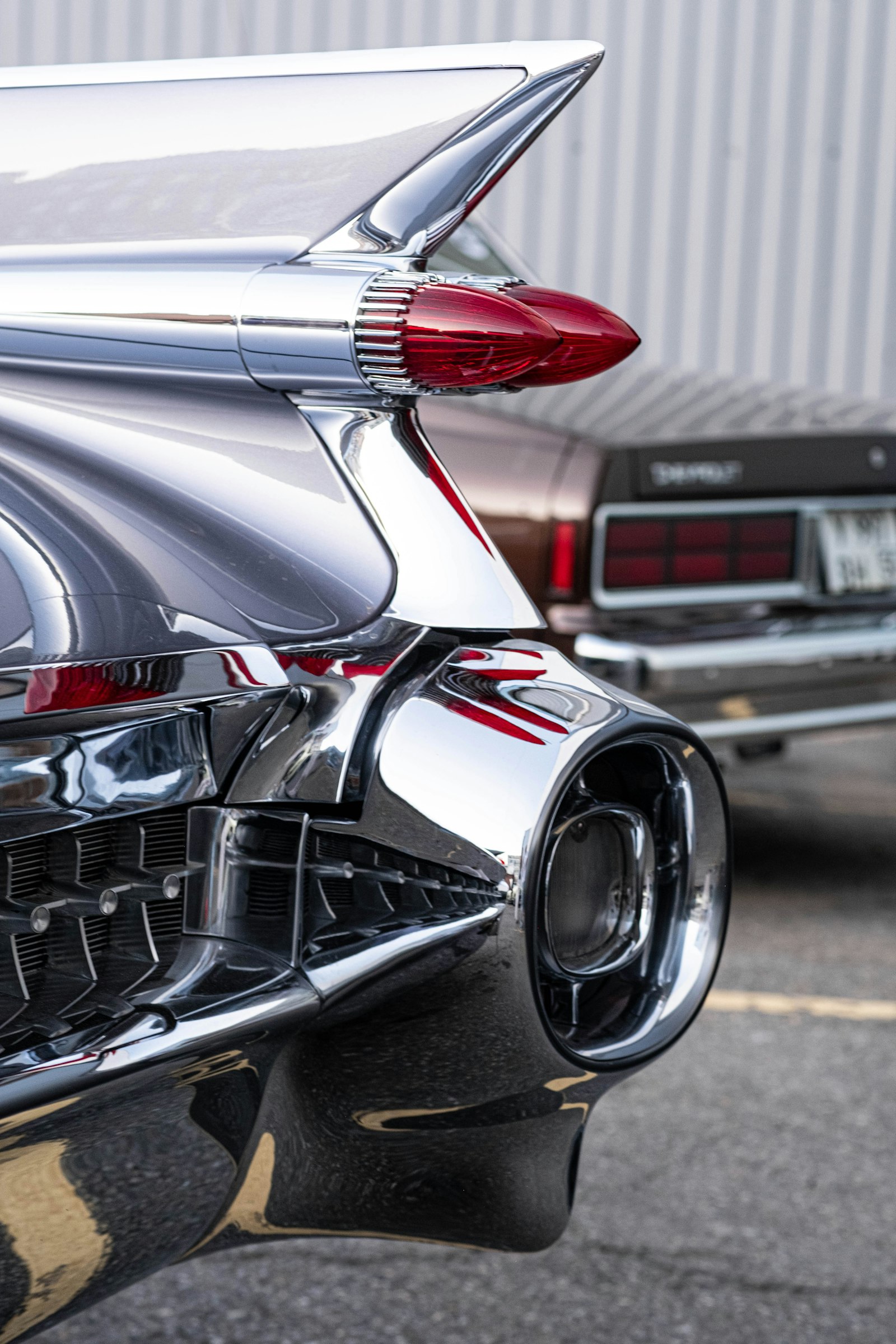
MagnaFlow will sell you a cat-back exhaust for the twin-turbo Charger Sixpack. Part number 19699, $3,359, three-inch stainless tubing, two straight-through mufflers, 4.5-inch black chrome tips.
Dodge has been unusually candid about the engine swap that created this complaint — see SRT’s turbo-lag fix. It is a well-made product from a serious company, and it will change how the car sounds.
It will not make it sound like a V8, and the reason has nothing to do with the exhaust. The sound people are missing is made by the crankshaft, and no pipe fitted downstream can put it back.
What you are buying, in the manufacturer’s own numbers
Start with MagnaFlow’s own product page, because it is more honest than the enthusiast conversation around it.
The system’s exterior sound rating is listed as MODERATE. The interior sound rating is MILD.
No horsepower figure is published. The page says dyno proven and references in-house testing, but no gain is stated. No decibel figure is published either.
And then the warranty, which contains the most quotable sentence in this entire story: MagnaFlow’s limited lifetime warranty “does not cover the quality of the ‘sound’ emitted by the particular exhaust product, unless related to a defect in the MagnaFlow product.”
A $3,359 product whose entire purpose is sound, sold to fix a sound complaint, with sound explicitly carved out of the guarantee. That is not a trick. It is a company being careful about the one thing it cannot promise, because the thing it cannot promise is not in its control.
The burble is a manufacturing defect that everybody learned to love
Here is the engineering, and it is genuinely lovely once you see it.
The classic American V8 rumble comes from the cross-plane crankshaft, whose crankpins sit at 90 degrees to each other. That layout makes the engine smooth, which is why it was chosen. But it also means that within each bank of four cylinders, the exhaust pulses do not arrive evenly spaced. One bank fires in an uneven pattern, the other bank fires in the mirror image, and the two irregular streams meet in the exhaust.
That syncopation is the burble. It is the acoustic signature of an engine whose two halves are not breathing in time with each other.
An inline-six has the opposite problem, which is to say it has no problem. Six cylinders on a single bank fire at perfectly even 120-degree intervals, and the layout is inherently balanced in both primary and secondary orders. Stellantis says as much in its own Hurricane press material, describing the “inherently smooth-running I-6 configuration.”
The engineering literature confirms the mechanism from the other direction. A 2025 SAE paper by Honda engineers describes deliberately using crankpin offset to create unequal combustion intervals, which “disperse orders in a wide range” and produce a quieter, more luxurious sound. An Aston Martin exhaust development paper describes its target as “a strong, linear, firing-order dominated sound which is unique to the vehicle.”
Firing order is sound character. The Hurricane fires evenly by construction. No pipe bolted on afterwards can re-space a combustion event that has already happened evenly.
The muffler you are not allowed to remove
There is a second reason a turbocharged engine sounds different, and it sits upstream of anything a cat-back can reach.
A turbocharger works by putting a turbine wheel directly in the exhaust stream and extracting energy from it to drive the compressor. That is the whole point of the device. But exhaust noise is energy — pressure pulses travelling down a pipe — and energy taken out to spin a shaft is energy that does not arrive at the tailpipe as sound.
Every turbocharged engine therefore has, by design, a large acoustic element sitting between the combustion chamber and everything you can legally modify. The research treats this as a design input: a 2019 paper on radial turbine acoustics notes that estimating turbine acoustics correctly “can lead to a more optimised design of the silencer,” which is a polite way of saying the turbine does part of the silencer’s job.
The Hurricane compounds it. Stellantis’ own technical material notes that each turbocharger feeds three cylinders, and that the engine uses “dual water-cooled exhaust manifolds integrated in the cylinder head.” A water-cooled manifold pulls heat, and therefore energy, out of the exhaust gas before it even reaches the turbo.
So the acoustic budget is spent before the gas gets anywhere near the aftermarket. And a cat-back, by definition, begins downstream of the catalytic converter. The turbines and the catalysts — the two biggest dampers in the system — are both upstream and both untouchable.
Untouchable technically, and untouchable legally. The Clean Air Act at 42 U.S.C. 7522(a)(3) prohibits removing or rendering inoperative an emission control device, and prohibits selling a part “where a principal effect of the part or component is to bypass, defeat, or render inoperative” such a device.
MagnaFlow is selling the only section of the exhaust the law leaves free, which is also the section with the least acoustic authority.
Part of what you are buying is silence
Now the detail that reframes the whole product category.
MagnaFlow’s SPEQ series, which this system belongs to, advertises what it calls No Drone Technology, which “utilizes quarter-wave passive noise cancellation to eliminate unwanted droning frequencies for improved interior comfort and sound.”
A quarter-wave resonator is a tuned side branch that cancels a specific frequency. It is a subtraction device. Part of the engineering in this $3,359 system is dedicated to making the car quieter.
Meanwhile the factory Scat Pack already ships with what Dodge describes as a performance-tuned active exhaust with electronically controlled valves and a unique tuning character for each drive mode, alongside active noise cancelling “engineered to minimize unwanted sound frequencies in the cabin while allowing in visceral external exhaust notes.”
So: a car with computer-controlled exhaust valves and electronic noise cancellation receives an aftermarket system that adds more cancellation. Nobody in this chain is simply making the car louder. Everyone is shaping a spectrum, and the disagreement is about which frequencies deserve to survive.
Dodge already agrees that engine sound is a product
If that sounds cynical, consider what Dodge does on the electric Charger, where there is no exhaust at all. It fits what it calls the Fratzonic Chambered Exhaust, described in its own press material as the world’s first patent-pending chambered exhaust with a signature rumble, with sound intensity tied to performance.
The industry has already conceded that engine sound in 2026 is authored rather than emitted — even the police version arrives without a V8. Nobody buying this MagnaFlow system is escaping engineered sound. They are paying $3,359 to become their own sound designer, using the one acoustic tool the regulator leaves on the table.
Two things a buyer should check first
MagnaFlow publishes no CARB Executive Order number for part 19699, and makes no California legality claim about it either way. California requires an Executive Order number for aftermarket parts that could affect emissions, and the state’s noise law sets a limit of 95 dBA measured to the current SAE standard. With no decibel figure and no EO reference published, a California buyer has nothing to check compliance against. Ask before ordering.
Second, the product listing does not say whether the system retains, replaces or defeats the Scat Pack’s factory active exhaust valves. On a car whose sound already changes with drive mode, that is the single most important question about the product, and it is unanswered on the page.
On warranties: federal law limits how far a manufacturer can tie warranty coverage to using its own parts, and blanket tie-in conditions are not permitted. That is not the same as immunity. A manufacturer may still decline a specific claim if it can show an aftermarket part caused the failure. MagnaFlow’s own FAQ states flatly that changing the exhaust cannot affect the factory warranty, which is a stronger claim than the law supports.
What to remember
Forget the tubing diameter. Remember where the sound actually comes from.
The Hurricane exists because a V8 could not meet the efficiency and emissions targets Stellantis set for itself; the company’s own launch material pitched it as up to 15 percent more efficient than larger engines, in service of a 2030 carbon goal. The turbochargers, the water-cooled manifolds and the catalysts are all part of how it achieves that. Every one of them is also a silencer.
Which means the missing noise is not a defect in the exhaust. It is the receipt for the engineering that made the engine possible.
You can buy back the last four feet of it. The rest is in the crankshaft, and that part is not for sale.
Would you spend over $3,000 chasing a sound an exhaust can’t actually deliver? Sound off in the comments.