
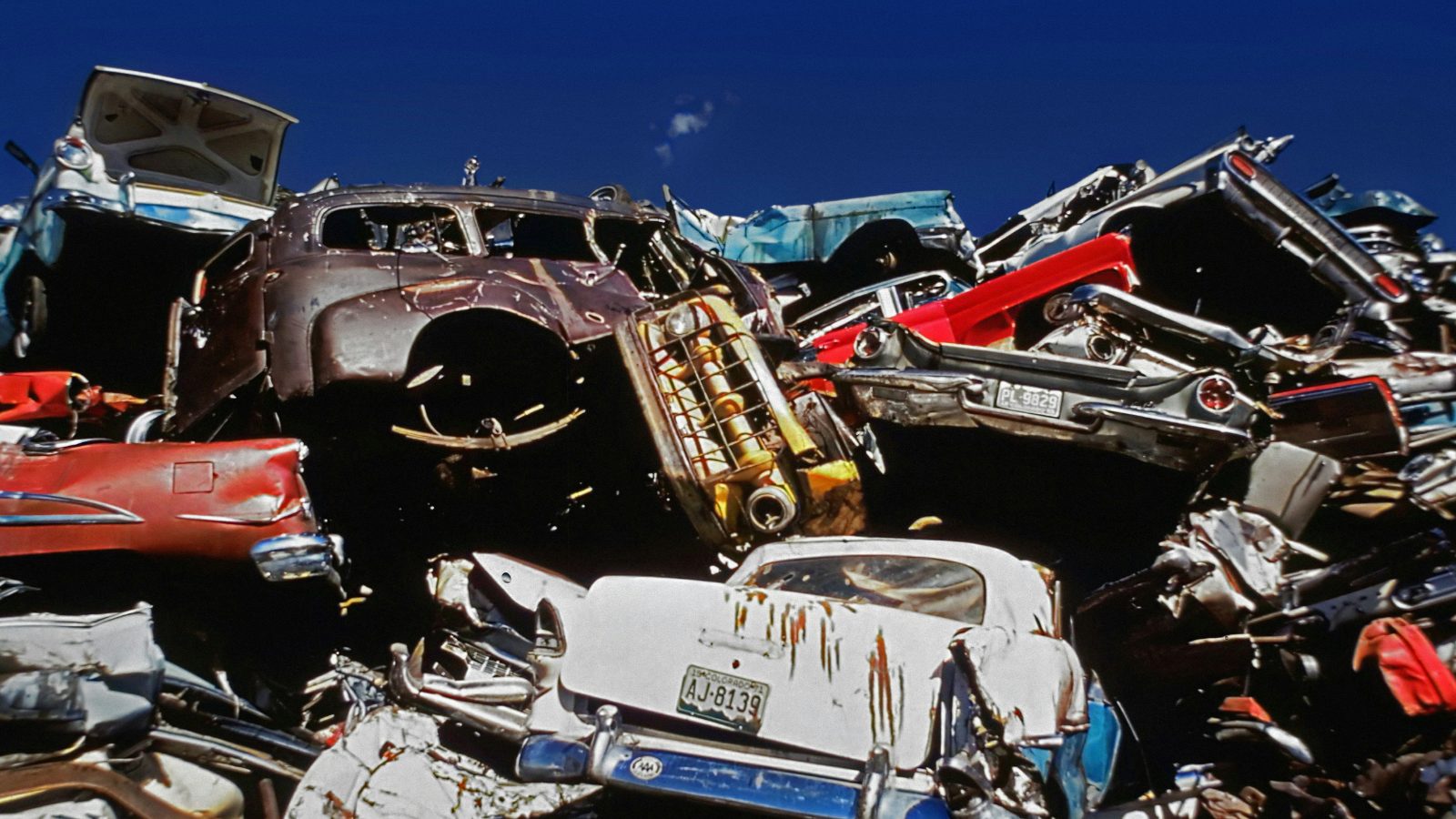
A salvage auction is the one corner of the car business where nobody has to describe the car.
It sells as-is, where-is, with a branded title and a gallery of photographs, to a dismantler pulling parts or an exporter loading a container. Nobody records the engine. Nobody measures the tread. Nobody argues about whether the paint on the quarter panel is original. The buyer is pricing what is left, not what it was. Copart built a $4.7 billion business on exactly that indifference, and our own tour through its Hellcat lanes is a decent illustration of the product: a photo set, a lot number, and good luck.
On September 10, Copart agreed to pay roughly $1.9 billion in cash for ACV Auctions, a Buffalo company whose entire reason for existing is describing cars.
Read that as an auction deal and you will miss the point. Copart is not short of lanes, acreage or buyers. What Copart has never had, because it has never needed it, is the ability to tell a stranger three time zones away precisely what is wrong with a car that still drives. That capability is what is being purchased. The marketplace came with it.
The number Copart buried under its own headline
The Copart ACV acquisition was announced the same day as Copart’s fourth quarter and full year fiscal 2026 results, which is a scheduling choice worth noticing.
Fiscal 2026 revenue came in at $4.7 billion, up 0.4 percent. Gross profit fell 0.8 percent to $2.1 billion. Net income dropped 4.4 percent to $1.5 billion. Service revenue, the fee income that is the actual Copart machine, was flat to the decimal. The only line that grew meaningfully was vehicle sales — cars Copart buys outright and resells for its own account — up 2.7 percent, and that is the lower-margin half of the business.
Copart did not have a bad year. It had a flat one, which for a company that spent three decades compounding is a different and more interesting problem.
The reason is structural. Copart’s supply is not something it controls. Its annual report is blunt about this: volumes rise with weather-related accidents in winter and with tornadoes, floods, hurricanes and hailstorms, and a mild year is a thin year. More to the point, Copart sourced 81 percent of the vehicles it processed in fiscal 2025 from insurance company sellers.
Four out of five cars on a Copart lot are there because an adjuster ran a number and decided the repair estimate had crossed the car’s value. Copart does not own that decision. It inherits it.
Five million versus twenty million
The investor presentation Copart filed alongside the merger agreement contains the cleanest explanation of the deal anywhere in the paperwork, and it is essentially a bucket count.
There are roughly 289 million vehicles in operation in the United States. About 39 million used vehicles change hands each year. Roughly 13 million leave the fleet annually. Of the cars flowing through wholesale channels, about 20 million move through dealer, commercial and wholesale lanes. About five million move through salvage auctions.
Copart is the colossus of the five. The twenty belongs to Manheim, to ADESA — now owned by Carvana — and to OPENLANE. ACV’s own annual report names all three as its principal competitors.
You can spend another decade optimizing a five-million-unit pond, or you can buy a boat.
What $1.9 billion actually buys
Strip the marketing off the deck and the asset list is unusual. ACV brings more than 70,000 transactions a month, over $10 billion in annual gross merchandise value, and more than 22,000 unique buyers. It also brings something Copart has no equivalent of: more than 850 field inspectors, and a data set the presentation describes as 250-plus data points per car drawn from 64 million auction bids and 1.6 billion price estimates.
Then there is the hardware. ACV’s VIPER system is a pair of imaging towers and an undercarriage scanner called Virtual Lift, installed in a dealership service lane. A car drives through it and comes out the other side with a condition summary and a valuation. It photographs all four tires from multiple angles and measures tread depth to the nearest thirty-second of an inch, which is a level of documentation most trade-in appraisals have historically handled by a technician crouching down and squinting.
And then there is the microphone.
Back in 2019, ACV started shipping something called Audio Motor Profile: custom hardware that records the engine running and attaches the audio to the condition report, so a dealer bidding remotely can listen to the car. The company’s chief technology officer claimed at launch that the recording quality was better than standing next to the vehicle in person. ACV filed for patents on it.
Sit with that for a second. Somebody in Buffalo concluded that the hardest problem in selling a used car sight-unseen was not photography or paperwork. It was that the buyer could not hear it. So they built a microphone rig and patented it.
That is the acquisition. Copart is buying the apparatus of description.
The price says something too
Copart is paying $10.50 a share. The press release calls that a 45 percent premium to ACV’s unaffected closing price on August 10, 2026, and 41 percent above its 30-day volume-weighted average — which works out to an unaffected price of roughly $7.24, and quietly tells you the stock had already moved well before the announcement was official.
ACV went public in March 2021 at $25.00 a share.
So the 45 percent premium is real, and holders who bought the IPO are still out about 58 percent. The business was not the problem. ACV grew revenue to $759.6 million in 2025 on $10.4 billion of merchandise value, and narrowed its GAAP net loss to $66.1 million from $79.7 million the year before. Through the first half of 2026 it lost $19.1 million on $418.1 million of revenue. Losses shrinking, revenue climbing, and an accumulated deficit of $568.5 million that says the company spent eleven years building infrastructure the market eventually decided it would rather rent than fund.
Digital wholesale worked. It just never paid, and after five public years the patience ran out. Copart, sitting on $4.49 billion in cash and held-to-maturity securities, wrote a check for about 42 percent of it with no financing condition attached.
The clause that says Copart expects an argument
Buried in the tender offer filing is the most honest sentence in the transaction. If ACV walks away for a better offer, it owes Copart $57.7 million. If Copart fails to clear antitrust review or an injunction by the end date, Copart owes ACV $115.3 million.
Exactly double. A reverse termination fee is a company putting a dollar figure on its own regulatory risk, and Copart priced its at twice what it charged ACV for changing its mind.
It is not hard to see why. Copart’s own fiscal 2025 annual report lists the largest national and regional vehicle auctioneers in the United States as RB Global, Carvana, OPENLANE, Manheim and — by name — ACV Auctions Inc. Copart spent a year telling the SEC that ACV was a competitor. It now has to spend some time telling antitrust regulators that the two companies were never really in the same business.
Both things can be true. They are just not true at the same volume.
Why any of this reaches your driveway
Start with the total-loss line, because that is where the two businesses touch.
Whether your car gets repaired or written off is arithmetic: estimated repair cost against the car’s value. Repair cost keeps climbing, for reasons we have covered at length — structural adhesives and bonded assemblies that turn a bent panel into a section replacement, sensors in every aperture, calibration procedures after the bodywork is done. Copart’s annual report says the quiet part plainly: it believes newer vehicles are more costly to repair and therefore more likely to be totaled.
The other side of that equation is the car’s value, and value in this industry is derived from wholesale auction data. After this deal closes, the company that runs the largest salvage marketplace in North America will also own one of the largest independent sources of pricing data for cars that were never damaged at all.
None of that requires anyone to behave badly. The point is narrower and harder to argue with: there is now one fewer independent answer to the question “what is this car worth,” and that question decides whether your car comes back from the body shop or goes to a lot with a lot number. The repair-versus-replace math everyone argues about at the kitchen table is, at the industry level, a data licensing question.
There is a second effect that is easier to see. ACV’s ClearCar and VIPER tools exist to put an instant number on your trade-in while you are sitting in the service lounge. That number is generated from the same data set. Convenience and leverage are the same object viewed from different sides of the desk.
And a third, which the deck advertises openly: Copart’s export network. In fiscal 2025, 38.8 percent of the U.S. vehicles Copart sold went to buyers registered outside the country. The merger presentation pitches dealer wholesale inventory flowing into that same global buyer network. The lease return your neighbor just handed back may soon be bidding against demand in Dubai.
The one thing to remember
Forget the share price, the termination fees, the bucket counts.
Copart got rich on cars nobody had to describe. It just paid $1.9 billion for the ability to describe them — because in the used car business, the party that writes the description is the party that sets the price.
Would you trust an AI-generated condition report over your own eyes before bidding on a used car? Sound off in the comments.