
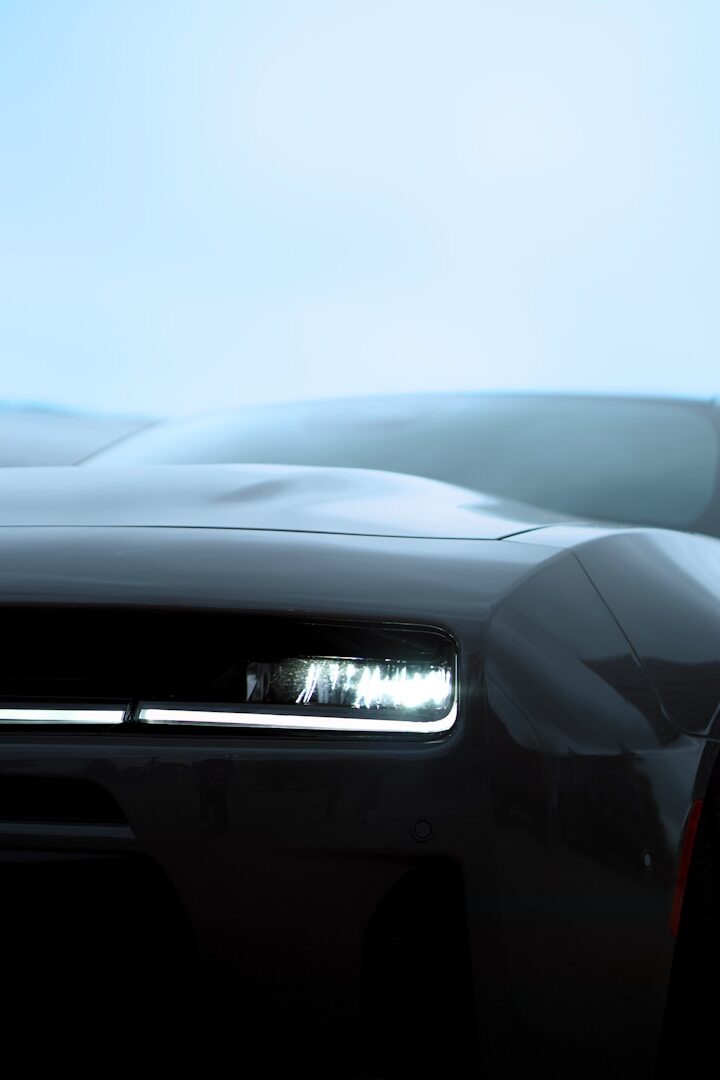
There is a number buried in Stellantis’s own 2023 fleet brochure that quietly demolishes the mythology of the American V8 police car, and almost nobody bothers to look it up.
The 5.7-liter HEMI in the final Dodge Charger Pursuit made 370 horsepower.
That’s the whole figure. Three hundred seventy horsepower and 395 lb-ft. The engine enthusiasts eulogize every time another agency orders a crossover, the one that spent two decades serving as the soundtrack to somebody’s very bad 2 a.m. decision, made less power than the base twin-turbo six Dodge just paraded around Daytona in police livery.
So yes, the 2027 Charger PPV that broke cover at the Police Fleet Expo at Daytona International Speedway has no V8. It also makes more power than the V8 it replaces, more torque, and comes with all-wheel drive as standard equipment.
The V8 was never the point. It took Dodge’s own fleet spec sheet to prove it.
Dodge doesn’t need a police car. It needs a buyer.
Start with the uncomfortable context, because it explains the timing better than any press release will.
The Charger is currently the slowest-selling new vehicle in the United States. Dealers are sitting on roughly 10,800 of them against about 1,260 sales in a 45-day window — a 385-day supply, at an average transaction price near $58,560. The runner-up on that list isn’t close.
Dodge has spent 2026 throwing product at that problem. It revived the Super Bee with 600 horsepower. SRT developed an electrically assisted boost system largely to make a turbocharged six feel like something it isn’t. None of it changes the fundamental math: Windsor is building a car that retail buyers are declining at a rate no incentive fixes.
A police contract doesn’t fix it either. But it does something a rebate can’t. Fleet orders are multi-unit, multi-year, on a defined replacement cycle, with no incentive war and no floorplan cost. They also park the car in front of every driver in a county, every day, for the next six years — a form of advertising Dodge has been monetizing since the nameplate turned into cultural shorthand.
Matt McAlear, who runs Dodge and Chrysler, said the quiet part about as plainly as a brand chief can: “It’s always taken a Charger to catch a Charger, and it’s not something we’re walking away from.” He also said the company is coordinating with the General Services Administration and working directly with the California Highway Patrol and Michigan State Police on pursuit certification.
That last detail matters more than the quote, and here’s why.
The segment Dodge is re-entering does not currently exist
The Michigan State Police ran its 2026 model-year vehicle evaluation and tested thirteen police vehicles.
Not one of them was a sedan.
The entire field is two Tahoes, two Silverados, a Blazer EV, two Durango Pursuits, a Ram 2500, three Explorer-based Police Interceptor Utilities, an F-150 Police Responder and a Mustang Mach-E GT. The four-door patrol car — arguably the most recognizable object in American law enforcement — had zero entrants.
Ford ended Police Interceptor Sedan production in 2019. Chevrolet’s Caprice PPV died in 2017. The Charger Pursuit limped on by itself until 2023 and then went with it. Dodge isn’t re-entering a competitive segment. It’s attempting to resurrect an extinct one, which is a completely different problem.
The sedan didn’t die because it was slow
Put the numbers side by side and the performance argument collapses.
The 2021 Charger Pursuit with the 370-hp HEMI ran 0-60 in 5.91 seconds. In Michigan’s 2026 testing, Ford’s Police Interceptor Utility with the 3.0-liter EcoBoost ran 5.95 seconds — and hit 148 mph, comfortably clear of the Charger’s 140.
A two-and-a-half-ton crossover matched a V8 muscle sedan to 60 mph and beat it flat out. It needed roughly 400 horsepower and a pair of turbochargers to get there, which is exactly the point. The Charger’s advantage was never displacement. It was mass and center of gravity. A sedan gets to be quick on less power because it isn’t hauling 800 extra pounds and six inches of ride height up the road. Delete the sedan and you buy that performance back with boost.
The fastest vehicle in Michigan’s 2026 evaluation, incidentally, was the electric Mustang Mach-E GT at 4.03 seconds. Enthusiasts are going to need a minute with that one.
Sedans died for boring reasons. Officers wearing thirty pounds of duty gear got tired of levering themselves out of a low seat forty times a shift. Agencies wanted the higher sight line for distracted-driving and speed enforcement. And everybody needed somewhere to put the equipment.
Dodge already built the best HEMI Charger, and you couldn’t buy it
Here’s the part most people genuinely don’t know.
From 2015 through 2020, the only way on earth to get a Charger with a HEMI V8 and all-wheel drive was to be a police department. Civilian Chargers forced the choice — V8 or AWD, pick one. The Pursuit didn’t, because it used an older five-speed automatic that could physically accommodate the transfer case. When that transmission supply dried up around 2021, Dodge killed the combination, and agencies that wanted all-wheel drive were pushed onto the 300-hp Pentastar V6.
Missouri’s Highway Patrol did exactly that across a fleet of 495 Chargers: surrendered 70 horsepower to get traction, without visible agony. Those ex-police HEMI AWD Chargers now bring a premium at surplus auction, which is its own quiet commentary on how Dodge managed its most interesting hardware.
So the real headline on the 2027 PPV isn’t the missing V8. It’s that Dodge just restored a capability it lost five years ago — maximum available output and all-wheel drive in the same patrol car — while adding at least 120 horsepower over the V6 agencies settled for in the meantime. Dodge hasn’t confirmed whether the PPV gets the 420-hp standard-output Hurricane or the 550-hp high-output version. Either one buries the HEMI.
The real engineering test isn’t a pursuit. It’s a parking lot.
This is what should be keeping Stellantis powertrain engineers up at night, and it has nothing to do with 0-60 times.
Department of Energy data on emergency-service vehicles puts police cars at idling roughly 60 percent of their operating time, burning about 21 percent of their total fuel while parked. The accessory load they’re idling to support — radios, laptops, cameras, light bars — draws under 2 horsepower from an engine making several hundred.
A patrol car does not live a retail Charger’s life. It sits, running, for hours.
That’s why the old Pursuit shipped with a 220-amp alternator, severe-duty cooling and an optional engine oil cooler as fleet-specific hardware, and why Ford fits a 250-amp alternator to the Interceptor Utility. It’s also why turbochargers make fleet maintenance managers twitch. Prolonged low-load idling is the operating condition most likely to coke oil in a turbo bearing housing, and police fleets track vehicles in idle hours precisely because that wear never appears on the odometer. A cruiser showing 60,000 miles can carry the internal wear of one well past 100,000.
Ford has run this experiment for years with EcoBoost Interceptors and survived it, so it’s solvable. But “solvable” is carrying weight in that sentence. It means police-specific calibration, cooling, oil specification and service intervals — and it means convincing fleet managers who have spent four years buying nothing from Dodge. Given Stellantis’s recent validation record, that is not a small ask.
The door Ford accidentally left open
Ford’s police vehicle market share hit 60.6 percent in the third quarter of 2025, up 9.6 points year over year. That looks like a locked door. It isn’t, quite.
When Ford killed the Interceptor Sedan in 2019, fleet managers learned a lesson they have not forgotten. Dakota County’s fleet manager told Government Fleet his agency would begin selecting upfit components that fit multiple manufacturers’ vehicles, so that “the only difference in equipment will be partitions and push bars.” Philadelphia deliberately split its orders across brands. An entire procurement discipline reorganized itself so that no single automaker’s product decision could strand it again.
Dodge is walking through a door that fleets themselves propped open.
There’s a money argument waiting behind it, too. A patrol sedan has historically run $3,000 to $4,000 cheaper per unit than the SUV equivalent, and it’s cheaper to upfit — Charleston’s fleet director noted the Interceptor Utility needs two partitions where a sedan needs one, plus secure cargo storage. Multiply that across a 200-car order in a budget cycle where nothing else is getting cheaper.
What Dodge still has to fix
The show car gives away the biggest remaining problem, and it isn’t under the hood.
Dodge stripped the center console for equipment mounting, which is correct. But the electronic shifter still sits precisely where a police console, siren controller and laptop mount need to live. Every square inch of that transmission tunnel is contested space in a patrol car. Ford solved this on the Interceptor Utility with a column shifter and says so outright in its own upfitter materials: it “frees up the center console space to accommodate police equipment.” That was never a styling decision.
Then there’s the calendar. Orders reportedly open in summer 2027, with production unlikely before late that year. Agencies replace patrol vehicles on four- to six-year cycles and budget a year ahead. By the time a Charger PPV can actually be delivered, Dodge will have been out of the segment for a full replacement cycle — long enough for a department to have bought Explorers twice, trained its technicians on them, and stocked the parts shelf accordingly.
Four doors, rear-drive bias, big power, sold to people who use it as a tool rather than a toy. It’s a version of the same bet GM is quietly making with a four-door Camaro: the American performance sedan isn’t dead, it just needs a customer with a reason to buy one.
The one thing worth remembering
The 2027 Charger PPV is not nostalgia and it is not a horsepower story. It’s a company sitting on 385 days of unsold inventory discovering that the one customer who won’t hold a missing V8 against it is the customer wearing a badge.
Police departments stopped caring about displacement years before enthusiasts did. Missouri traded 70 horsepower for all-wheel drive and never looked back. That wasn’t a betrayal of the American cop car. It was a fleet manager doing arithmetic.
Dodge is finally selling to the buyer who was doing that arithmetic the whole time. The question was never whether the six is fast enough.
It’s whether it can survive eight hours of doing absolutely nothing.