
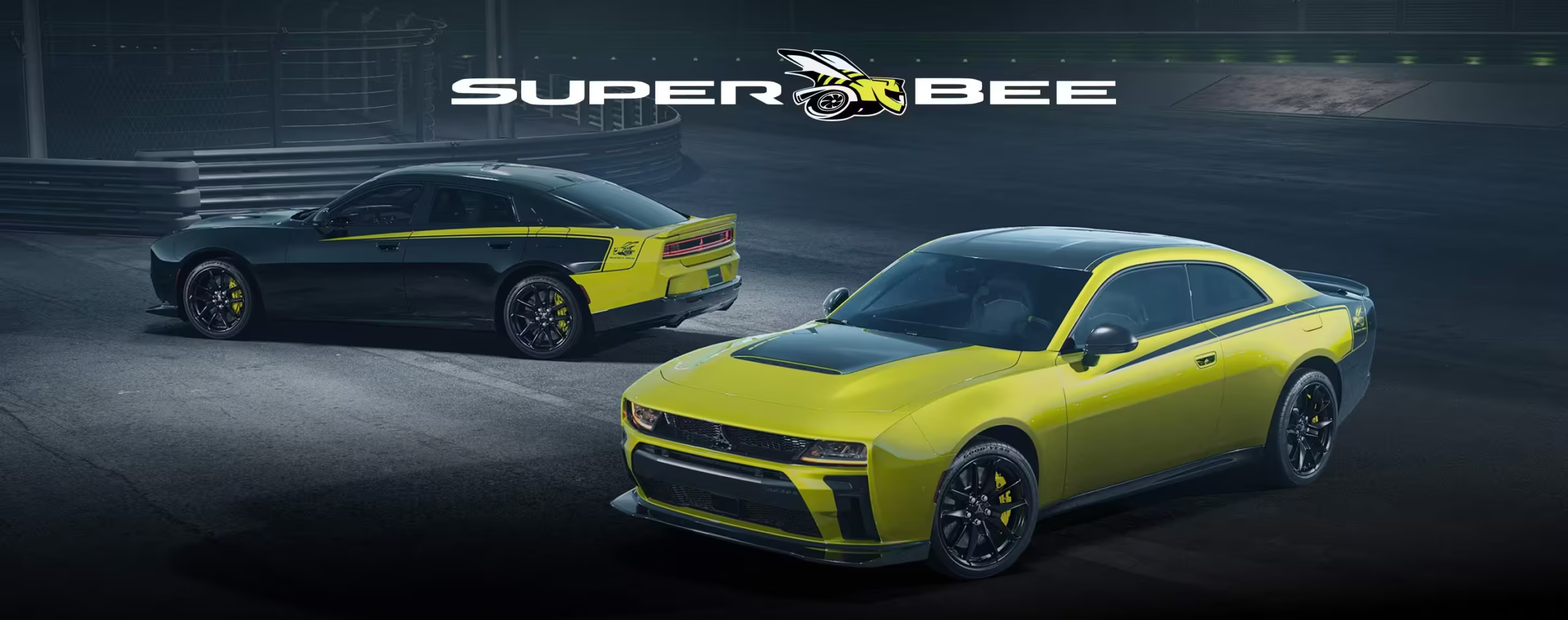
Read the press release Dodge sent out on August 7 closely enough, and it tells on itself. Dodge calls the new 2027 Charger Super Bee Launch Edition the “quickest, fastest, most powerful SIXPACK Charger” ever built. Notice the qualifier. Not the quickest, fastest, most powerful Charger, full stop. The quickest, fastest, most powerful SIXPACK Charger. That word is doing a lot of quiet work.
Dodge already sells a quicker, more powerful Charger. It’s called the Daytona Scat Pack, it’s electric, and it makes 670 horsepower. Three years ago, that car was supposed to be the future of the nameplate. Now Dodge’s engineering budget, marketing muscle, and one of the most beloved names in muscle car history are all going toward the gasoline engine that was originally pitched as the electric car’s supporting act.
That’s the real story hiding inside this reveal.
The horsepower number is real. The retreat behind it is the bigger news.
On paper, the Super Bee’s numbers are legitimately wild. The Charger’s twin-turbo, 3.0-liter “Hurricane” straight-six, which Dodge markets as SIXPACK, already makes 550 horsepower in the standard Charger Scat Pack. The Super Bee pushes that to a SAE-certified 600 horsepower and 531 lb-ft of torque, courtesy of larger 56mm Garrett turbochargers running more than 30 psi of boost, a reworked cooling system, stronger half-shafts, and new engine calibration. Dodge claims a 3.6-second run to 60 mph and an 11.8-second quarter-mile, a half-second quicker than the Scat Pack it’s built on.
Do the math on that and something jumps out. Six hundred horsepower from three liters works out to roughly 200 horsepower per liter, which Dodge itself is calling the highest power density of any muscle car ever built. The supercharged 707-hp Hellcat V8 from a decade ago made about 114 horsepower per liter. A naturally aspirated Corvette Z06 flat-plane V8, one of the most exotic engines General Motors has ever put in a production car, makes roughly 155. A Dodge wearing a bee decal is now producing specific output in the neighborhood of a Ferrari.
There’s a practical reason Dodge chased that number with a turbocharged six instead of a bigger V8. Modern fuel economy and emissions rules didn’t kill the Hemi in the Charger because engineers ran out of ideas for it. They killed it because a large-displacement engine, supercharged or not, is brutally difficult to certify against today’s fuel economy targets in a car this heavy. A smaller, turbocharged engine can match or beat that peak output while posting dramatically better numbers on the test cycle that actually determines compliance, because it isn’t working nearly as hard at a light-throttle cruise. The Super Bee’s real engineering achievement isn’t the horsepower ceiling. It’s reaching that ceiling without dragging a V8-sized compliance problem behind it.
The most interesting piece of engineering in Dodge’s press kit isn’t a spec at all. It’s a feature called Torque Reserve. While the car is stopped with the driver standing on the brake, the system opens the throttle and deliberately retards ignition timing, so the engine burns fuel without making much power and instead fires hot, high-energy exhaust straight at the turbochargers to spin them up before the car ever moves. Release the brake, and ignition timing snaps back, unleashing torque that’s already been banked. That’s a factory-installed, street-legal cousin of anti-lag, a trick borrowed from rally and drag racing that most manufacturers avoid because of the thermal stress it puts on turbos, catalytic converters, and exhaust manifolds. Dodge is bolting it to a car that still needs to pass a 100,000-mile warranty.
Here’s the detail that gets lost under the horsepower headlines. The Super Bee name wasn’t created to be a flagship. In 1968, the Coronet-based Super Bee existed specifically as Dodge’s budget muscle car, a way to get Hemi-adjacent performance without paying for the options list on a numbers-matching Hemi Charger R/T. It was the stripped-down, blue-collar version of Mopar muscle.
The 2027 Charger Super Bee Launch Edition inverts that completely. Dodge hasn’t announced pricing, but this car replaces a Scat Pack that already starts near $57,000, wears a limited-production Launch Edition badge, and carries the most track-focused hardware ever bolted to a Charger. The name that used to mean cheap and fast now means expensive and exclusive.
That’s not an accident, either. Dodge has run this play before with the Hellcat Redeye Jailbreak and the Demon 170: launch a limited, feature-loaded, unpriced Launch Edition first, let enthusiast demand and dealer markups set the market, then backfill a standard trim later once the halo car has generated its headlines and its dealer foot traffic. A press release this detailed leaving out a price isn’t an oversight. It’s a strategy.
Zoom out, and the Super Bee fits a pattern that’s been hard to miss across Stellantis’ American brands this year. The company bet heavily on electrification with cars like the Charger Daytona, then watched demand come in soft enough that combustion engineering, not battery engineering, is where the marketing dollars, the event placements, and the legacy nameplates are landing in 2026. Dodge chose a Woodward Avenue drag-racing festival to reveal this car. Not an EV showcase. A gasoline drag strip, on the Charger’s 60th anniversary.
Enthusiasts who wanted proof that a turbocharged six could carry the muscle-car torch just got a fairly convincing answer. Anyone hoping the Super Bee name meant an affordable on-ramp back into V8-adjacent performance should adjust expectations now. And it matters to Stellantis’ bottom line too: a sold-out, premium-priced halo car is exactly the kind of margin-rich production the company needs after a year of uneven demand and dealer inventory swings elsewhere in its lineup.
Owners should also budget for what this level of performance costs once the car leaves the showroom. Packing auxiliary radiators into the outboard corners of the front fascia solves a real cooling problem, but it also means a fender-bender that used to total a bumper cover and a headlight now involves specialty cooling hardware buried in the nose. The 305-section Goodyear Eagle F1 Supercar 3 tires aren’t something a typical tire shop keeps in stock, either. None of that shows up in a 0-60 time. It shows up on an insurance quote and a body shop estimate.
Forget the horsepower figure by next week. Spec sheets don’t stick. What’s worth remembering is this: Dodge didn’t resurrect the Super Bee because it had spare engineering budget lying around. It resurrected the Super Bee because the electric experiment didn’t sell the way the slideshow promised, and the six-cylinder engine that was supposed to be a bridge to the future is now, quietly, the entire plan.