
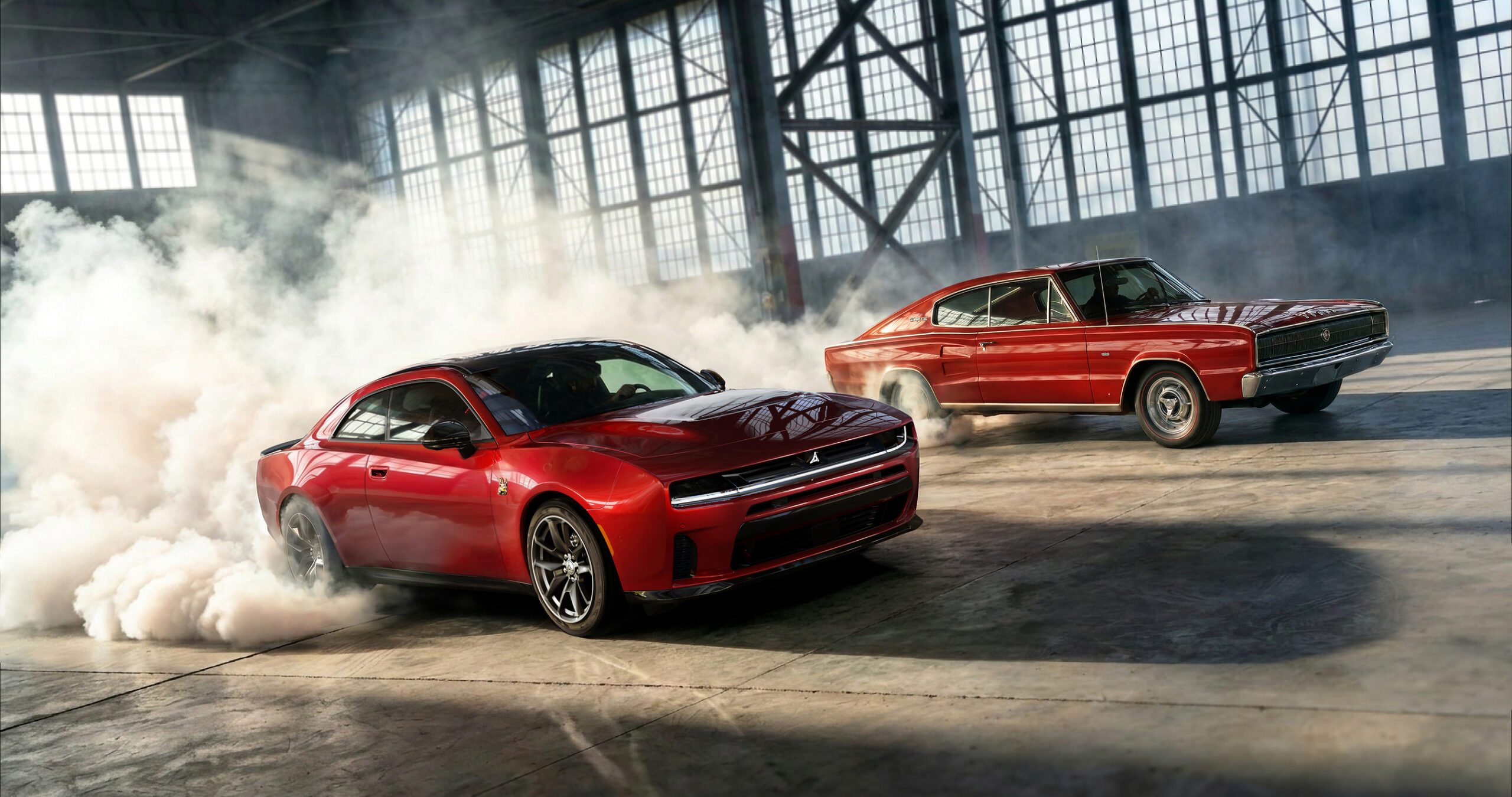
Dodge wants you to spend this summer thinking about 1966. Starting this week, the brand is rolling a nationwide birthday party for the Charger nameplate across the country: a walk-around at the Carlisle Chrysler Nationals, a Route 66 centennial parade with the Petersen Automotive Museum, the return of Roadkill Nights on Woodward Avenue, and a cruise to the first NHRA national event held in Michigan in 66 years. It’s a genuinely good itinerary, and Dodge deserves credit for throwing one of the more thorough car-culture tours in recent memory.
Garage-worthy EDC gear, on sale this week.
But the detail that matters isn’t on the invitation. For the first time in the Charger’s 60-year history, the anniversary lineup doesn’t include a V8. Not a small-block, not a Hemi, not even an option box to check. The 420-horsepower Charger R/T and the 550-horsepower Charger Scat Pack are both powered by a 3.0-liter twin-turbo inline-six that Dodge calls the Hurricane SIXPACK. The quickest Charger of them all, the 670-horsepower Charger Daytona Scat Pack, doesn’t burn gasoline at all. Every version comes standard with all-wheel drive.
That’s not a footnote. That’s the story. Dodge CEO Matt McAlear framed the tour around the brand’s bloodline, saying the new Scat Pack is “proving performance remains at its core.” What he didn’t say is that the core has been swapped out entirely, twice, in under three years.
The Charger Has Never Been One Car
Dodge’s own official generation timeline, published alongside the tour announcement, quietly undercuts the “60 years of muscle” pitch. Generation IV, the 1975 Charger SE, was a rebodied Chrysler Cordoba built for buyers who wanted a vinyl roof and a soft ride, not a stoplight fight. Generation V, launched in 1981, was a front-wheel-drive Omni-based hatchback with a four-cylinder engine, sold to compete with economy cars, not with the Camaro. Add those years together and the nameplate spent roughly a third of its existence as something other than a muscle car by any honest definition.
That’s the first thing worth knowing: the Charger has always been an adaptable badge stapled onto whatever platform Dodge needed to sell that decade, not a fixed piece of engineering DNA. The current pivot to a turbocharged six and an electric motor isn’t a betrayal of the nameplate’s history. It’s the nameplate’s history repeating itself, just with higher stakes and a much louder marketing campaign around it.
This Tour Is Also Damage Control
The second thing worth knowing is how bumpy the road to this specific lineup actually was. The eighth-generation Charger launched in 2024 as an EV-only proposition, the Charger Daytona, built around the idea that an amplified speaker system called Fratzonic Chambered Exhaust could stand in for a real engine note. Enthusiasts weren’t buying it, and by our own reporting, they largely weren’t buying the car either. Owners went on to report repeated reliability problems, and some Daytona and Wagoneer S EVs were even reported rolling away while parked.
The gas-burning SIXPACK six-cylinder, the one now carrying the 60th-anniversary torch, had its own rough introduction. Early test footage had people, including us, describing the engine note as flat and uninspired next to a supercharged Hemi. There were credible reports the whole SIXPACK program might be scrapped as Stellantis reworked its capital spending under financial pressure. Production then stumbled through a stop-and-start stretch before finally ramping up at the Windsor Assembly Plant late last year. Sixty years of continuous Charger production, and the current generation still needed a rescue mission before it could headline its own birthday party.
None of that is a secret. It’s on this website. But you won’t find any of it in a press release, and that’s exactly why it needs saying: this tour isn’t only a celebration, it’s a reintroduction, timed for the moment the gas-powered Charger finally has enough inventory on dealer lots to be worth celebrating.
Why an Inline-Six and Not Another V8
The engineering case for the swap is real, even if it’s rarely spelled out. A twin-turbo six can be packaged lower and lighter than a big-inch V8, which matters when every Charger now ships with standard all-wheel drive and the extra hardware that comes with it. It also burns less fuel per mile than a naturally aspirated or supercharged eight, which matters more than it used to. Corporate Average Fuel Economy rules judge a manufacturer’s entire fleet, not any single model, and a 550-horsepower six that meets emissions targets more easily gives Stellantis room to keep building thirstier vehicles elsewhere in the lineup. The electric Daytona Scat Pack does even more of that heavy lifting, generating the kind of zero-emission volume that helps offset gas-powered Ram trucks and Durangos on the same compliance ledger. Dodge’s “multi-energy” language is a marketing term. Underneath it is a hedge against regulation as much as a menu of customer choice.
There’s a real cost buried in that trade, too, and it isn’t about sound. Six decades of small-block and Hemi V8 architecture built an enormous, interchangeable parts ecosystem: crate engines, cams, headers, entire businesses built on the assumption that a Charger’s engine bay could be freely modified with parts developed for a dozen other Mopar models. A turbocharged inline-six and a permanent-magnet electric motor don’t share that lineage. Independent repair shops, restomodders, and the aftermarket that has quietly subsidized Dodge’s performance image for decades are starting this generation from zero. That’s not a knock on the new engine. It’s a genuine break in continuity that owners, insurers, and future used-car buyers will feel long after the anniversary tour packs up.
It also means the last Hemi-powered Chargers, the 2023 “Last Call” cars Dodge name-checks in its own generation history, are the final examples of a 60-year architecture that isn’t coming back. Values on those cars aren’t likely to go down.
The Pattern Is Bigger Than Dodge
Widen the lens and this is a familiar shape in 2026: an automaker leads with an aggressive electric-first launch, gets a colder reception than projected, and quietly walks it back toward gas power while keeping the EV in the lineup for the buyers, and the compliance math, that still want it. Dodge just happens to be running that entire arc under a single, extremely famous nameplate, in public, during a summer-long parade built to celebrate it.
That’s the real thesis behind the confetti. This isn’t a story about 60 years of muscle. It’s a story about a company trying to convince a skeptical fanbase that the last two years of stumbles, recalibrations, and walk-backs were the plan all along.
Building one great engine proves a team can design something brilliant. Getting sixty years of buyers to keep believing in a badge, no matter what’s actually bolted underneath it, proves something else entirely: that Dodge has always sold identity first and hardware second. The Charger’s engine has changed more times than most owners realize. What’s never changed is the pitch.
So enjoy the tour. Watch the SIXPACK-powered Scat Pack run Woodward Avenue, look at the new Purple Haze color debuting at Carlisle, and appreciate a nameplate that has survived a genuine identity crisis. Just don’t mistake the party for the whole story. The most important thing about this Charger isn’t that it turned 60. It’s that it got there without the engine that made it famous in the first place.